Executive Summary: July 9th AEG DMV Stakeholder Challenge: Affordability & Grid Optimization
Overview
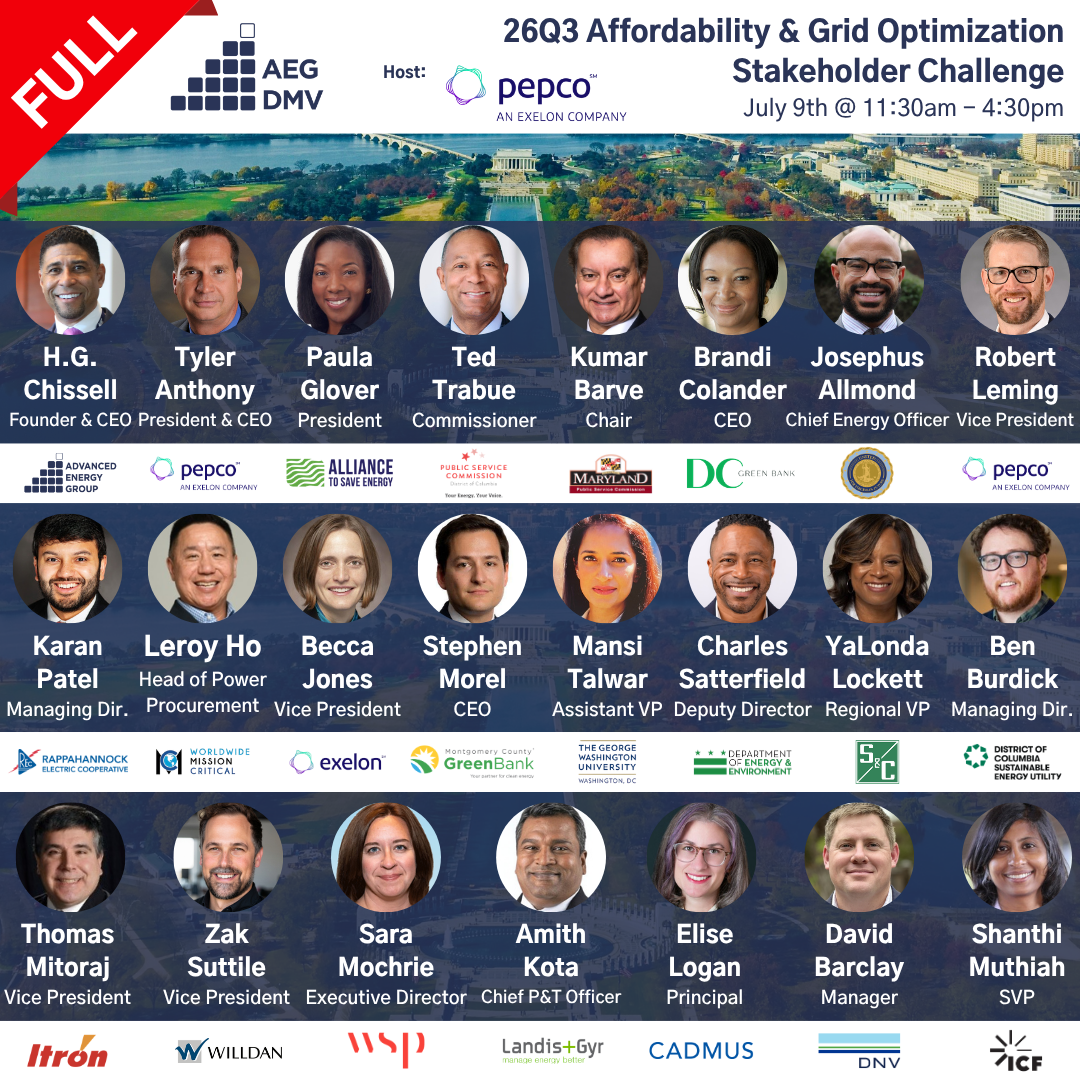
Held on July 9th, 2026 at Pepco Edison Place Gallery in Washington, DC, seventy public and private industry leaders convened for the AEG DMV 26Q3 Affordability & Grid Optimization Stakeholder Challenge. The purpose of this challenge was to: 1.) Align on a critical obstacle regarding Affordability & Grid Optimization for the DMV; 2.) Engage as cross sector teams to agree on a 90-day sprint and 12-month goal; 3.) Empower leaders to deliver the solution and present the outcome in 12 months with 90 day sprints.
Tyler Anthony, President & CEO, Pepco, Ted Trabue, Commissioner, DC Public Service Commission, and Kumar Barve, Chairman, Maryland Public Service Commission, opened the conversation, providing diverse perspectives to frame the discussion surrounding affordability & grid optimization for DMV. Josephus Allmond, Chief Energy Officer, Office of the Governor of Virginia served as a pre-challenge moderator, posing and answering audience questions to create a road map for the upcoming workshop.
During the Speaker Challenge, each speaker provided a presentation that concluded with this completed statement: "Regarding Affordability & Grid Optimization, to achieve DMV’s health, prosperity & energy goals, a critical obstacle to collectively overcome in 12 months is _________."
5 Key Themes
1. Developing a Distribution Grid Utilization Roadmap
To achieve meaningful rate relief, the region must shift from a default infrastructure buildout to a flexibility focus that unlocks unused capacity on the existing electric system. Currently, the grid is designed around rare peak demand hours, leaving less than half of its asset capacity used on average. By aligning utilities, regulators, and data center operators on a unified utilization roadmap, grid costs can be shared across a larger customer base to lower average retail rates.
"Convening and aligning utility and interested stakeholders on a distribution grid utilization roadmap." - Robert Leming, Vice President, Regulatory Policy & Strategy, Pepco
2. Siting and Funding Distributed Energy Storage
Deploying localized energy storage provides an immediate shield against soaring wholesale capacity prices while traditional generation projects face multi-year construction timelines. This immediate infrastructure deployment is vital in Virginia, which has overtaken California as the nation's leading net importer of generation. Failing to fund and site these battery projects increases regional vulnerability to rolling brownouts, climate-related health risks, and escalating bills.
"Regarding Affordability & Grid Optimization, to achieve DMV's health & energy and prosperity goals, a critical obstacle to collectively overcome in 12 months is siting and funding more Energy Storage." - Karan Patel, Managing Director, Energy Solutions & Clean Energy, Rappahannock Electric Cooperative
3. Dismantling Energy Efficiency Gaps for Small Businesses
Cost-burdened neighborhood small businesses often operate in old, inefficient facilities with thin margins and minimal access to capital. Aggregating energy efficiency upgrades across these commercial properties creates a powerful, distributed demand-side resource to ease grid constraints and lower emissions. Regional programs must systematically dismantle complex application processes, high transition costs, and split landlord-tenant incentives to unlock this untapped tool.
"...closing the awareness, access, and transition barriers that prevent small businesses from adopting EE as a business investment - leaving one of the region's most powerful tools for affordability, health, and grid optimization on the table." - Paula Glover, President, Alliance to Save Energy
4. Democratizing Interconnection Transparency and Modernizing Models
Interconnection queue timelines now average five years, introducing severe financial and viability risks to new clean energy and large load projects. To alleviate this backlog, grid operators must adopt high-compute platform services to minimize lengthy engineering model run times. Democratizing this process requires making grid headroom data transparent to all stakeholders, allowing developers to self-serve and evaluate viability before entering the queue.
"Improve interconnection study transparency for all stakeholders, including developers, and ensure models use appropriate technology to reduce run times while maintaining reliable results.” - Leroy Ho, Head of Power Procurement, Worldwide Mission Critical
5. Bridging Information Gaps and Aligning Stakeholder Data
Severe capacity price spikes highlight a deep information gap in the market system between generation utilities and large load agents. Overcoming these barriers requires an immediate stakeholder effort to map existing initiatives and define specific performance metrics that directly benefit vulnerable communities. Over a 12-month horizon, this foundation must transition into a coordinated framework for data management, unified public messaging, and recommended policy changes.
"90: identify stakeholders, research on existing initiatives, goals to benefit communities, define metrics, agree on milestones. 12: convene, data and info management on grid optimization, public messaging, financial framework, recommend policy change." - DMV 26Q3 Stakeholder Challenge Participants
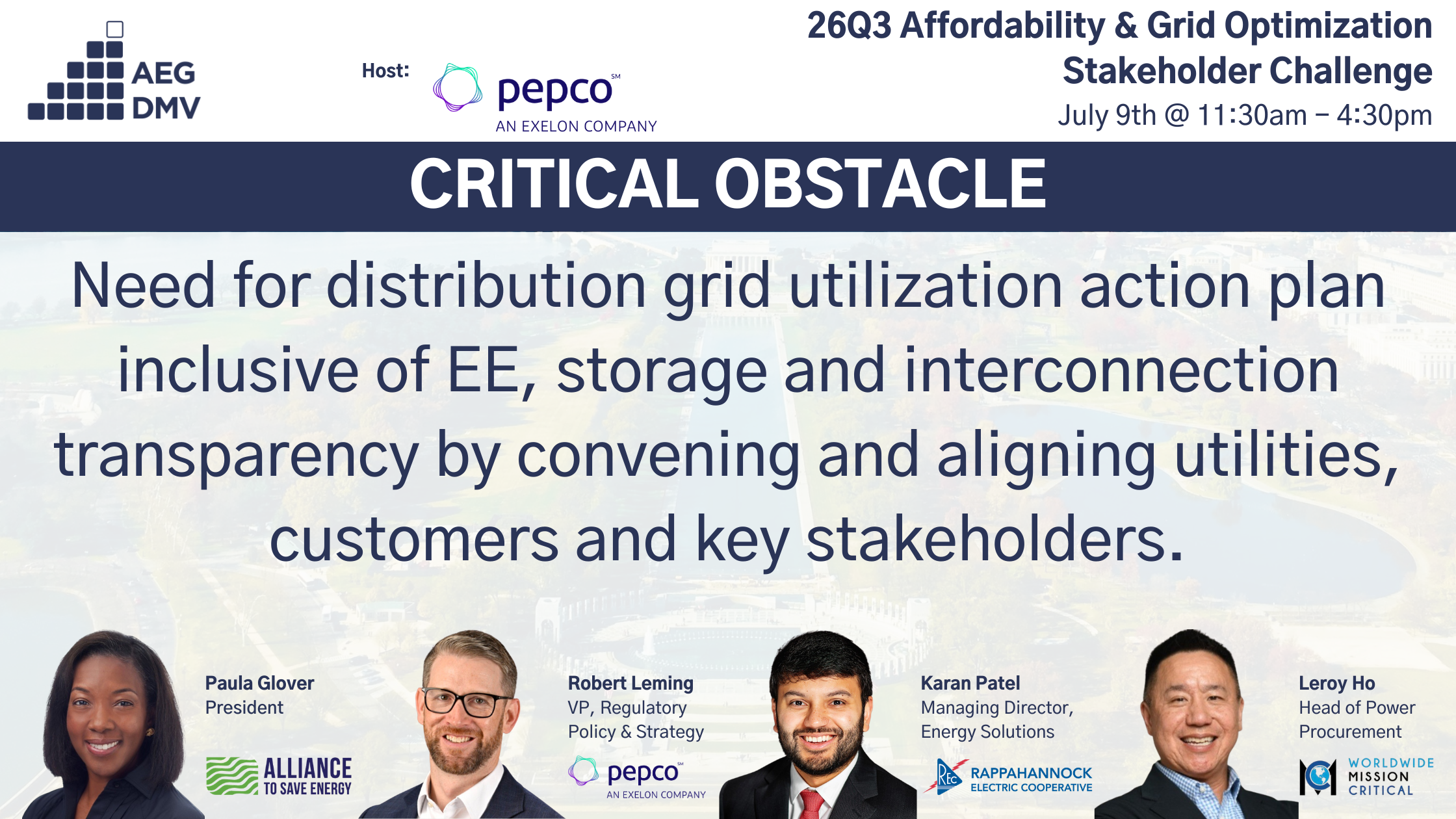
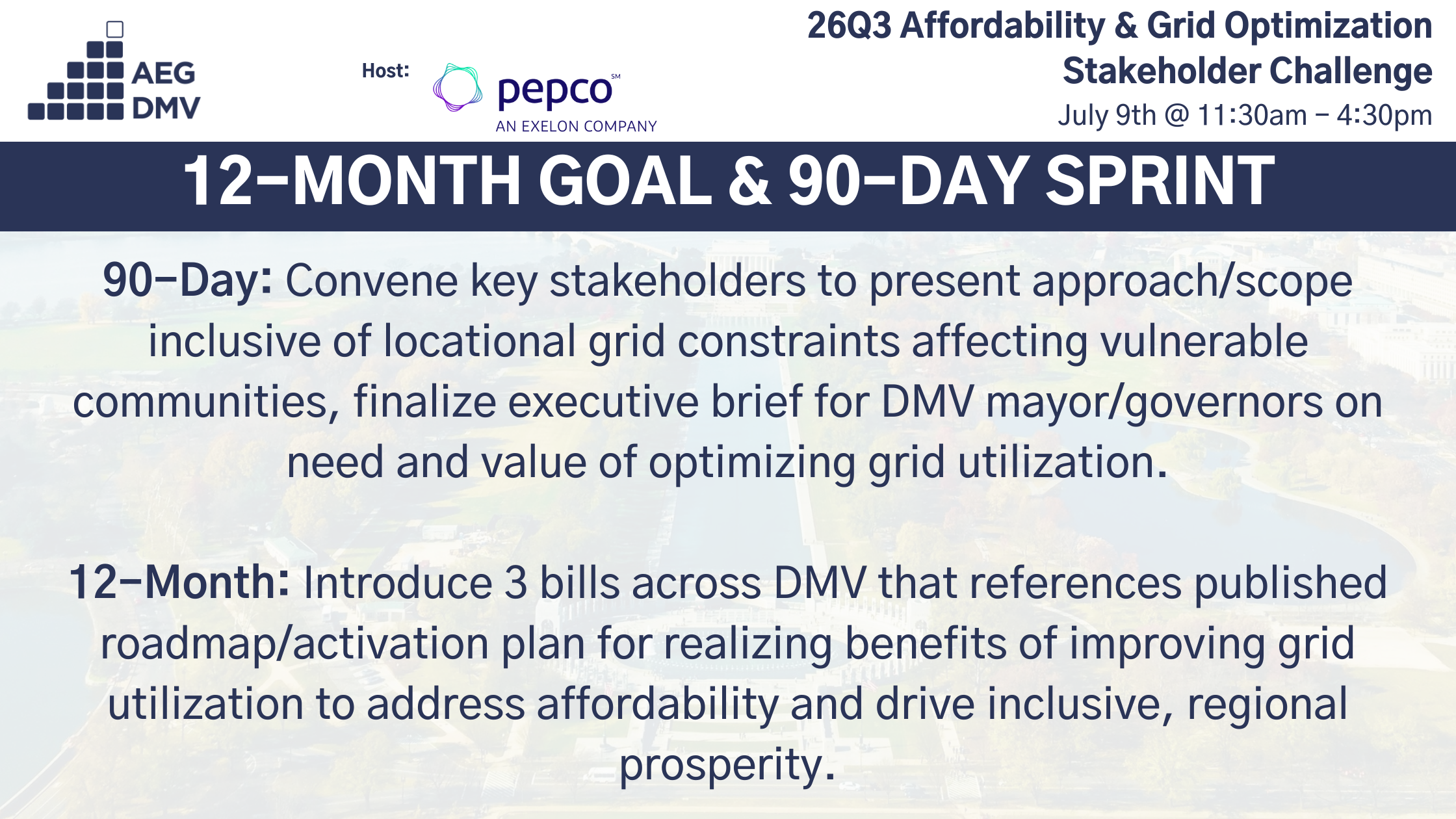
Inspired by the statements provided by all speakers, Robert Leming (Pepco), Paula Glover (ASE), and Leroy Ho (Worldwide Mission Critical), participants agreed to prioritize this selected obstacle statement: “Need for distribution grid utilization action plan inclusive of EE, storage and interconnection transparency by convening and aligning utility, customer and key stakeholders.” Participants then designed, and pitched a 90-day sprint and 12-month goal to best address this critical obstacle.
19 leaders formed a volunteer Task Force to complete the 90-day sprint and 12-month goal.
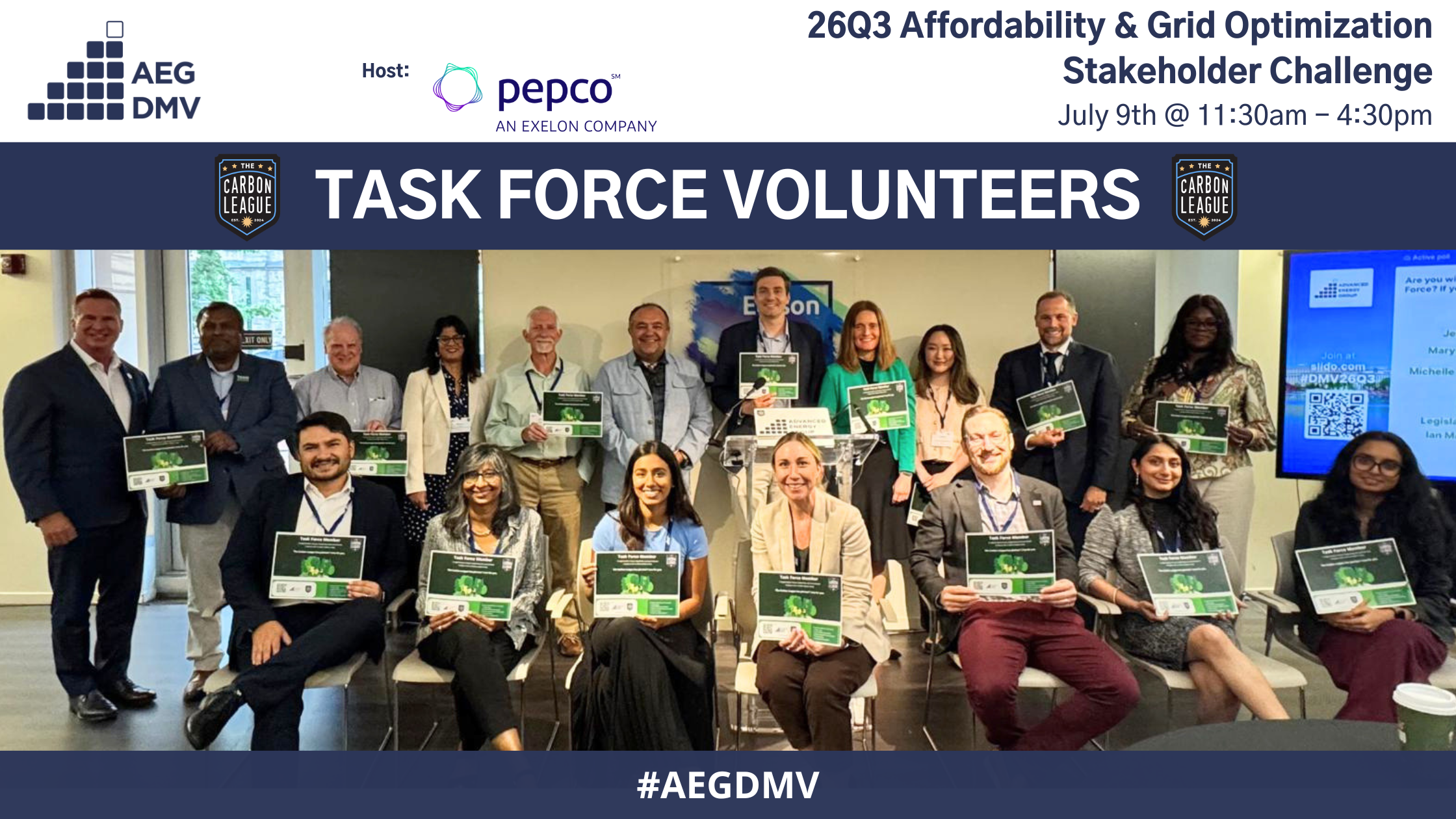
Task Force Volunteers: Tyler Anthony, Pepco, Amith Kota, Landis+Gyr, Richard Fioravanti, MPR Associates, Monisha Shah, EnergyHub, Larry Martin, GRID2.0 Working Group, Nick Vardalos, Landis+Gyr, Ian Magruder, Utilize Coalition (Co-Lead), Becca Jones-Albertus, Exelon, Jessica Yu, BGE, Zachary Suttile, Willdan, Michelle Ware-Allen, Orivia Tech, Marcelo Sandoval, Landis+Gyr, Shanthi Muthiah, ICF, Romita Biswas, Electrify DC (Co-Lead), Colleen Tomaino, Pepco (Co-Lead), Ben Margolis, Maryland Energy Innovation Accelerator, Sapna Dowla, Alliance to Save Energy, Akanksha Madhu, Orivia Tech, Shalom Flank, Microgrid Architect (Not Pictured)
To join this group of volunteers, please contact us at info@goadvancedenergy.com.
Conclusion
The AEG DMV 26Q3 Affordability & Grid Optimization Stakeholder Challenge convened utility executives, clean energy developers, regulatory bodies, and community leadership to confront the structural, informational, and financial barriers slowing the modernization of regional grid infrastructure. The strategic focus centered on unlocking underutilized capacity within the existing grid, expanding distributed energy storage as an immediate demand shield, and closing critical access gaps for energy efficiency programs within cost-burdened small business sectors. Moving forward, stakeholders will advance a focused 90-day sprint dedicated to convening key stakeholders to present an approach and scope inclusive of locational grid constraints affecting vulnerable communities, and finalizing an executive brief for DMV mayors and governors on the need and value of optimizing grid utilization. This collaborative alignment will directly support the overarching 12-month goal to introduce three bills across the DMV that reference a published roadmap and activation plan for realizing the benefits of improving grid utilization to address affordability and drive inclusive, regional prosperity. Ultimately, this Challenge establishes a coordinated, replicable pathway for the DMV region to accelerate scalable load flexibility and asset utilization solutions that put downward pressure on electricity bills, eliminate peak demand constraints, and strengthen economic resilience.
Access to private resource pages, which include speaker presentations, and survey responses, from AEG Stakeholder Challenges is reserved for Signature Sponsors and City/Government Partners. To become a Signature Sponsor, learn more here: https://aeg.team/engage
Advanced Energy Group is a sponsor supported organization that facilitates quarterly challenges for high-impact stakeholders to deliver on health, energy and prosperity commitments for U.S. cities and vulnerable regions.