Executive Summary: May 27th AEG DMV Stakeholder Challenge: Campus & Building Decarbonization
Overview
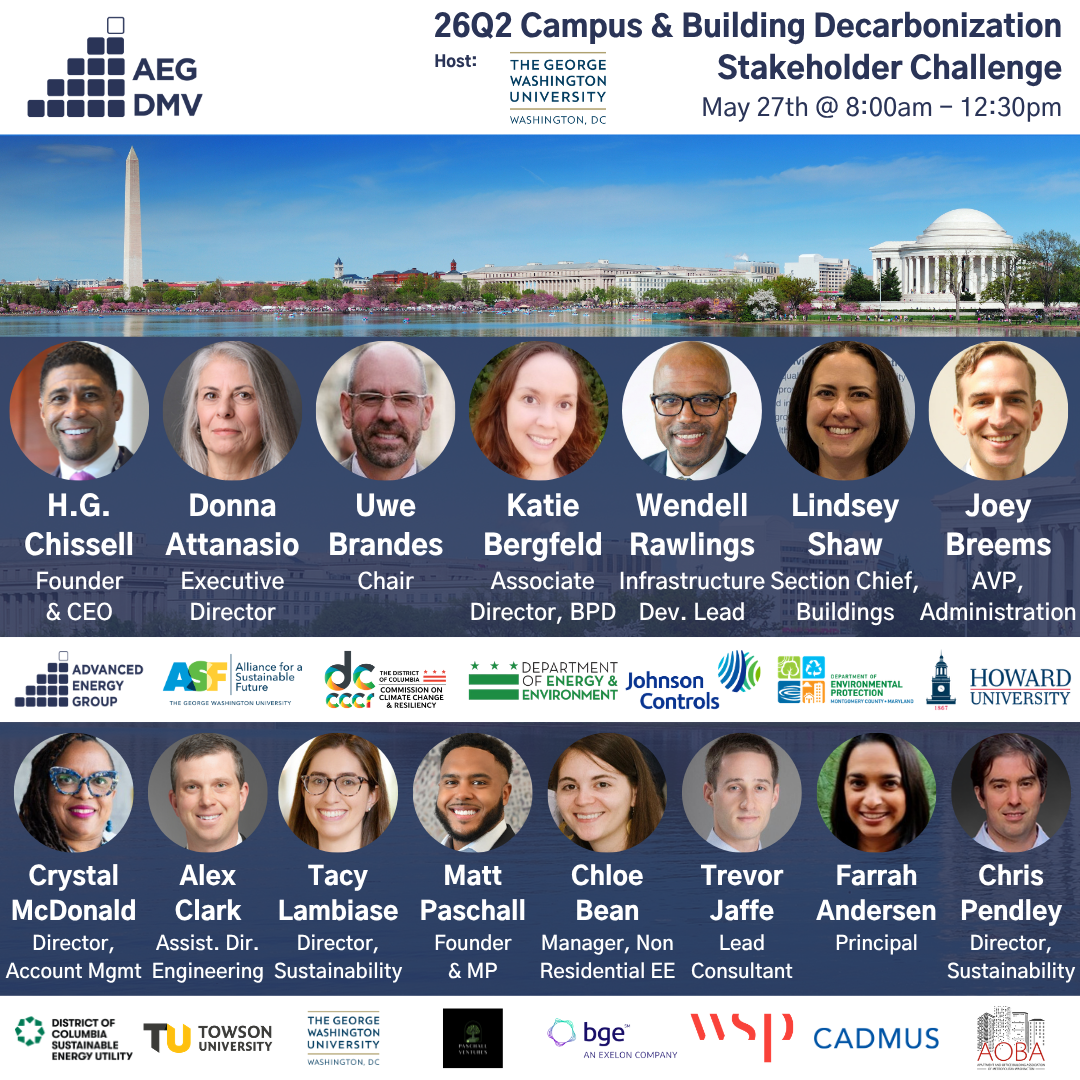
Held on May 27th, 2026 at The George Washington University in Washington, DC, forty public and private industry leaders convened for the AEG DMV 26Q2 Campus & Building Decarbonization Stakeholder Challenge. The purpose of this challenge was to: 1.) Align on a critical obstacle regarding Campus & Building Decarbonization for the DMV; 2.) Engage as cross sector teams to agree on a 90-day sprint and 12-month goal; 3.) Empower leaders to deliver the solution and present the outcome in 12 months with 90 day sprints.
Donna Attanasio, Executive Director, The George Washington University Alliance for a Sustainable Future, Katie Bergfeld, Associate Director, Building Performance Division, Department of Energy & Environment, and Uwe Brandes, Chair, DC Commission on Climate Change & Resiliency provided opening remarks to frame the discussion surrounding campus & building decarbonization for DMV.
Opening remarks were followed by the Speaker Challenge, where each speaker provided a presentation that concluded with this completed statement: "Regarding Campus & Building Decarbonization, to achieve DMV’s health, prosperity & energy goals, a critical obstacle to collectively overcome in 12 months is _________."
5 Key Themes
1. Breaking the Status Quo through Executive Buy-In
Many regional institutions remain stuck in reactive deferred maintenance cycles because leadership teams feel overwhelmed by fragmented priorities, complexity, and operational uncertainty. To resolve this, leadership teams require transparent financial modeling, phased execution maps, and clear milestones to reduce structural risk and ignite decisive organizational action.
"Regarding Campus & Building Decarbonization to achieve DMV's health, energy, and prosperity goals... a critical obstacle to collectively overcome in the next 12 months is the STATUS QUO - specifically institutional analysis paralysis fueled by fragmented stakeholder priorities and a lack of executive buy-in." - Wendell P. Rawlings, Capital Planning & Infrastructure Development Lead, Johnson Controls
2. Establishing Real-Time Visibility of Energy Infrastructure
Complex, aging legacy infrastructures across university networks frequently operate without modern, interconnected tracking capabilities. Stakeholders emphasize issuing immediate Requests for Information (RFIs) and implementing submetering upgrades to secure full, real-time tracking of distributed energy resources (DERs), which serves as a baseline to safely scale building electrification.
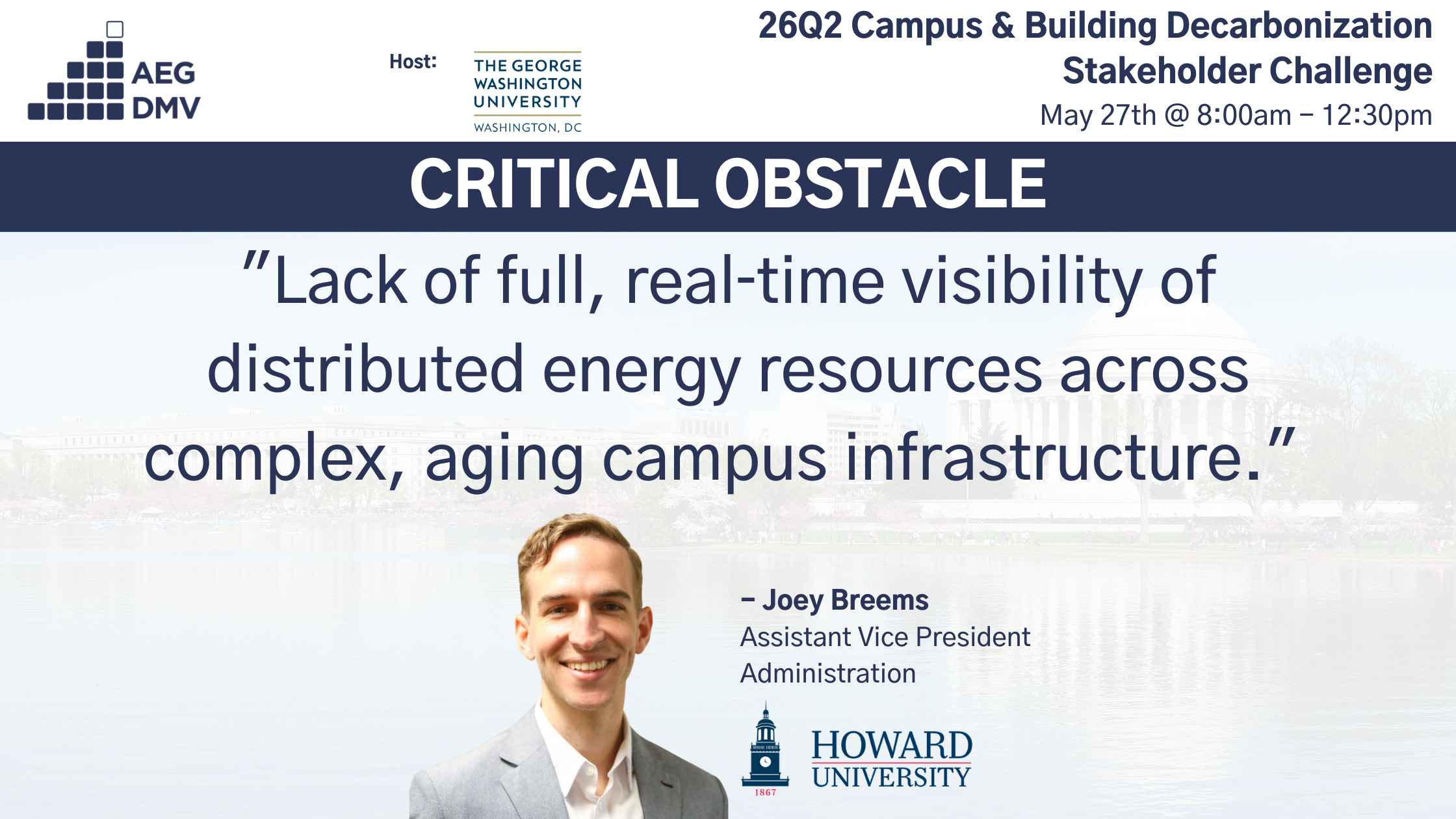
"Establishing full, real-time visibility of distributed energy resources across complex, aging campus infrastructure." - Joey Breems, Assistant Vice President for Administration, Howard University
3. Aligning Local Incentives with Regulatory Mandates
Stringent regional metrics like Building Energy Performance Standards (BEPS) risk minimal uptake or high enforcement burdens if they lack clear alignment with supportive financial programs. Municipalities can drive private-sector engagement by leveraging multi-tiered property tax credits and utilizing local stakeholder workgroups to build long-term policy trust.
"The need for a new stakeholder workgroup process that ensures local-level incentives include broad stakeholder support, and effectively inspire action towards BEPS." - Lindsey Shaw, Section Chief, Buildings & Transportation Programs, Montgomery County DEP
4. Embedding Geothermal Development into Capital Planning
Strictly limited campus footprints mean large-scale green utility retrofits risk becoming intrusive and cost-prohibitive if left out of broader master plans. Engineering groups must immediately anchor physical space-availability surveys to lucrative external financing mechanisms, such as the 30% federal Investment Tax Credit (ITC), to optimize campus footprints effectively.
"The need for a strategic framework that optimizes limited campus footprints for geothermal infrastructure, ensures its integration into long-term capital planning, and identifies viable funding mechanisms within restrictive budget parameters." - Alex Clark, Assistant Director of Engineering, Towson University
5. Consolidating Siloed Data into Unified Management Platforms
Fragmented datasets and institutional silos heavily impair an organization's high-level strategic planning and compliance decisions. Organizing rapid 90-day needs assessments for comprehensive, open-source data systems and building details provides the baseline clarity required to target 12-month decarbonization goals.
"Proposed 90 Day Sprint: recommend HU create a comprehensive utility management platform, a clear understanding of the building square footage; Proposed 12 month goal: helping HU better refine their decarbonization strategy to cost effectively reach compliance targets" - AEG DMV 26Q2 Participants
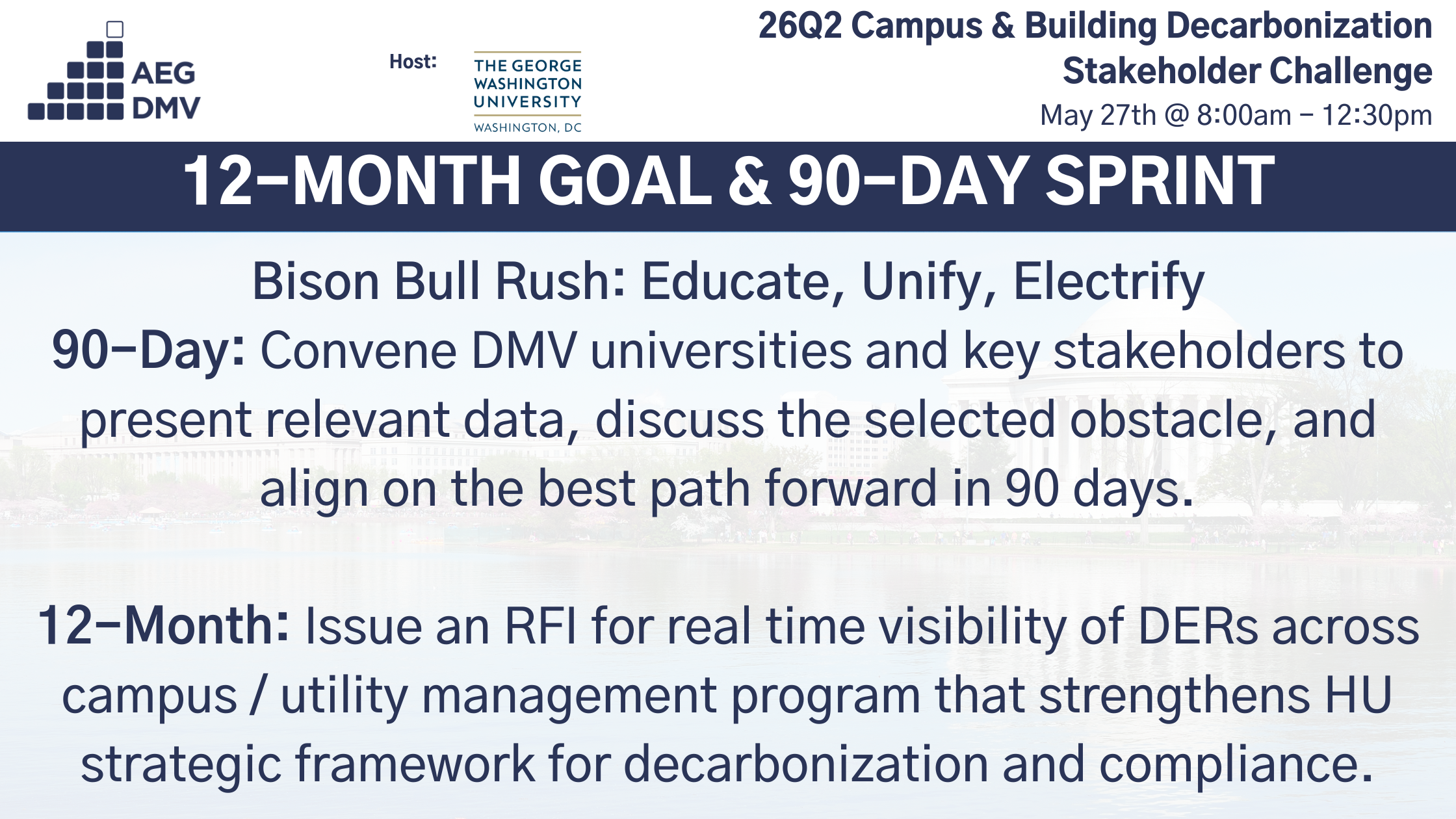
Participants agreed to prioritize the obstacle statement provided by Joey Breems (Howard University): “Lack of full, real‑time visibility of distributed energy resources across complex, aging campus infrastructure.” Participants then designed, and pitched a 90-day sprint and 12-month goal to best address this critical obstacle.
10 leaders formed a volunteer Task Force to complete a 90-day sprint.
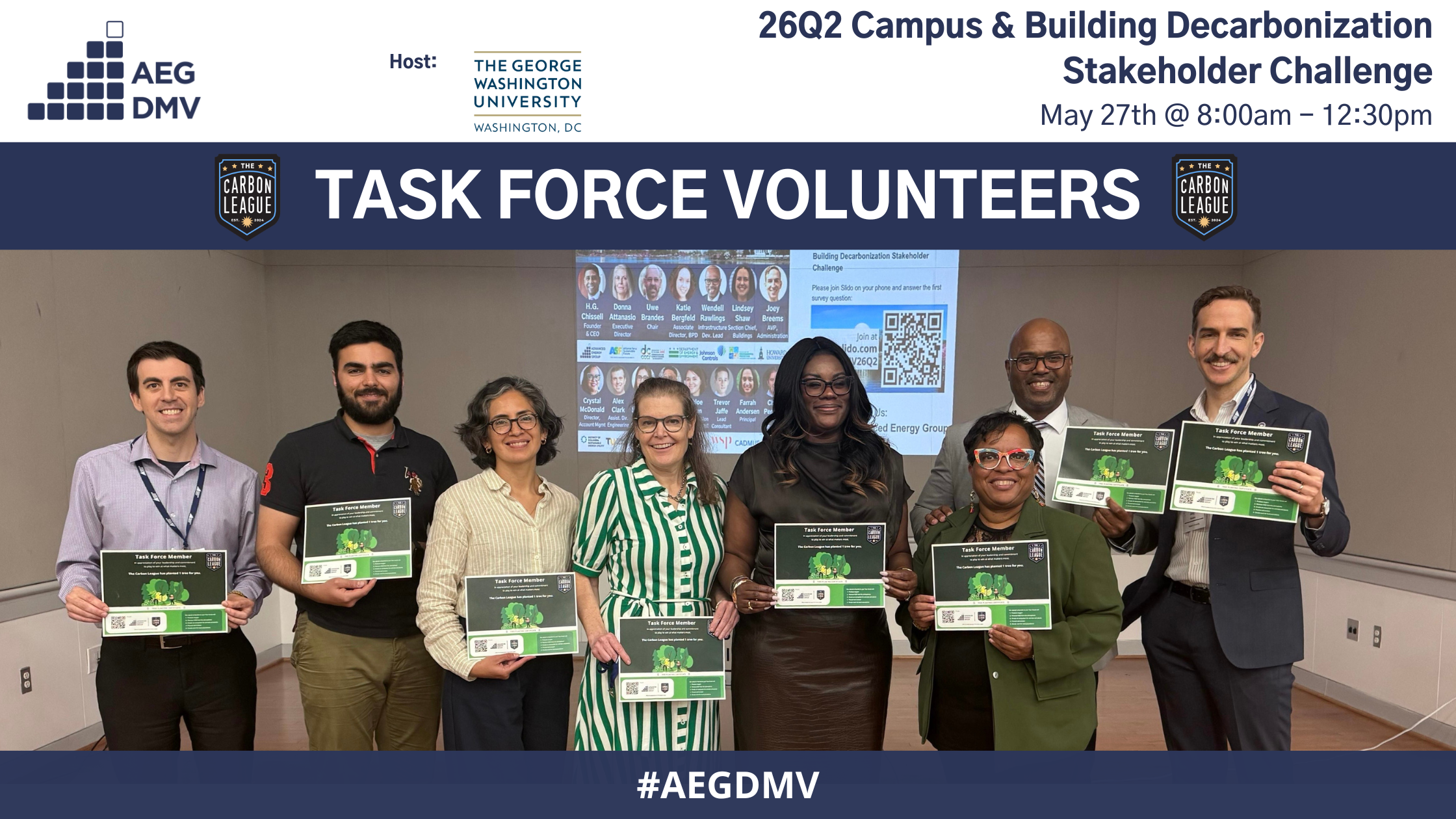
Task Force Volunteers: Divesh Gupta, BGE, Henry Wade, Daikin U.S., Crystal McDonald, DCSEU, Sandra Medina, DCSEU, Cristine Gibney, DOEE, Michael Raad, GWU, Joey Breems, Howard University, Wendell Rawlings, Johnson Controls Inc., Michelle Ware-Allen, Orivia Tech, Benjamin Gorisek-Gazze, The Carbon League
To join this group of volunteers, please contact us at info@goadvancedenergy.com.
Conclusion
The AEG DMV 26Q2 Campus & Building Decarbonization Stakeholder Challenge convened municipal sustainability executives, university administration and engineering leaders, and private energy solutions providers to confront the systemic, regulatory, and technical barriers slowing the modernization of regional infrastructure. The strategic focus centered on dismantling institutional analysis paralysis, capturing real-time energy visibility across complex legacy systems, and seamlessly integrating clean energy retrofits–such as large-scale geothermal networks–directly into long-term capital asset planning cycles. Moving forward, stakeholders will advance a focused 90-day sprint dedicated to convening and unifying DMV universities to gain critical education on their institutional experiences and inputs. This collaborative alignment will directly support the overarching 12-month goal to issue an RFI for real-time visibility of distributed energy resources (DERs) across campus infrastructure to systematically drive electrification. This Challenge establishes a coordinated, replicable pathway for the Greater Washington region to accelerate scalable electrification solutions that advance climate equity, support utility cost savings, and strengthen community resilience across the DMV.
Access to private resource pages, which include speaker presentations, and survey responses, from AEG Stakeholder Challenges is reserved for Signature Sponsors and City/Government Partners. To become a Signature Sponsor, learn more here: https://aeg.team/engage
Advanced Energy Group is a sponsor supported organization that facilitates quarterly challenges for high-impact stakeholders to deliver on health, energy and prosperity commitments for U.S. cities and vulnerable regions.