Executive Summary: April 24th AEG New York Campus & Building Decarbonization Summit
Overview
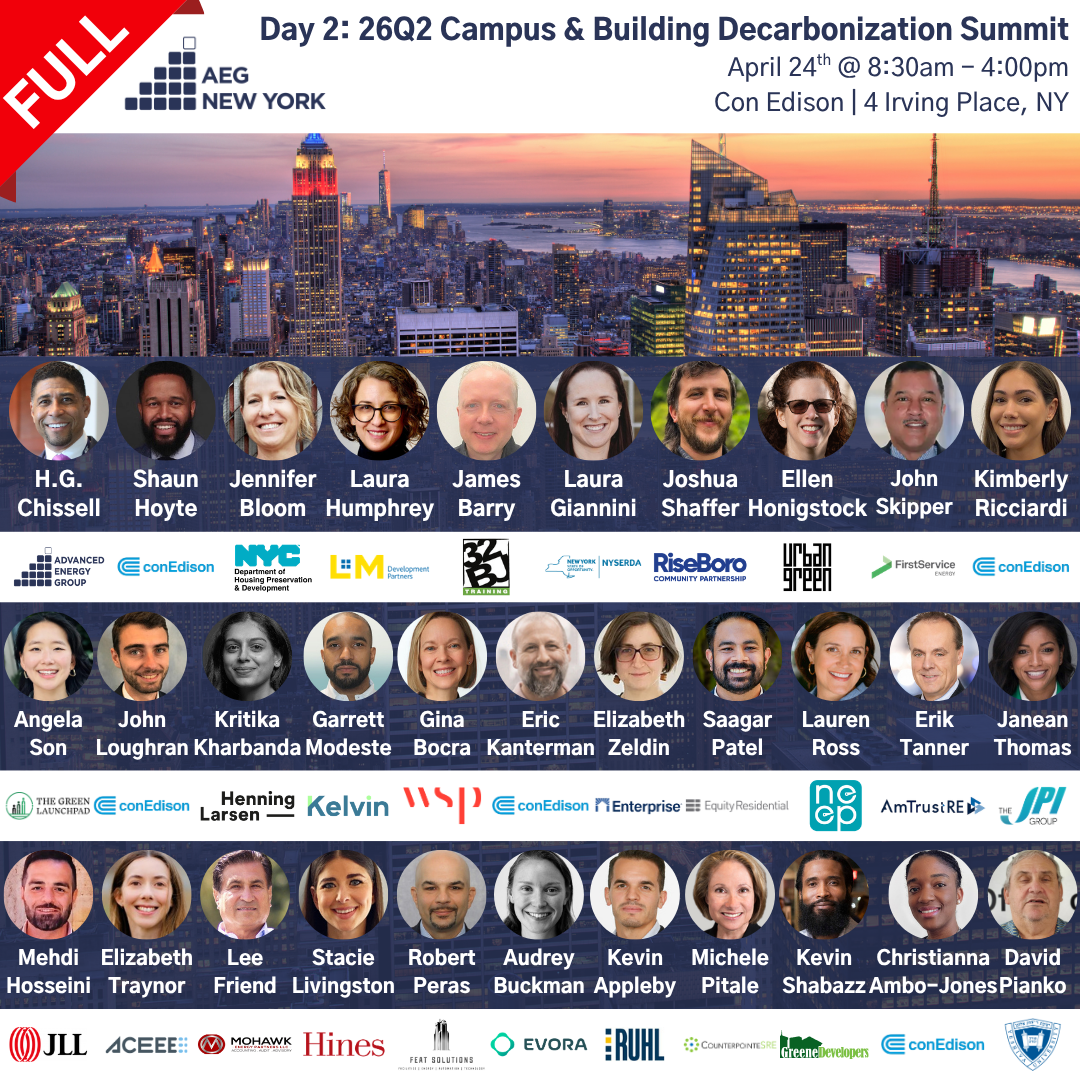
Held on April 24th, 2026 at Con Edison in New York, one-hundred and fifty public and private industry leaders convened for Day 2 of the AEG New York 26Q2 Campus & Building Decarbonization Summit. The purpose of Day 2 was to: 1.) Demonstrate key obstacles regarding NY building electrification and weatherization across four core pillars: Projects in Motion, Workforce Development, Affordable Housing, and a Customer Panel; 2.) Engage as cross sector teams to agree on a 90-day sprint; and 3.) Empower leaders to deliver the solution and present the outcome in 12 months with 90 day sprints.
H.G. Chissell, Founder & CEO, Advanced Energy Group, Shaun Hoyte, Head of Clean Energy Networks, Con Edison and Jennifer Bloom Leone, Assistant Commissioner/Chief Sustainability Officer, New York City Department of Housing Preservation and Development, provided opening remarks to frame the discussion surrounding building electrification and weatherization for New York.
Opening remarks were followed by a series of specialized panels—Projects in Motion, Workforce Development, and Affordable Housing—culminating in the Customer Panel “Speaker Challenge”. Each speaker provided a presentation that concluded with this completed statement: "Regarding building electrification and weatherization, a critical issue to collaboratively address over the 12 months is _________."
5 KEY THEMES
1. Scaling Through Economic and Engineering Rigor
The "Projects in Motion" panel demonstrated that scaling decarbonization across diverse sectors—from industrial facilities like Steinway & Sons to institutional campuses like Yeshiva University—requires a fundamental realignment of financial and engineering priorities. Participants concluded that for complex retrofits to be "built to last," technical implementation must move beyond "green language" and be grounded in the economic rigor necessary to solve the capital problem.
"Regarding building electrification and weatherization, a critical issue to collaboratively address over the next 12 months is to bring the groups of people together who want to save the planet and the groups of people together who want to make money." - Kevin Appleby, Empire Building Challenge Partner, RUHL
2. Coordinating a Unified Workforce Ecosystem
The "Workforce Development: Training & Collaboration" panel demonstrated that scaling the region’s decarbonization labor pool—from upskilling incumbent building operators at 32BJ to launching new career pipelines through The Green Launchpad—requires a fundamental realignment of fragmented training pipelines. Participants concluded that for training programs to meet New York’s urgent building electrification needs, technical curriculum must move beyond isolated education and be grounded in the employer-informed coordination necessary to "connect the dots" between job seekers and industry demand.
"Regarding building electrification and weatherization, a critical issue to collaboratively address over the next 12 months is bolstering connections between employers, technical training and education providers, workforce development organizations, and job seekers to grow a strong workforce to deliver effective building electrification and weatherization work at scale." - Laura Giannini, Contractor, NYSERDA
3. Preserving Financial Stability in Affordable Housing
The "Decarbonization Considerations for Affordable Housing in NY" panel detailed an acute financial crisis within New York’s multifamily sector, where per-unit operating expenses have spiked 45% since 2017. With nearly 60% of nonprofit-owned projects now cash-flowing negatively, experts stressed that decarbonization mandates must be paired with regional coordination to prevent energy upgrades from further destabilizing affordable housing stock. Stakeholders highlighted the necessity of aligning program rules and financing to protect both building viability and tenant affordability.
"The rise in expenses, combined with reduced collections, has led to financial distress for many projects... nearly 60% of projects are taking in less revenue than they are paying out." - Elizabeth Zeldin, Director, Enterprise Community Partners
4. Defaulting to Deep, Whole-Building Retrofits
The "Customer Panel" Speaker Challenge demonstrated that achieving New York’s climate targets requires a decisive shift from incremental upgrades toward comprehensive, whole-building transformations. Experts from the design, financing, and utility sectors highlighted that while single-measure retrofits are easier to implement, success at scale depends on synchronizing sustainable architectural design with robust incentives and private capital.
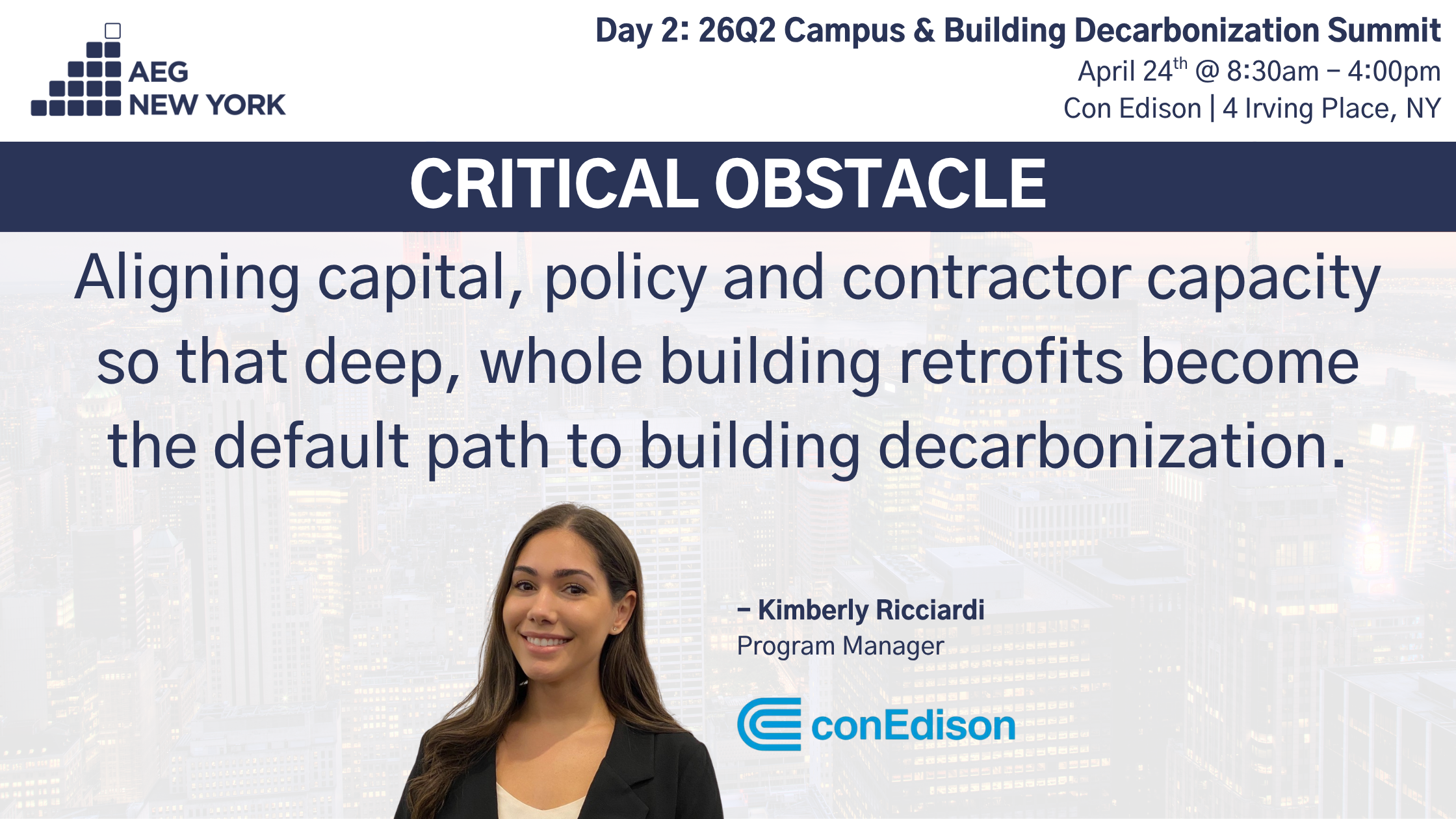
"Regarding building electrification and weatherization, a critical issue to collaboratively address over the next 12 months is aligning capital, policy and contractor capacity so that deep, whole building retrofits become the default path to building decarbonization." - Kimberly Ricciardi, Program Manager, Con Edison
5. Removing Friction Through Radical Collaboration
Achieving New York’s ambitious 2040 and 2050 climate goals requires a systemic shift toward radical collaboration to dismantle the operational and financial bottlenecks slowing the energy transition. Because buildings represent 68% of the city’s greenhouse gas emissions, stakeholders must focus on "friction removal" to ensure that technical ambition successfully translates into real-world implementation. By slowing down to ask better questions and borrowing cross-sector strengths, leaders can develop durable, equitable solutions that scale across the region's vast building stock.
"Collaboration is how we borrow each other's strengths. It's how technical expertise meets market reality. How ambition meets implementation. How good ideas survive contact with the real world." - Shaun Hoyte, Head of Clean Energy Networks, Con Edison
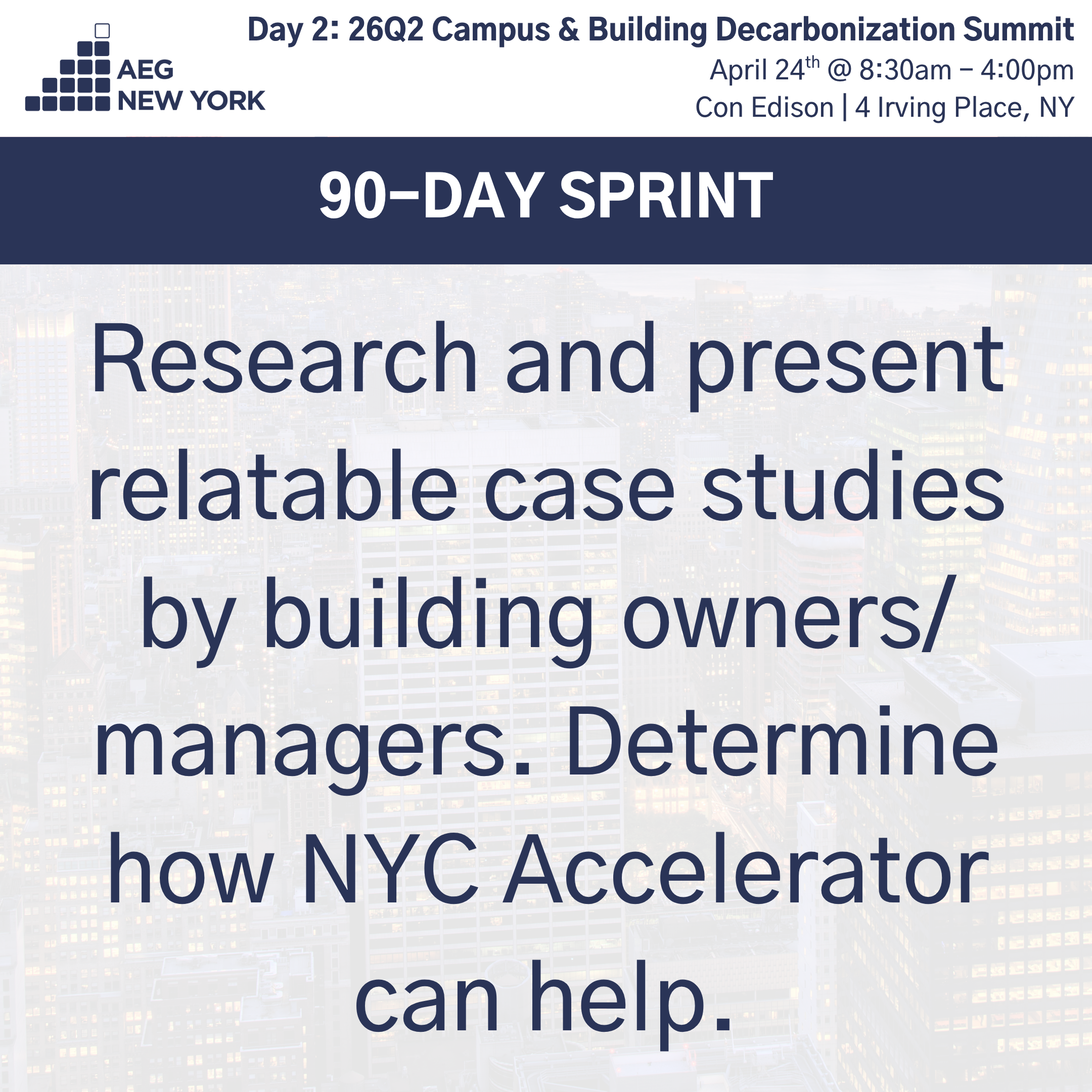
Inspired by the statement provided by Kimberly Ricciardi (Con Edison), participants agreed to prioritize this selected obstacle statement: “Aligning capital, policy and contractor capacity so that deep, whole building retrofits become the default path to building decarbonization.” Participants then designed, and pitched a 90-day sprint to best address this critical obstacle.
4 leaders formed a volunteer Task Force to complete a 90-day sprint.
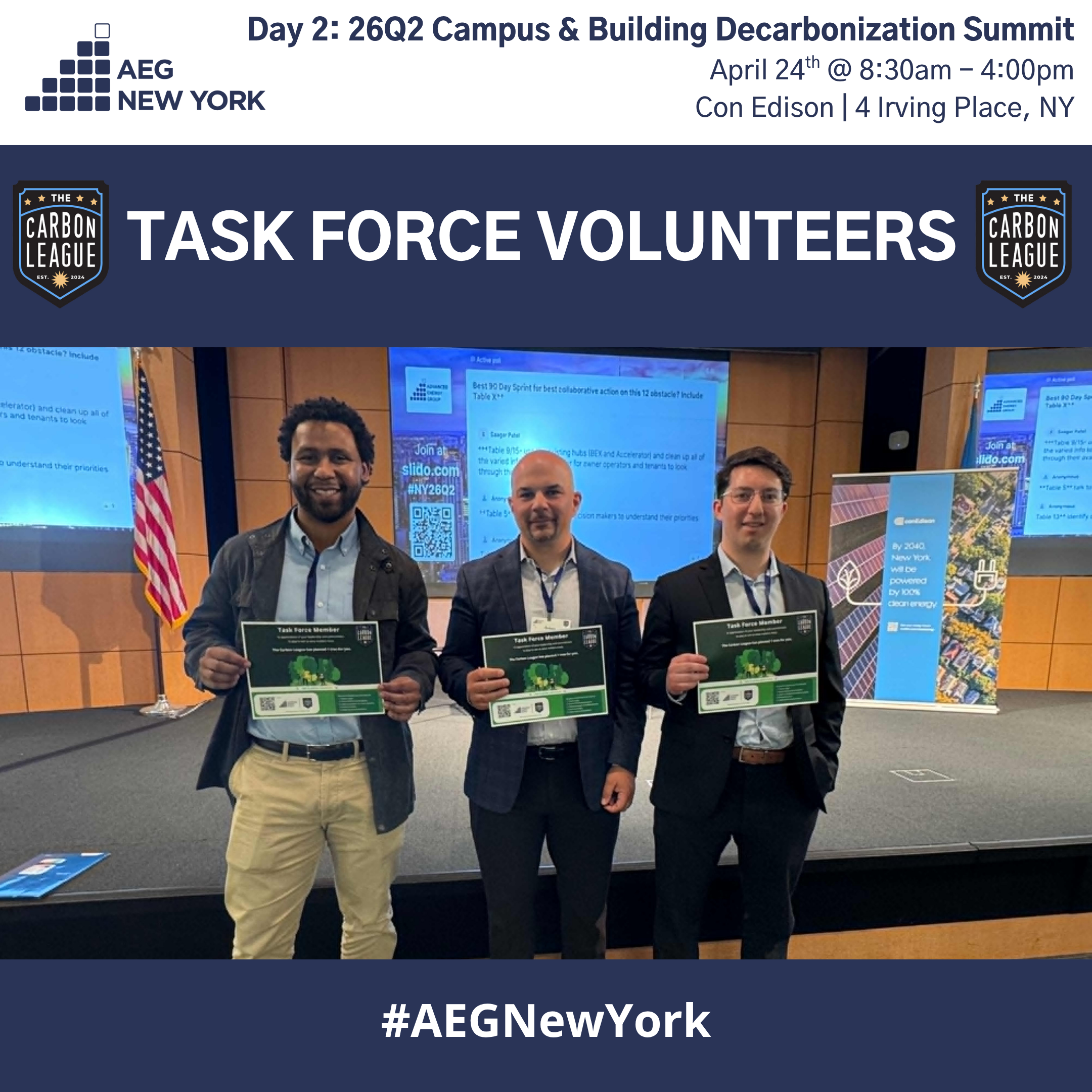
Task Force Volunteers: Kim Ricciardi, Con Edison, James Momperousse, Carrier Corporation, Robert Peras, FEAT Solutions, Caleb Kreeger, The Durst Organization
To join this group of volunteers, please contact us at info@goadvancedenergy.com.
Conclusion
The AEG New York 26Q2 Campus & Building Decarbonization Summit convened public and private leaders at Con Edison to establish deep, whole-building retrofits as the default path for New York’s energy transition. Addressing the critical need to align capital, policy, and contractor capacity, a volunteer Task Force is advancing a 90-day sprint focused on developing relatable, owner-led case studies. By empowering building owners and managers to directly deliver these implementation insights, the group aims to remove systemic friction and provide peers with a practical roadmap for successful decarbonization. This Challenge establishes a clear pathway to accelerate modernizations that improve resident health, ensure grid stability, and secure long-term energy prosperity for the region.
Advanced Energy Group is a sponsor supported organization that facilitates quarterly challenges for high-impact stakeholders to deliver on health, energy and prosperity commitments for U.S. cities and vulnerable regions. To become an AEG Sponsor, learn more here: https://aeg.team/engage