Executive Summary: April 23rd AEG New York Campus & Building Decarbonization Summit
Overview
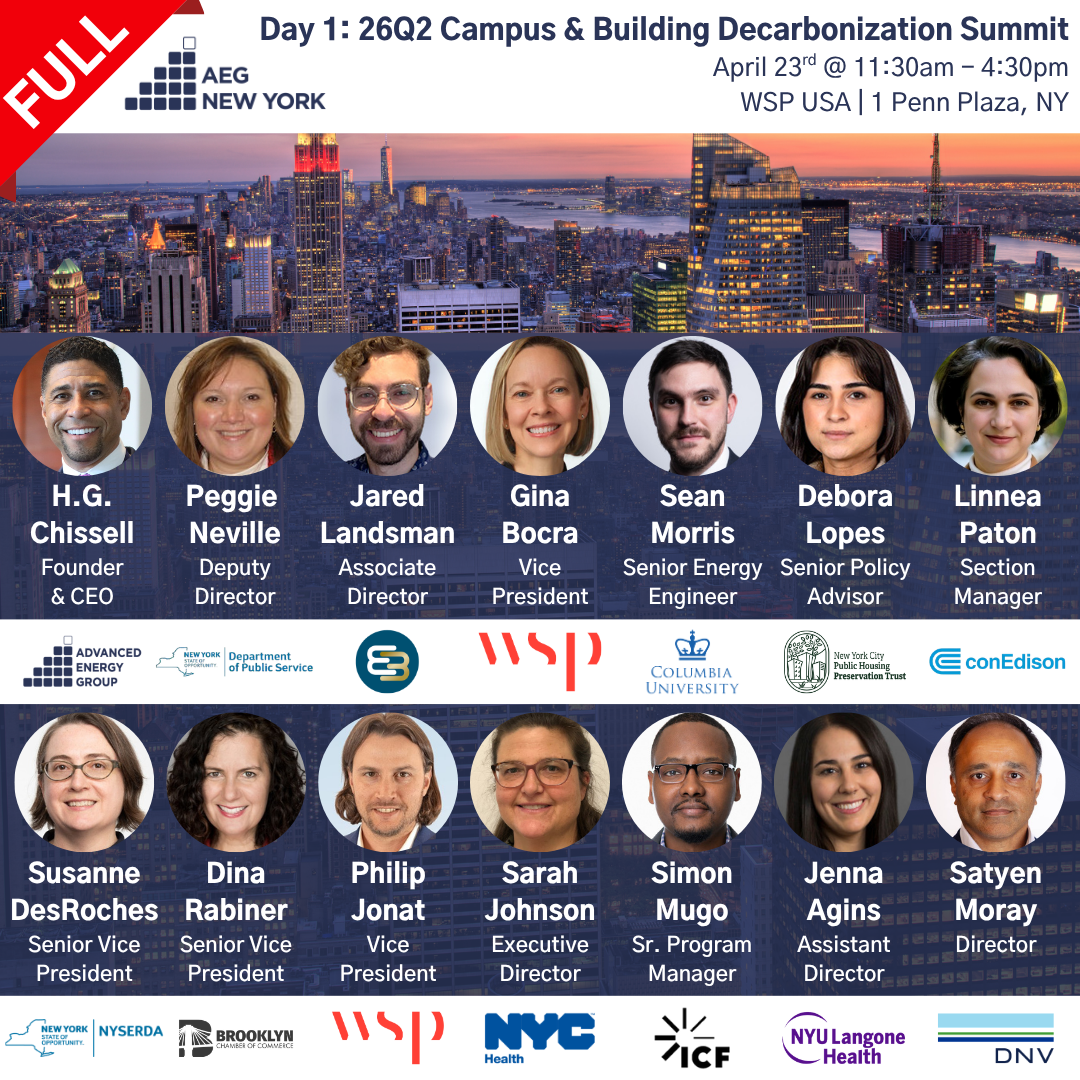
Held on April 23rd, 2026 at WSP USA in New York, sixty public and private industry leaders convened for Day 1 of the AEG New York 26Q2 Campus & Building Decarbonization Summit. The purpose of Day 1 was to: 1.) Align on a critical obstacle regarding Campus & Building Decarbonization for New York; 2.) Engage as cross sector teams to agree on a 90-day sprint and 12-month goal; 3.) Empower leaders to deliver the solution and present the outcome in 12 months with 90 day sprints.
Gina Bocra, Vice President, Built Ecology, WSP USA, Peggie Neville, Deputy Director, Efficiency, Equity & Innovation, Office of Markets & Innovation, New York State Department of Public Service, and Jared Landsman, Associate Director, E3, provided opening remarks to frame the discussion surrounding campus & building decarbonization for New York.
Opening remarks were followed by the Speaker Challenge, where each speaker provided a presentation that concluded with this completed statement: "Regarding Campus & Building Decarbonization, to achieve New York’s health, energy & prosperity goals, a critical obstacle to collectively overcome in 12 months is _________."
5 KEY THEMES
1. Regulatory Flexibility for Campus-Scale Networks
Current regulatory frameworks, such as Local Law 97, are often designed for individual buildings rather than shared energy networks. Stakeholders emphasize the need to reform these rules to allow campuses to report emissions on an aggregated basis, which would encourage energy sharing and prevent millions of dollars from being wasted on redundant metering that does not drive carbon reduction.
"Regarding Campus & Building Decarbonization... a critical obstacle to collectively overcome in 12 months is: reforming the regulatory environment to let campuses be campuses."- Sean Morris, Senior Energy Engineer, Columbia University
2. Early Alignment of Funding and Project Scope
Decarbonization often becomes a secondary priority or is reduced to incremental upgrades if it is not integrated into the core project budget during the predevelopment phase. Success requires aligning scope, cost, and financing from the outset to ensure that clean energy systems are treated as essential infrastructure rather than optional "betterments."
"A critical obstacle to collectively overcome in 12 months is ensuring decarbonization built into project scope from the start by aligning scope, funding, and priorities early." - Debora Lopes, Senior Policy Advisor, NYC Public Housing Preservation Trust
3. Leveraging District Energy for Grid Resilience
New York City’s electric grid faces significant local power supply shortages and transmission constraints. Expanding the use of existing district energy systems—specifically through district steam cooling and thermal waste heat recovery—offers a scalable way to decarbonize communities while simultaneously mitigating summer and winter electric peaks.
"A critical obstacle... is: to maximize the number of buildings using district steam cooling affordably, reduce electric loads with thermal waste heat recovery, and develop new visions for mitigating peaks with district energy systems." - Linnea Paton, Section Manager, Steam Long Range Planning, Con Edison
4. Coordinated and Phased Infrastructure Planning
Deploying community-scale thermal energy networks is complex and requires a phased approach that syncs infrastructure development with individual building retrofit schedules. To manage upfront costs and ensure systems operate efficiently at all stages of growth, best practices must be established to coordinate pipe laying with building equipment replacement cycles.
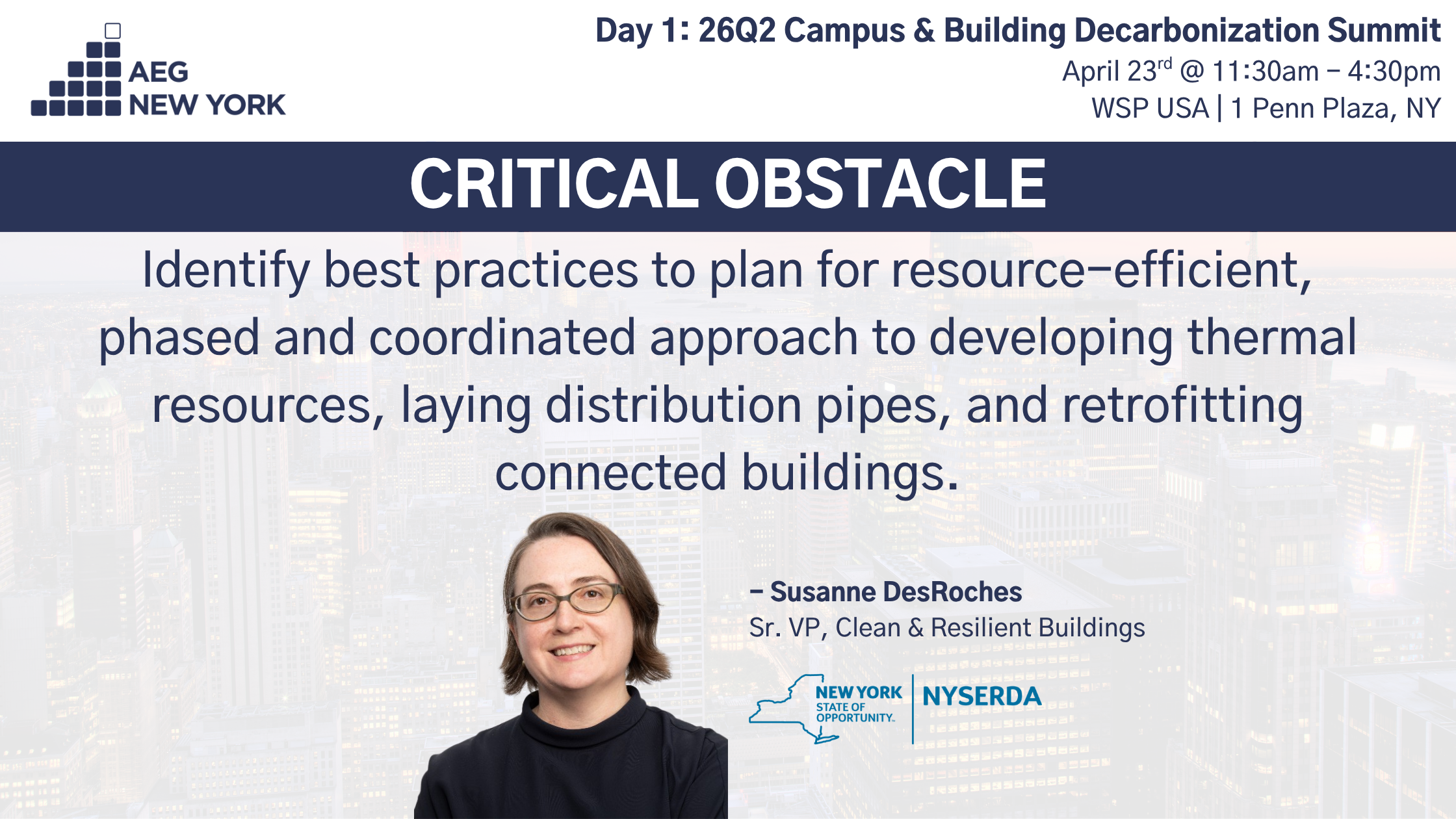
"Identify best practices to plan for resource-efficient, phased and coordinated approach to developing thermal resources, laying distribution pipes, and retrofitting connected buildings." - Susanne DesRoches, Sr. Vice President, Clean & Resilient Buildings, NYSERDA
5. Integrating Decarbonization with Health and Reliability
Decarbonization is most successful when it is embedded in comprehensive modernization projects that solve immediate resident needs, such as failing heating systems, recurring mold from plumbing leaks, and unreliable elevators. This holistic approach ensures that infrastructure investments deliver improved comfort and health outcomes alongside carbon reductions.
"The Trust delivers comprehensive building renovations that integrate decarbonization with critical capital needs."- Debora Lopes, Senior Policy Advisor, NYC Public Housing Preservation Trust
Inspired by the statement provided by Susanne DesRoches (NYSERDA), participants agreed to prioritize this selected obstacle statement: “Identify best practices to plan for resource-efficient, phased and coordinated approach to developing thermal resources, laying distribution pipes, and retrofitting connected buildings.” Participants then designed, and pitched a 90-day sprint and 12-month goal to best address this critical obstacle.
9 leaders formed a volunteer Task Force to complete a 90-day sprint.
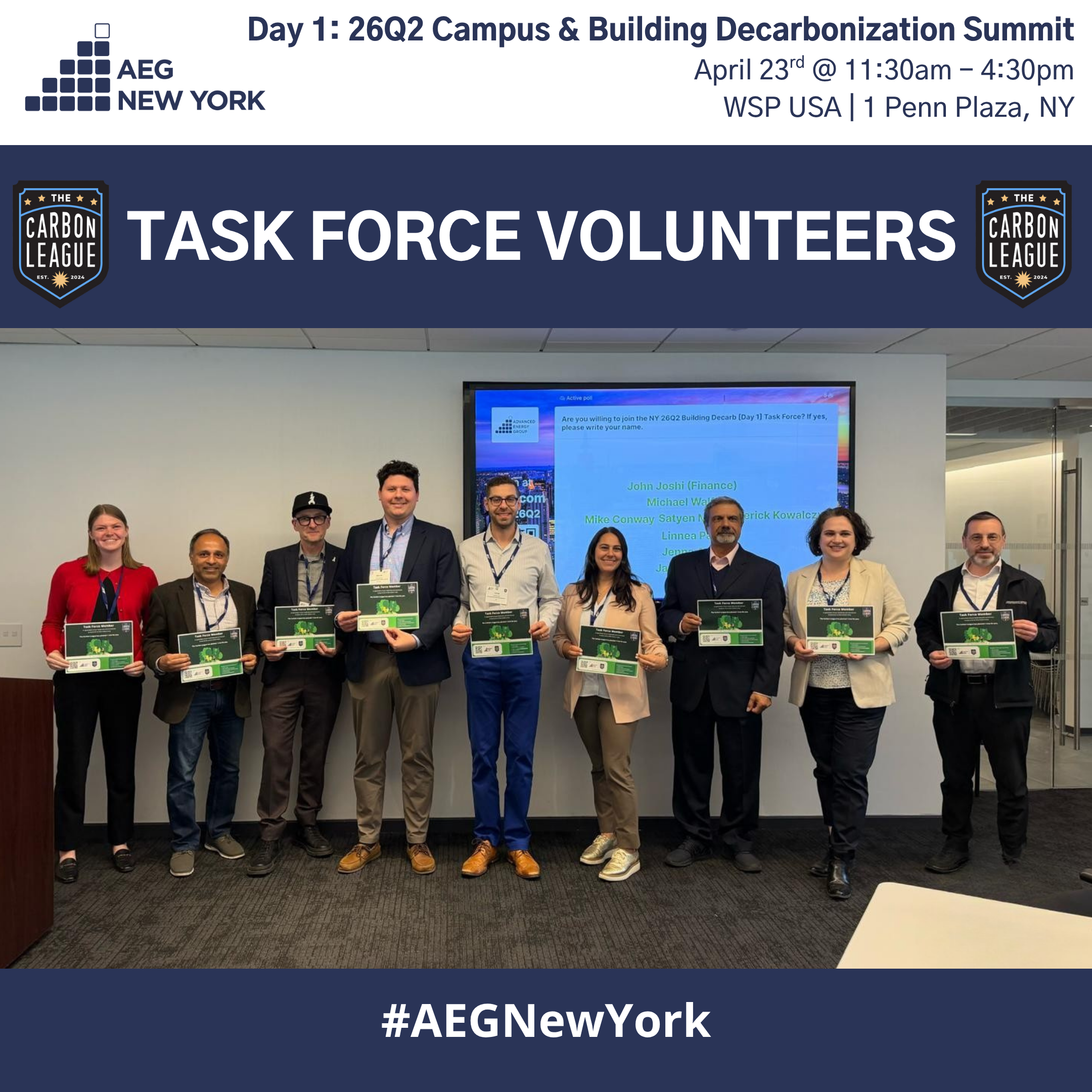
Task Force Volunteers: Linnea Paton, Con Edison, Satyen Moray, DNV, Jared Landsman, E3, John Joshi, NYSERDA, Derick Kowalczyk, Willdan, Michael Walfish, Building Efficiency Services, Jenna Agins, NYU Langone Health, Mike Conway, Stacks + Joules, Grant Salmon, Trane
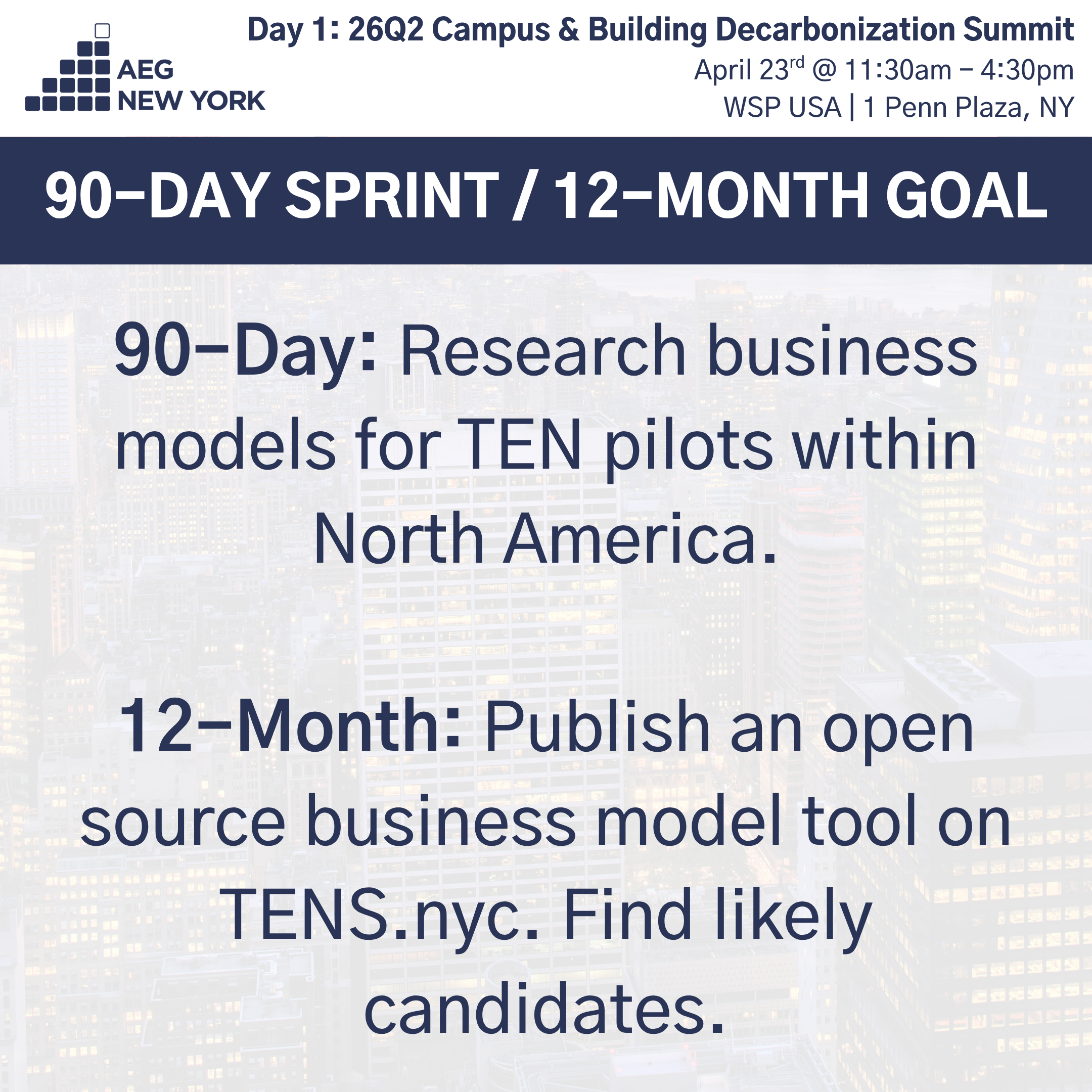
To join this group of volunteers, please contact us at info@goadvancedenergy.com.
Conclusion
The AEG New York 26Q2 Campus & Building Decarbonization Stakeholder Challenge convened City and State leadership, utility operators, academic institutions, and public housing authorities to confront the structural barriers slowing the modernization of the region's built environment. The focus centered on reforming regulatory environments to support campus-scale energy sharing and aligning capital funding early in predevelopment to ensure decarbonization remains a core project priority. As stakeholders advance 90-day sprints—focused on building board-ready value propositions that link decarbonization to cost control and convening expert workshops to enable "no-regrets" energy planning —working toward 12-month outcomes centered on presenting unified decarbonization plans to secure long-term board commitment and publishing financial frameworks for shared savings —this Challenge establishes a clear pathway for New York to accelerate infrastructure solutions that advance health, resident comfort, and grid resiliency while positioning the region for long-term climate leadership.
Advanced Energy Group is a sponsor supported organization that facilitates quarterly challenges for high-impact stakeholders to deliver on health, energy and prosperity commitments for U.S. cities and vulnerable regions. To become an AEG Sponsor, learn more here: https://aeg.team/engage