Executive Summary: April 9th AEG Philadelphia Stakeholder Challenge: Campus & Building Decarbonization
Overview
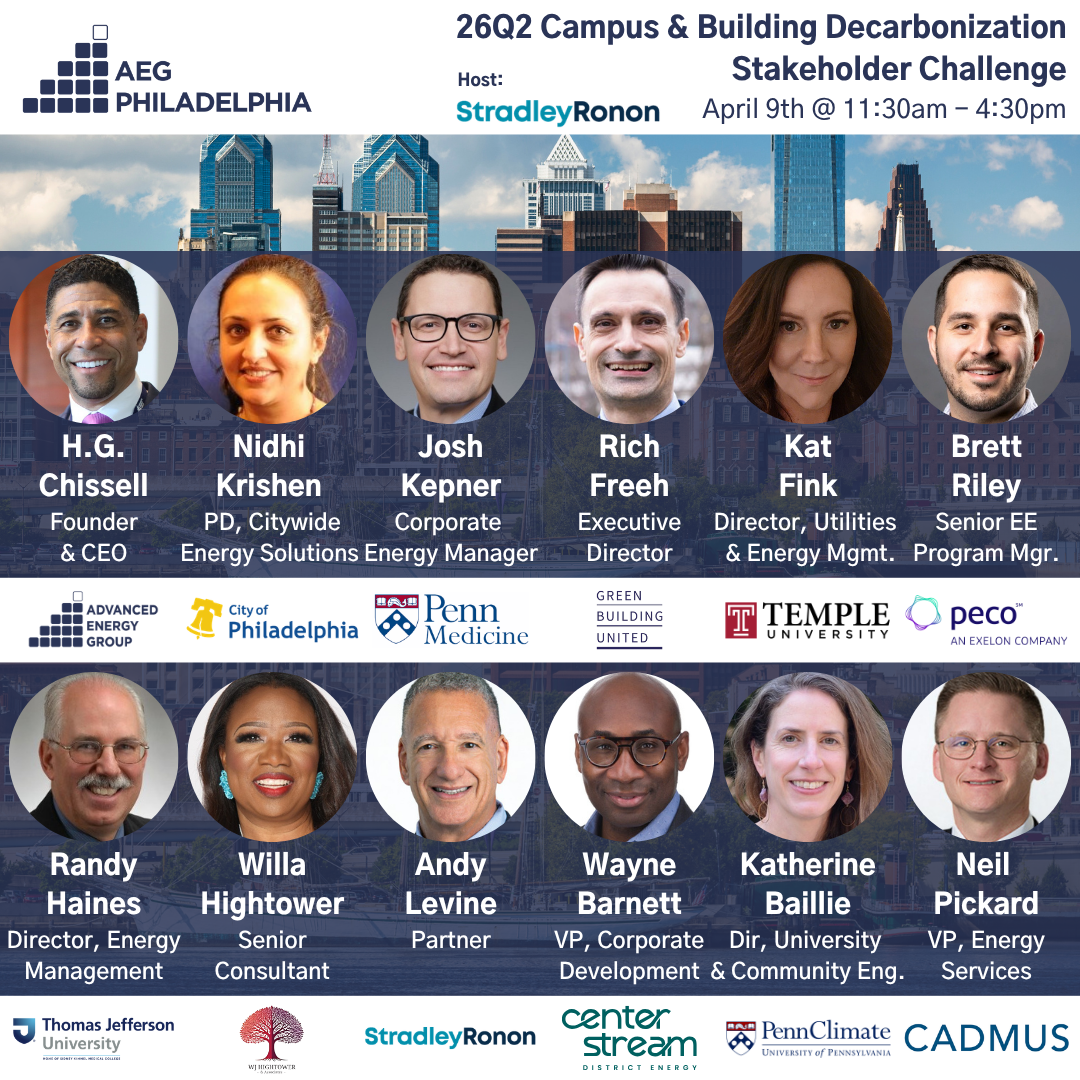
Held on April 9th, 2026 at Stradley Ronon in Philadelphia, thirty-six public and private industry leaders convened for the AEG Philadelphia 26Q2 Stakeholder Challenge: Campus & Building Decarbonization. The purpose of this challenge was to: 1.) Align on a critical obstacle regarding Campus & Building Decarbonization for Greater Philadelphia; 2.) Engage as cross sector teams to agree on a 90-day sprint and 12-month goal; 3.) Empower leaders to deliver the solution and present the outcome in 12 months with 90 day sprints.
Andy Levine, Partner, Stradley Ronon, and Nidhi Krishen, Program Director, Citywide Energy Solutions, City of Philadelphia, provided opening remarks to frame the discussion surrounding campus & building decarbonization for Greater Philadelphia.
Opening remarks were followed by the Speaker Challenge, where each speaker provided a presentation that concluded with this completed statement: "Regarding Campus & Building Decarbonization, to achieve Greater Philadelphia's health, prosperity & energy goals, a critical obstacle to collectively overcome in 12 months is _________."
5 Key Themes
1. Synchronizing Near-Term Investments with Long-Term Strategy
Near-term capital projects, such as Combined Heat and Power (CHP), frequently conflict with long-term decarbonization goals, creating a high risk of locking in fossil fuel infrastructure for decades. Successful implementation requires synchronizing these immediate infrastructure investments with future-proof growth strategies to avoid stranded assets.
"Regarding Campus & Building Decarbonization... a critical obstacle to collectively overcome in 12 months is aligning near-term infrastructure investments—like CHP—with long-term growth and decarbonization strategy."- Kat Fink, Director, Utilities & Energy Management, Temple University
2. Providing Market Certainty Through Technical Guidance
Capital planners and designers currently face a lack of clear standards for zero-carbon thermal energy systems. Creating a "no-regrets" energy project playbook is essential to give stakeholders the confidence to make capital decisions today that remain compatible with future green energy delivery.
"A lack of clear, actionable guidance defining what buildings and campuses must include in today's capital planning to be compatible with future zero-carbon thermal energy systems." - Josh Kepner, Energy Manager, Penn Medicine
3. Overcoming Fragmented Customer and Financial Priorities
Decarbonization efforts are often slowed by misaligned incentives and customer priorities. Establishing a board-ready value proposition that links decarbonization to cost control and capital planning is necessary to move past fragmented adoption and enable scalable electrification.
"Overcoming fragmented customer priorities and slow adoption of proven energy efficiency solutions needed to enable cost-effective energy efficiency, scalable building electrification, and grid-ready decarbonization." - Brett Riley, Sr. Energy Efficiency Program Manager, PECO
4. Building a Shared Regional Vision and Policy Framework
A complex ecosystem of regional partners currently operates without a unified roadmap. Addressing political uncertainty and the elimination of federal incentives requires a shared vision and framework to align regional resources with state and local policy needs.
“…a lack of shared vision and alignment around resource and policy needs for our region." - Rich Freeh, Executive Director, Green Building United
5. Empowering the Operational Workforce and Internal Stakeholders
The human element of decarbonization, including maintenance personnel and upper management, is a pivotal factor in long-term success. Ensuring these groups understand and are educated on sustainability goals is vital, though finding the time to develop and implement such training programs remains a significant hurdle.
"Regarding Campus & Building Decarbonization... a critical obstacle to collectively overcome in 12 months is allocation of time to develop the program." - Randy Haines, Director, Energy Management, Jefferson Health
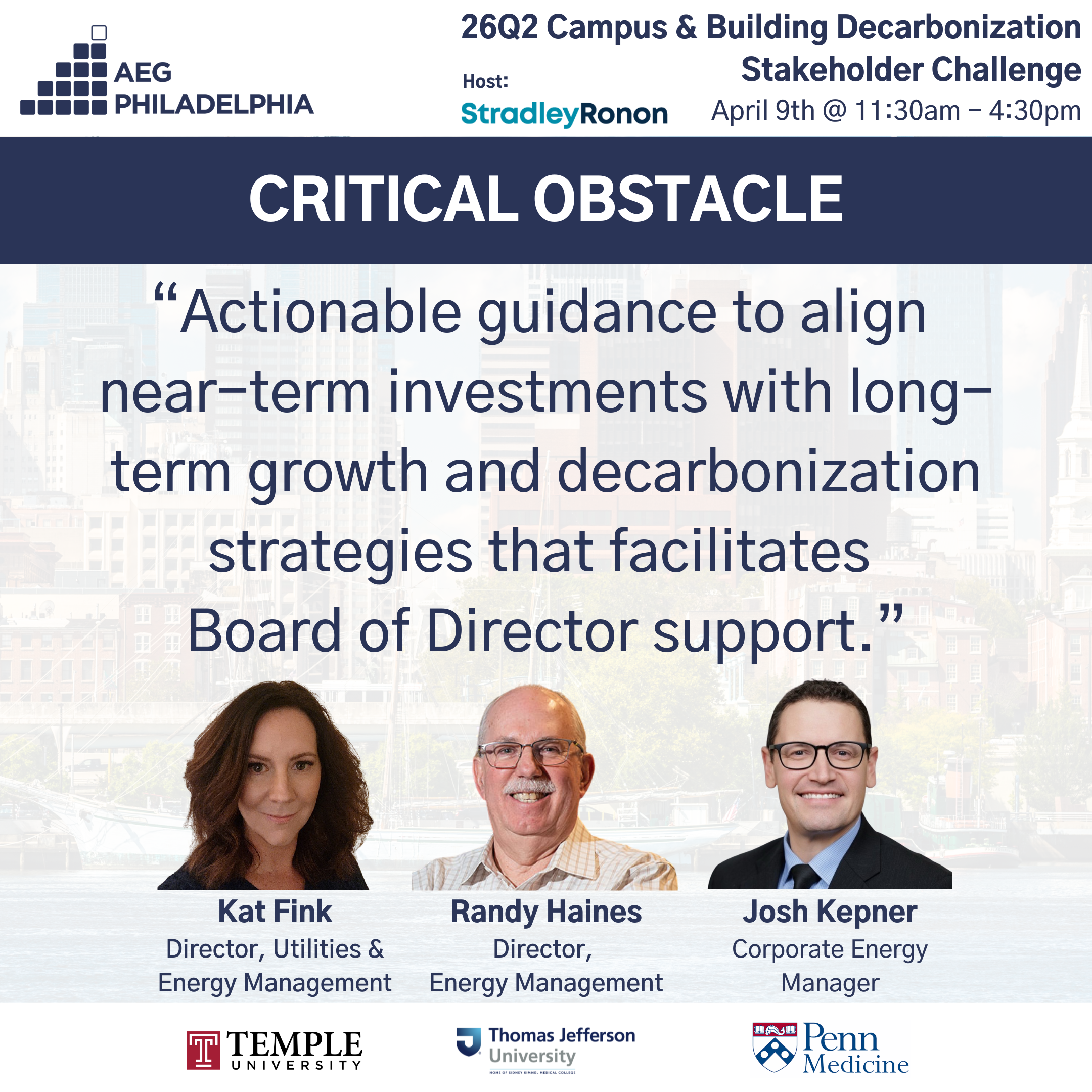
Inspired by the statements provided by Kat Fink (Temple University), Randy Haines (Jefferson Health), and Josh Kepner (Penn Medicine), participants agreed to prioritize this selected obstacle statement: “Actionable guidance to align near-term investments with long-term growth and decarbonization strategies that facilitate Board of Director support.” Participants then designed, and pitched a 90-day sprint and 12-month goal to best address this critical obstacle.
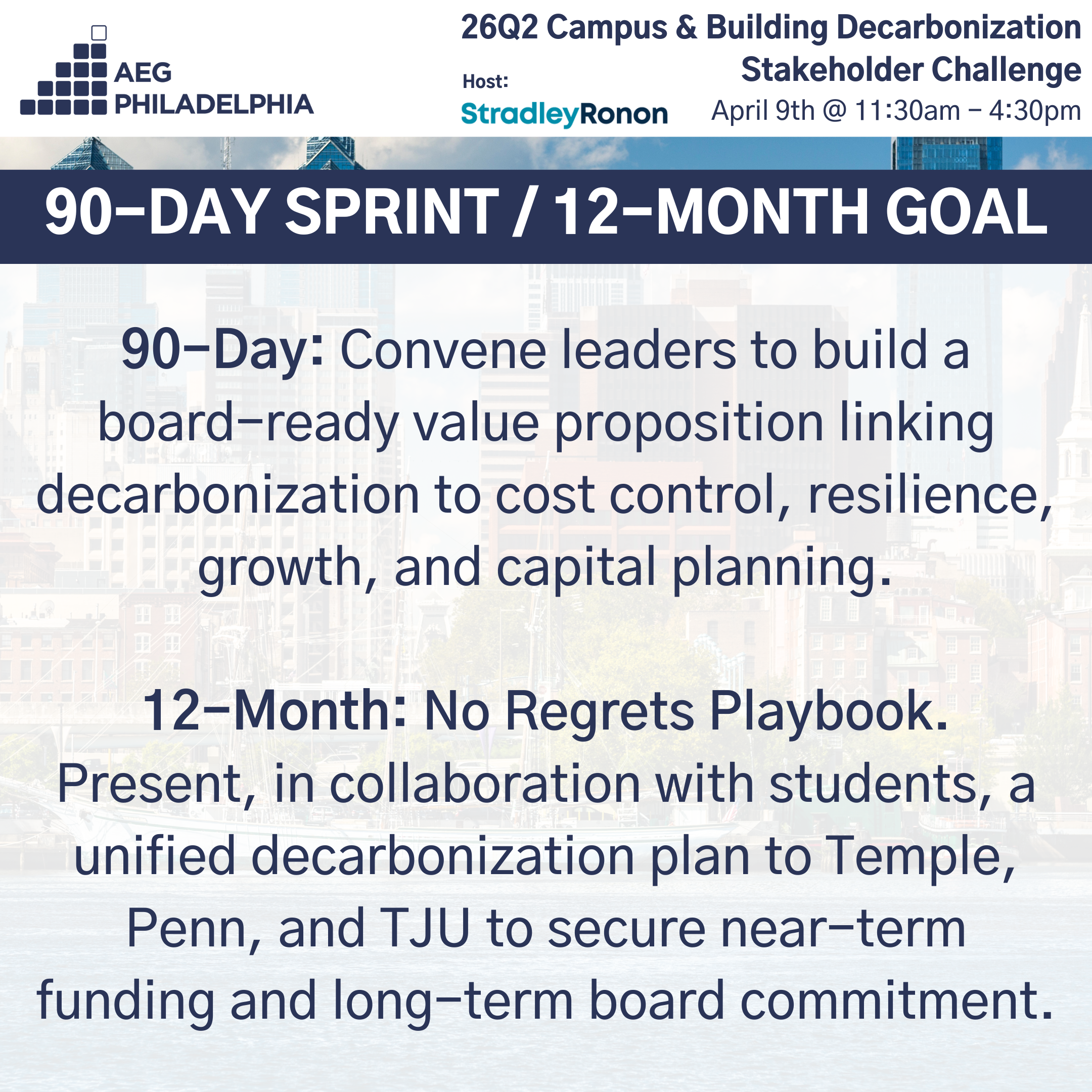
14 leaders formed a volunteer Task Force to complete a 90-day sprint.
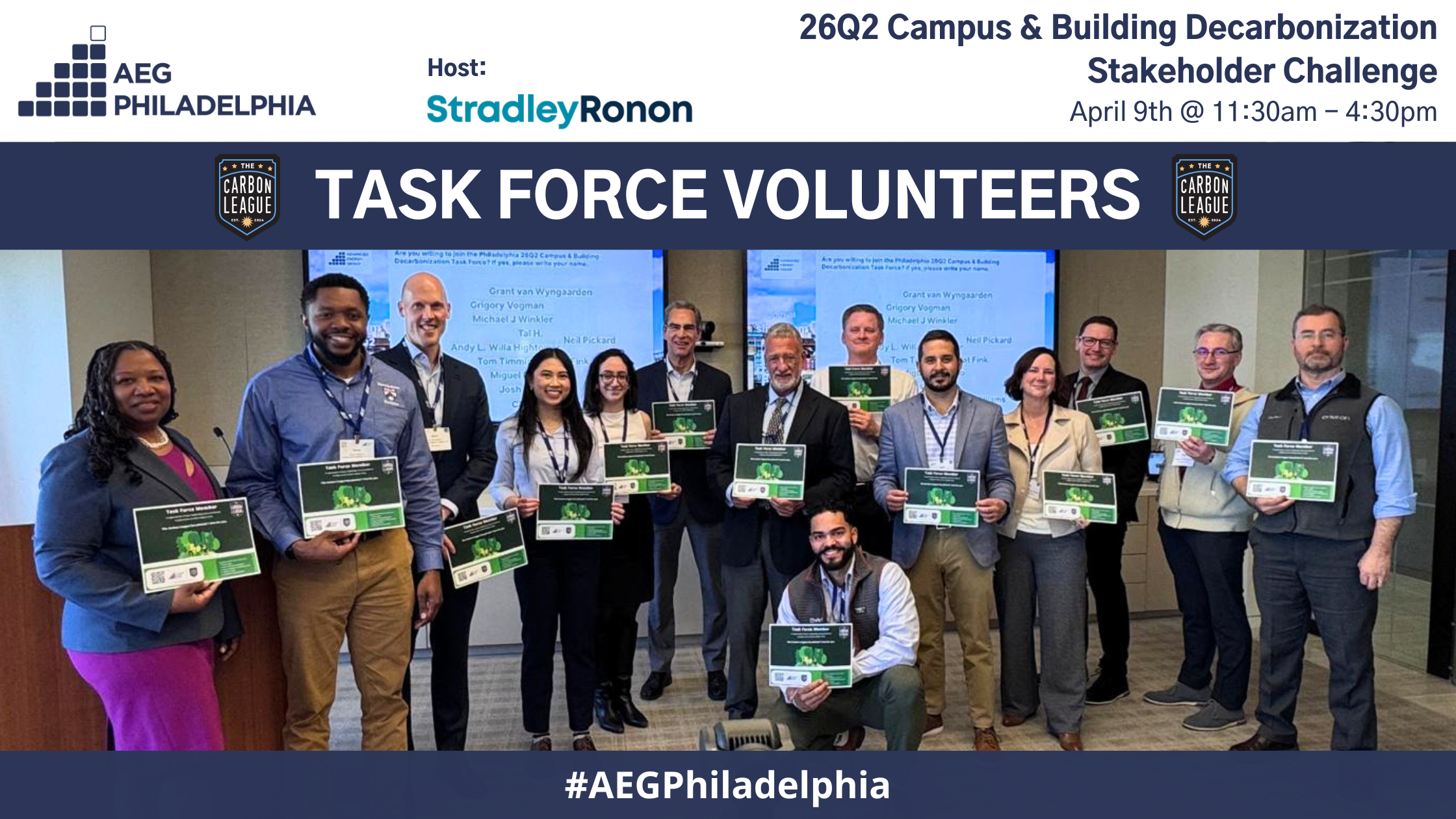
Task Force Volunteers: Michael Winkler, Environ Energy, Brett Riley, PECO/Exelon, Neil Pickard, The Cadmus Group, Tal Henig-Hadar, Willdan, Corey Crews-Williams, Penn Medicine, Josh Kepner, Penn Medicine, Andy Levine, Stradley Ronon, Kat Fink, Temple University, Grigory Vogman, Temple University, Grant van Wyngaarden, Bandorie, Tom Timmins, Ecosave, Miguel Feliciano, Vicinity Energy, Willa Hightower, WJ Hightower & Associates, Alexis Luong, The Carbon League
To join this group of volunteers, please contact us at info@goadvancedenergy.com.
Conclusion
The AEG Philadelphia 26Q2 Stakeholder Challenge: Campus & Building Decarbonization convened regional university and healthcare leadership, utility operators, and sustainability advocates to confront the structural barriers slowing the transition to a carbon-neutral built environment. The focus centered on aligning immediate infrastructure investments with long-term decarbonization strategies and creating actionable technical guidance for future-ready capital planning. As stakeholders advance 90-day sprints—focused on building board-ready value propositions that link decarbonization to cost control and growth—working toward 12-month outcomes centered on securing long-term board commitment and unified funding plans for major institutions—this Challenge establishes a clear pathway for Philadelphia to accelerate building solutions that advance health, prosperity, and regional competitiveness while positioning the area for long-term climate leadership.
Advanced Energy Group is a sponsor supported organization that facilitates quarterly challenges for high-impact stakeholders to deliver on health, energy and prosperity commitments for U.S. cities and vulnerable regions. To become an AEG Sponsor, learn more here: https://aeg.team/engage