

Executive Summary: December 11th AEG Philadelphia Stakeholder Challenge: Mobility & Clean Transportation
Overview
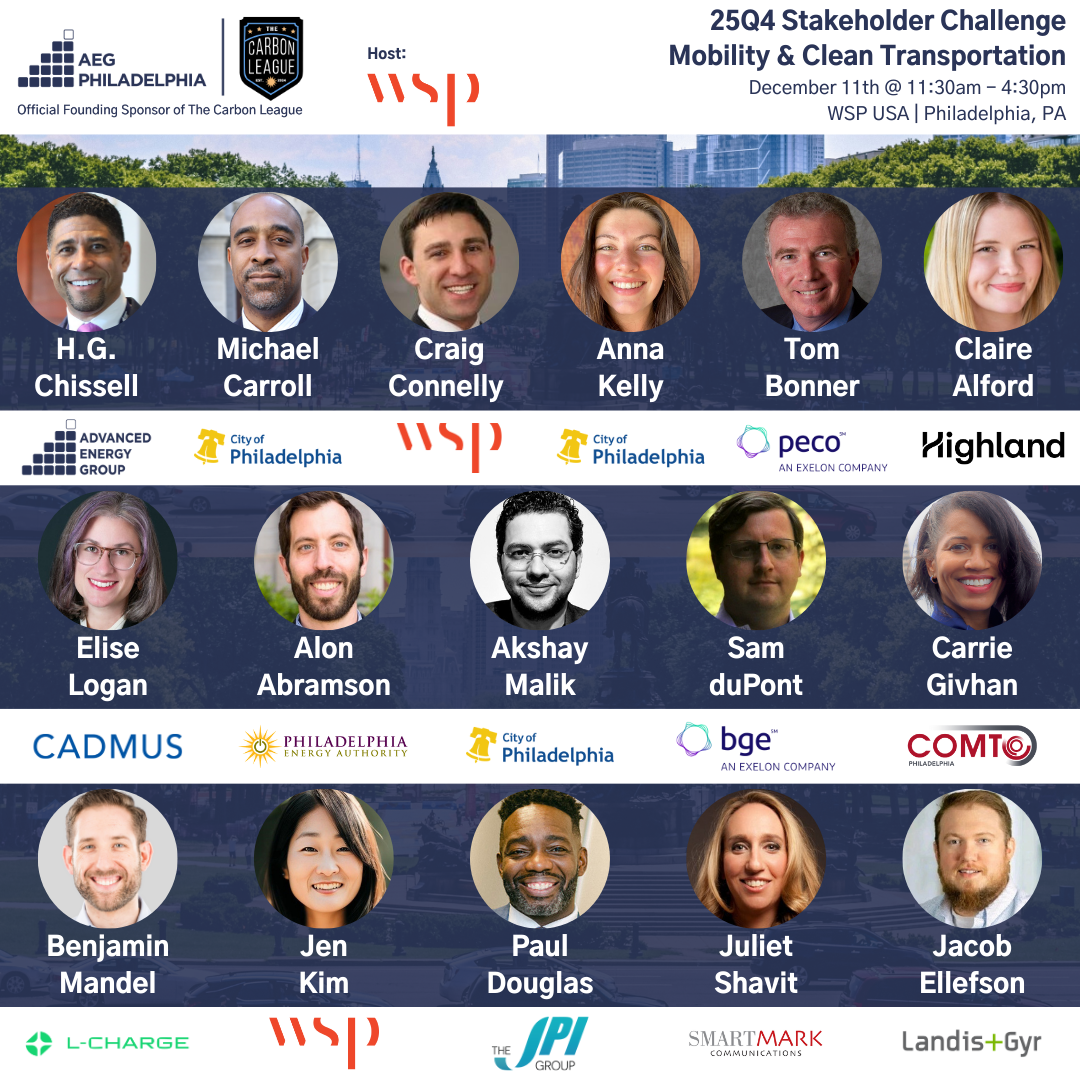
Held on December 11th, 2025 at WSP in Philadelphia, thirty public and private industry leaders convened for the AEG Philadelphia 25Q4 Mobility & Clean Transportation Stakeholder Challenge. The purpose of this challenge was to: 1.) Align on a critical obstacle regarding mobility & clean transportation for Greater Philadelphia; 2.) Engage as cross sector teams to agree on a 90-day sprint and 12-month goal; 3.) Empower leaders to deliver the solution and present the outcome in 12 months.
Craig Connelly, Vice President, Business Transformation Energy & Innovation, WSP and Michael Carroll, Deputy Managing Director, Office of Transportation and Infrastructure Systems, City of Philadelphia, provided opening remarks to frame the discussion surrounding mobility and clean transportation for Greater Philadelphia.
Opening remarks were followed by the Speaker Challenge, where each speaker provided a presentation that concluded with this completed statement: "Regarding Mobility & Clean Transportation, to achieve Greater Philadelphia's health, prosperity & energy goals, a critical obstacle to collectively overcome in 12 months is _________."
5 Key Themes
1. Coordinate Charging & Alternative Fuel Infrastructure Within a Constrained Urban Right-of-Way
Philadelphia’s dense curbside environment requires intentional coordination between EV charging, freight, transit, biking, and pedestrian priorities. Participants emphasized that clean transportation cannot be layered on top of existing systems without an integrated multimodal framework.
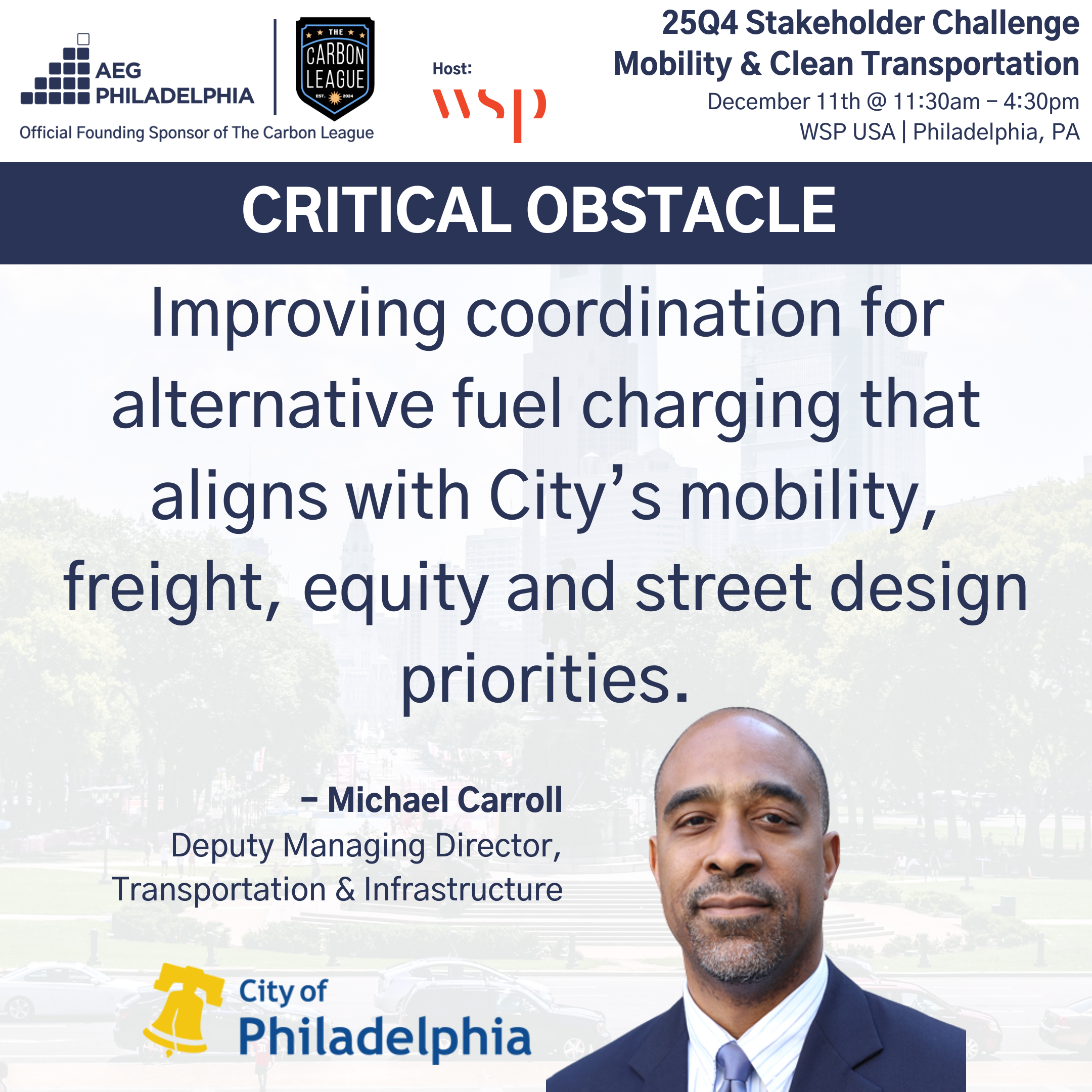
“A critical obstacle to overcome in 12 months is creating a coordinated alternative fuel charging—light-duty, commercial, and future charging/fueling medium- and heavy-duty—with the City’s broader mobility, freight, and street-design priorities.” — Michael Carroll, Deputy Managing Director, Office of Transportation and Infrastructure Systems, City of Philadelphia
2. Align Public Access Charging With a Sustainable Business Model
While the City has articulated a clear vision for equitable public charging, long-term success hinges on pairing that vision with viable ownership, operations, and financing models that can scale without over-reliance on short-term grants.
“The need to align with and support the City’s public access charging plan and identify a sustainability business model to providing this service.” — Tom Bonner, Director of Policy, Advocacy and External Affairs, PECO
3. Prevent EVSE “Walled Gardens” and Enable Local Repair & Management
The risk of closed, proprietary charging systems that limit interoperability, slow repairs, and exclude local workforce participation was highlighted as a critical challenge to overcome. Open standards and repairable infrastructure were seen as essential to reliability and equity.
“Actively preventing EVSE walled gardens in the City and crafting policies to enable local repair and management.” — Akshay Malik, Smart Cities Director, City of Philadelphia
4. Reduce Upfront Cost & Risk Through Electrification-as-a-Service (EaaS) Models
High upfront capital costs, technical complexity, and risk aversion—especially for public agencies and school districts—continue to slow adoption. EaaS models were repeatedly cited as a way to bundle vehicles, charging, operations, and maintenance into predictable, long-term contracts.
“Educating school districts and municipalities on the benefits of the EaaS model and available incentives.” — Claire Alford, Eastern Regional Manager, Market Development, Highland Electric Fleets
5. Use Data, Mapping, and Stakeholder Collaboration to Set Clear Priorities
The need for shared data, story maps, and structured stakeholder engagement to identify priority corridors, equity gaps, and pilot locations—turning vision into near-term action– was expressed among Stakeholders as a critical need.
“Compile a story map that will clearly illustrate the priority needs and challenges on alternative fuel infrastructure in Philadelphia.” — AEG Philadelphia 25Q4 Participant
Inspired by the statement provided by Michael Carroll (City of Philadelphia), participants agreed to prioritize this selected obstacle statement: “Improving coordination for alternative fuel charging that aligns with City’s mobility, freight, equity and street design priorities.” Participants then designed, and pitched a 90-day sprint and 12-month goal to best address this critical obstacle.

8 leaders formed a volunteer Task Force to complete a 90-day sprint.
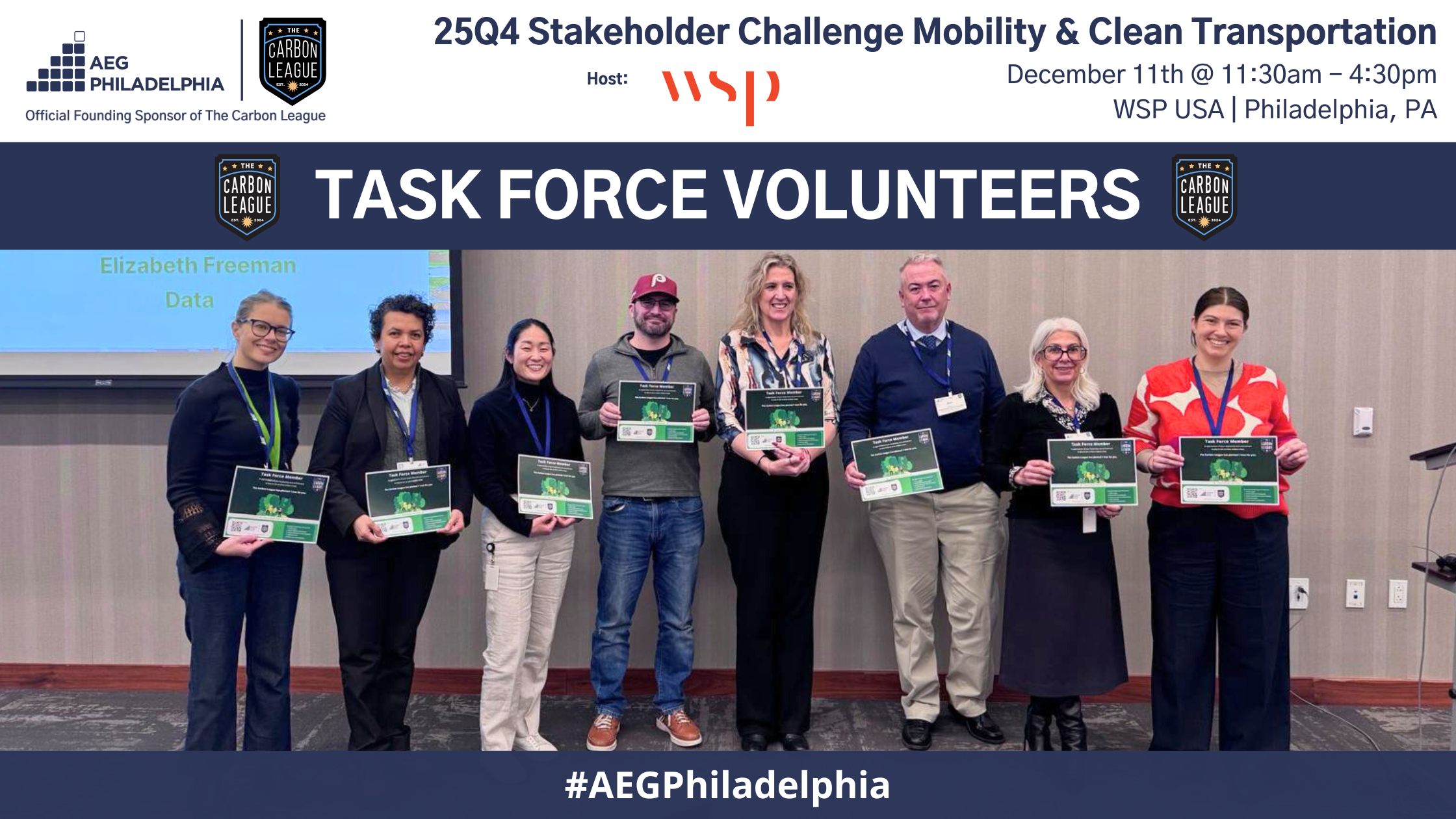
Task Force Volunteers: Christopher Shelley, City of Philadelphia, Anna Kelly, City of Philadelphia, Flora Castillo, COMTO Philadelphia, Sean Greene, Delaware Valley Regional Planning Commission, Elizabeth Freeman, Reap Energy, Anne Tyska, SEPTA, Pamela Conti, WSP, Jen Kim, WSP
To join this group of volunteers, please contact us at info@goadvancedenergy.com.
Conclusion
The AEG Philadelphia 25Q4 Mobility & Clean Transportation Stakeholder Challenge convened City leadership, utilities, fleet operators, technology providers, and community stakeholders to confront the structural barriers slowing equitable clean transportation deployment across Greater Philadelphia. The discussion underscored the urgency of coordinating alternative fuel charging within a constrained urban right-of-way, aligning public access infrastructure with sustainable business models, preventing EVSE walled gardens, and reducing cost and complexity through scalable financing approaches such as Electrification-as-a-Service. Participants also emphasized the foundational role of shared data, mapping, and cross-sector collaboration to translate vision into prioritized, near-term action. As stakeholders advance 90-day sprints focused on data aggregation, stakeholder alignment, and pilot identification—and look toward 12-month outcomes centered on coordinated planning and implementation—this Challenge establishes a clear pathway for Philadelphia to accelerate mobility solutions that advance health, prosperity, and energy equity while positioning the region for long-term clean transportation leadership.
Advanced Energy Group is a sponsor supported organization that facilitates quarterly challenges for high-impact stakeholders to deliver on health, energy and prosperity commitments for U.S. cities and vulnerable regions. To become an AEG Sponsor, learn more here: https://aeg.team/engage
