

Executive Summary: December 4th AEG Chicago Stakeholder Challenge: Mobility & Clean Transportation
Overview
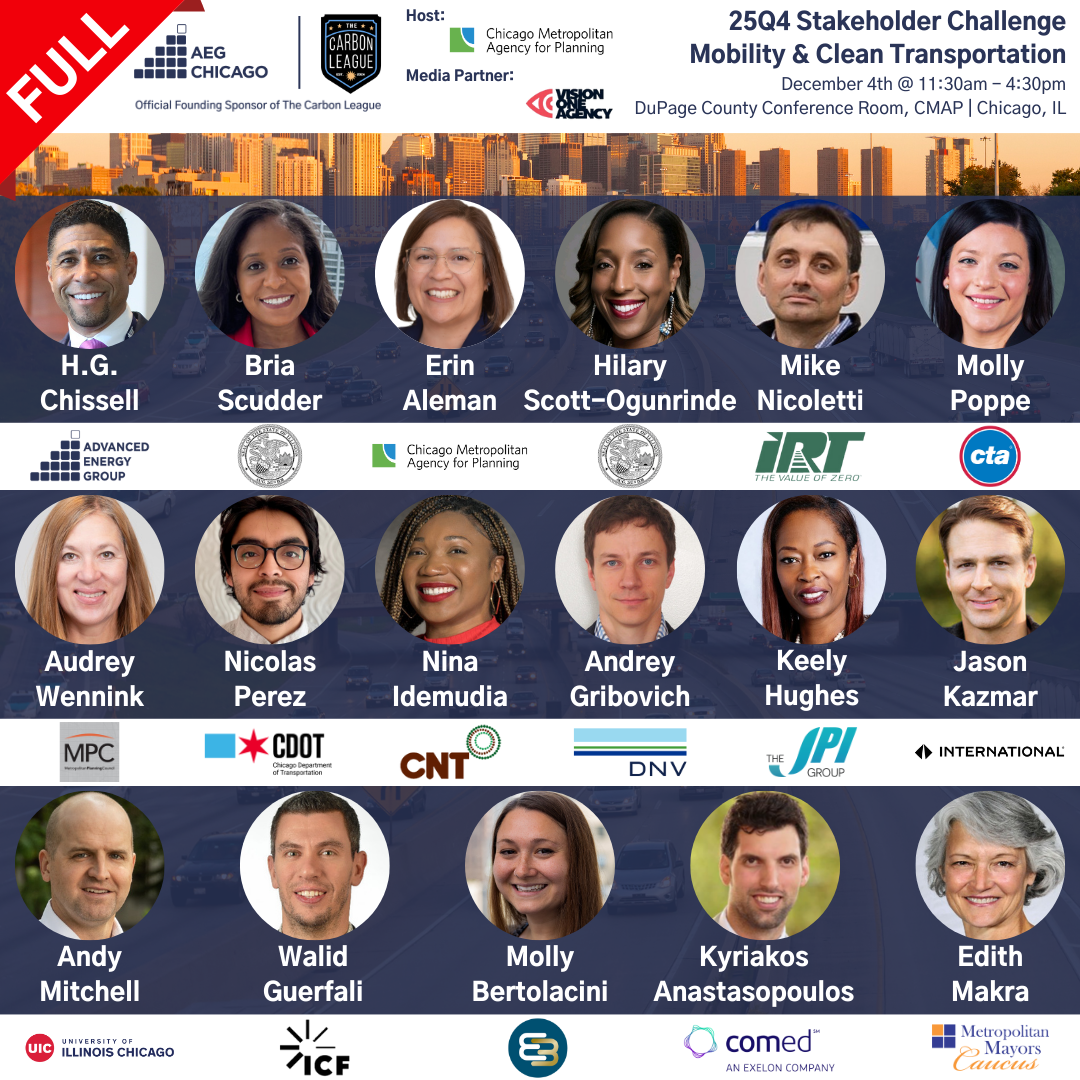
Held on December 4th, 2025 at CMAP in Chicago, fifty-five public and private industry leaders convened for the AEG Chicago 25Q4 Mobility & Clean Transportation Stakeholder Challenge. The purpose of this challenge was to: 1.) Align on a critical obstacle regarding mobility & clean transportation for Chicagoland; 2.) Engage as cross sector teams to agree on a 90 day sprint and 12-month goal; 3.) Empower leaders to deliver the solution and present the outcome in 12 months.
Erin Aleman, Executive Director, Chicago Metropolitan Agency for Planning, Bria Scudder, Deputy Governor for Infrastructure, Public Safety, Energy & Environment, State of Illinois, and Hilary Scott-Ogunrinde, Deputy Director, Energy & Business Utility, Illinois Department of Commerce & Economic Opportunity, provided opening remarks to frame the discussion surrounding mobility and clean transportation for Chicagoland.
Opening remarks were followed by the Speaker Challenge, where each speaker provided a presentation that concluded with this completed statement: "Regarding Mobility & Clean Transportation, to achieve Chicagoland's health, prosperity & energy goals, a critical obstacle to collectively overcome in 12 months is _________."
5 Key Themes
1. Turn Diesel Hotspots into Health Action Zones
Chicago’s freight network is a national asset, but its pollution burden falls hardest on low-income communities on the South and Southwest Sides. The next phase must shift from awareness to targeted deployment of zero-emission trucks, buses, and supporting infrastructure in overburdened corridors like Little Village and Pulaski Road.
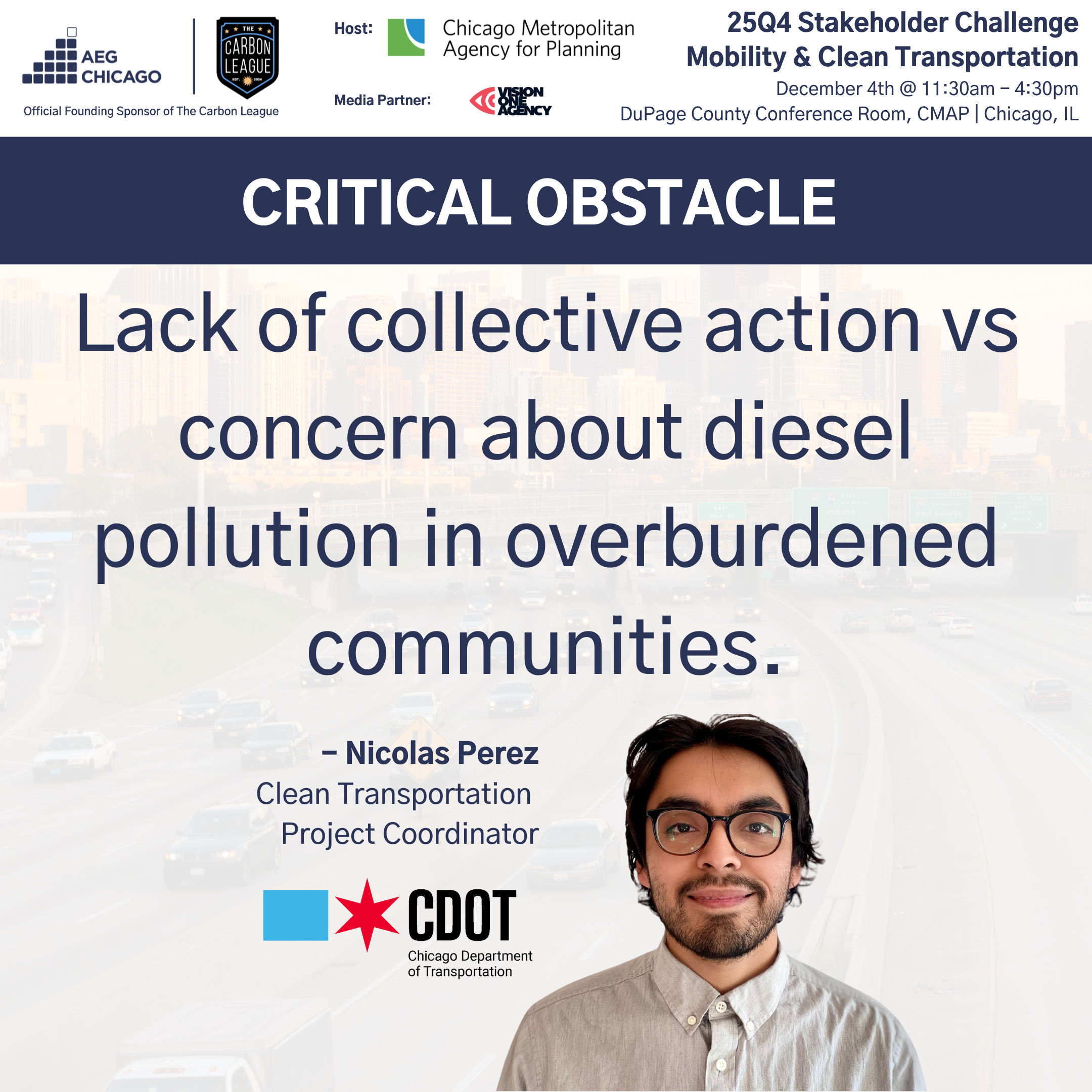
“To achieve Chicagoland’s health, prosperity & energy goals, a critical obstacle to collectively overcome in 12-months is: to move from shared concern about diesel pollution in overburdened communities into meaningful, collective action.” — Nicolas Perez, Chicago Department of Transportation
2. Build a Shared Data Governance Model for Mobility Decisions
Transportation data systems remain fragmented across agencies, advocates, and private stakeholders. Progress requires a co-governance model where communities help shape data standards, validation, and access—so investment, enforcement, and planning reflect lived reality.
“Creating a shared governance model that enables system-level problem-solving—giving communities real authority in the data systems shaping mobility and freight decisions.” — Nina Idemudia, Center for Neighborhood Technology
3. Measure What Actually Harms Health—Not Just CO2
Diesel criteria pollutants (PM2.5 and NOx) drive disproportionate health damage, yet rail and marine assets remain largely invisible in public datasets. Chicago must inventory, locate, and quantify the health impact of locomotives and tugboats to unlock mitigation strategies with the highest return for community health.
“A critical obstacle to overcome is to identify and count, as well as quantify, the impacts of rail and marine assets with emphasis placed upon Criteria Pollution—not CO2 emissions.” — Mike Nicoletti, Innovative Rail Technologies
4. Leverage Transit Reform to Unlock Walkable, Equitable Growth
With the creation of the Northern Illinois Transit Authority (NITA) and $1.2B/year in operations funding, the region has a once-in-a-generation chance to align transit reform with housing, jobs, and commercial density near stations—but cultural resistance in the suburbs must be addressed.
“Legislation passed in October—effective June 1, 2026—creates NITA with the authority to lead all regional transit planning, capital planning, and fare policy.” — Audrey Wennink, Metropolitan Planning Council
5. Coordinate Public Funding Around Community-Led Pilots
Survey results emphasize urgency around pilots, site selection, and funding alignment (e.g., Volkswagen Settlement, CPRG). Chicago’s next 12 months should prioritize small-area demonstration projects that show measurable emissions reductions and health outcomes before scaling citywide.
“12 month goal: realize 5% lower emissions at a designated intersection. 90 day Sprint: choose a location and primary operator and convene a meeting to evaluate solutions.” — AEG Chicago 25Q4 Participant
Inspired by the statement provided by Nicolas Perez (CDOT), participants agreed to prioritize this selected obstacle statement: “Lack of collective action vs concern about diesel pollution in overburdened communities.” Participants then designed, and pitched a 90-day sprint and 12-month goal to best address this critical obstacle.
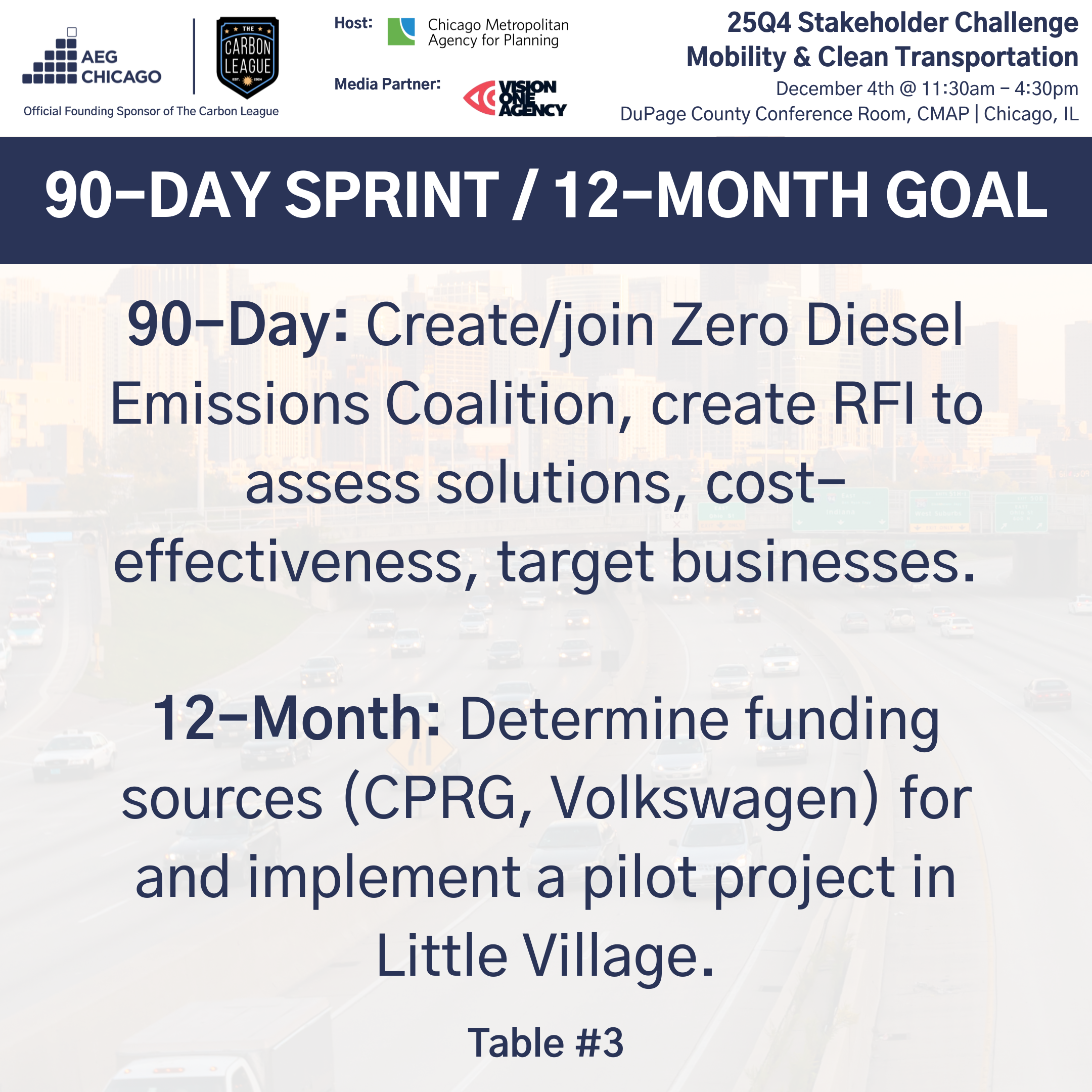
16 leaders formed a volunteer Task Force to complete a 90-day sprint.
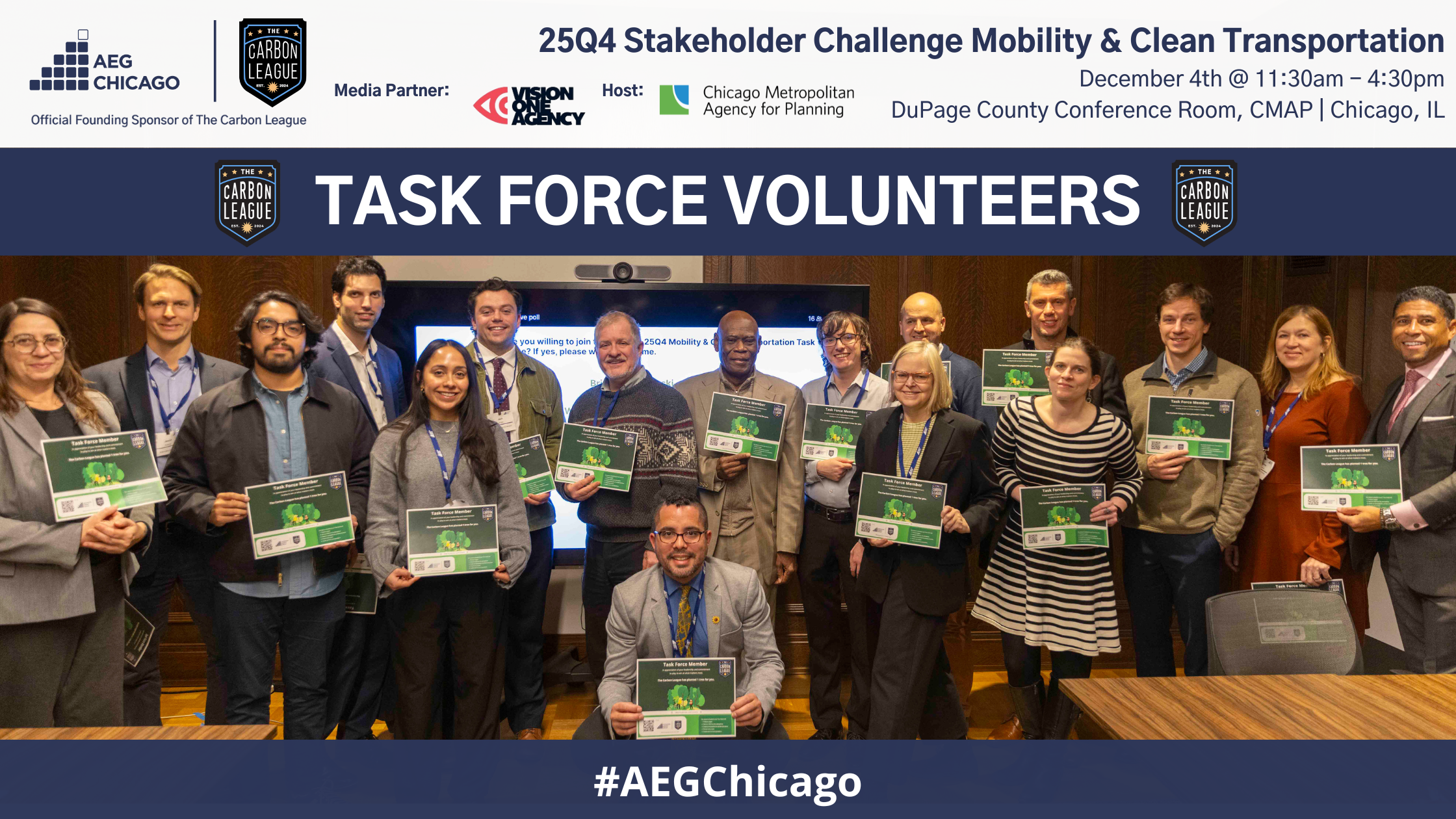
Task Force Volunteers: Andrey Gribovich, DNV, Jason Kazmar, International Motors, Heather Ferguson, WSP USA, Lizette Saenz, WSP USA, Walid Guerfali, ICF, Andy Mitchell, UIC, Kyriakos Anastasopoulos, Pepco, Laura Saltzman, Access Living, Nicolas Perez, Chicago Department of Transportation, Jack Jordan, Climate Action Evanston, Gregory Norris, ISEEJustice40, Brian Urbaszewski, Respiratory Health Association, Audrey Wennink, Metropolitan Planning Council, Sarah Bortt, Michael Thuis, The Carbon League, Zeynep Alptekin, The Carbon League
To join this group of volunteers, please contact us at info@goadvancedenergy.com.
12-Month Task Force Update
The 12-month deliverable of the AEG Chicago 24Q4 Mobility & Clean Transportation Task Force is the launch of the “Clean Bus For All Of Us” initiative—an action-oriented coalition designed to advance equitable bus electrification and mode shift across the city’s highest-impact corridors. Over the past year, the task force convened cross-sector stakeholders from transportation agencies, utilities, community organizations, and the private sector to align on a data-driven deployment strategy and produced a corridor mapping framework integrating transit performance, socioeconomic conditions, health burdens, and environmental indicators. This work culminated in the identification of Garfield, Pulaski, and Western as priority corridors and the convening of transit and business leaders to accelerate implementation readiness. As the initiative transitions into delivery through formal handoff to the CTA, the Task Force’s work now stands as a replicable model for pairing beneficial electrification with mobility equity; proving that cleaner buses can serve not only as climate solutions, but as infrastructure for healthier, more resilient communities across Chicago.
Conclusion
The AEG Chicago 25Q4 Mobility & Clean Transportation Stakeholder Challenge convened city agencies, community leaders, transit planners, infrastructure innovators, and health advocates to confront the most urgent barriers to clean transportation across Chicagoland. Discussions underscored the need to move from concern to action on diesel pollution in overburdened communities, establish a shared governance model for mobility data, and surface the hidden health impacts of rail and marine assets. Key themes included transforming diesel hotspots into community health action zones, aligning public investment with measurable outcomes, and leveraging transit reform to accelerate transit-oriented development despite persistent political headwinds in suburban communities. As volunteer Task Force members advance a 90-day sprint and 12-month roadmap, their work will be critical to proving that cleaner transportation can deliver better health, stronger communities, and a more equitable economic future for Chicagoland.
Advanced Energy Group is a sponsor supported organization that facilitates quarterly challenges for high-impact stakeholders to deliver on health, energy and prosperity commitments for U.S. cities and vulnerable regions. To become an AEG Sponsor, learn more here: https://aeg.team/engage
