Executive Summary: February 12th AEG Mid-Atlantic Stakeholder Challenge: Critical Infrastructure, Resilience & Affordability
Overview
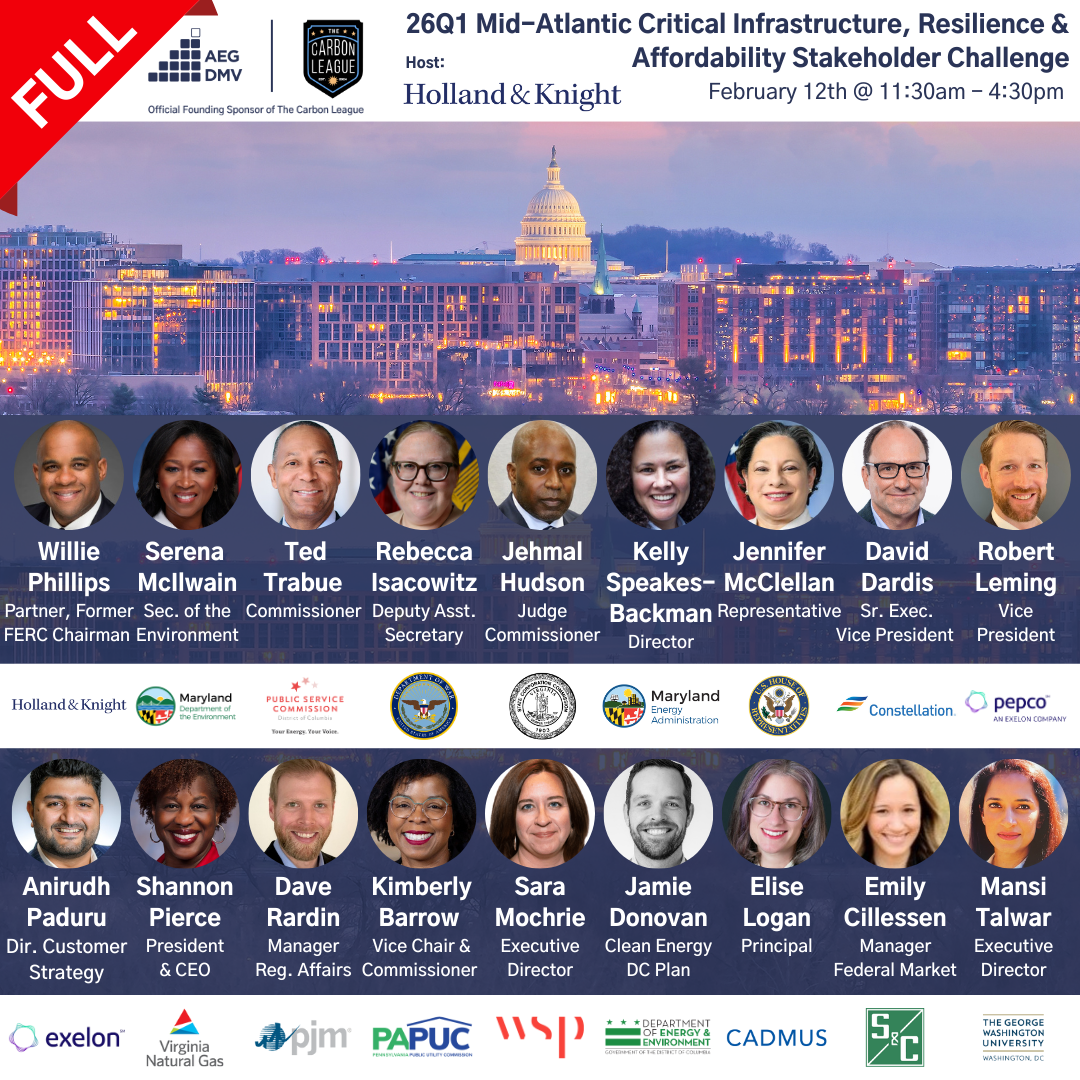
Held on February 12th, 2026 at Holland & Knight in Washington, DC, forty-eight public and private industry leaders convened for the AEG Mid-Atlantic 26Q1 Critical Infrastructure, Resilience & Affordability Stakeholder Challenge. The purpose of this challenge was to: 1.) Align on a critical obstacle regarding Critical Infrastructure, Resilience & Affordability for the Mid-Atlantic; 2.) Engage as cross sector teams to agree on a 90-day sprint and 12-month goal; 3.) Empower leaders to deliver the solution and present the outcome in 12 months.
Taite McDonald, Partner, Holland & Knight provided a welcome for this discussion. Willie Phillips, Former FERC Chairman, Partner, Holland & Knight moderated an Opening Remarks Panel to help frame the discussion surrounding critical infrastructure, resilience & affordability for the Mid-Atlantic. Panelists included Serena Coleman McIlwain, Secretary of the Environment, Maryland Department of the Environment, David Dardis, Senior Executive Vice President and Chief External Affairs & Growth Officer, Constellation Energy, Jehmal Hudson, Judge/Commissioner, Virginia State Corporation Commission.
The Opening Remarks Panel was followed by the Speaker Challenge, where each speaker provided a presentation that concluded with this completed statement: "Regarding Critical Infrastructure, Resilience & Affordability, to achieve DMV's climate, health & energy goals, a critical obstacle to collectively overcome in 12 months is _________."
5 Key Themes
1. Cross-Sector Regional Engagement for Risk Planning
Fragmented planning cycles across state energy offices, utilities, and federal partners often leave the region vulnerable to outages and supply chain disruptions. A primary objective is to move beyond siloed decision-making toward collective engagement in a regional approach to energy-related risk and resilience planning.
"National security risk and resilience considerations are often addressed separately or late in the planning process, leaving the U.S. vulnerable to outages and supply chain disruptions." — Rebecca Isacowitz, Deputy Assistant Secretary of War for Energy Resilience and Optimization, United States Department of War
2. Strategic Permitting for Decentralized Energy
The sudden pullback in certain funding streams has jeopardized billions in clean energy investments, making it critical for states and localities to carry the work forward. Streamlining permitting processes for smaller clean energy generation projects that fall outside federal review is a vital step toward bringing more capacity online and encouraging decentralized adoption.
"In spite of the Administration, how do we continue to adopt clean energy, particularly by improving how states and localities permit smaller projects that don't need federal review." — Jennifer McClellan, Congresswoman, Virginia 4th District, US House of Representatives
3. Balancing Infrastructure Growth with Customer Trust
The defining challenge for utilities is simultaneously keeping lights on, enabling unprecedented load growth through electrification, and maintaining customer affordability. Achieving this requires creating shared visibility into hosting capacity and hosting needs before capital is deployed to ensure affordability is a design parameter from the start.
"Our challenge is not whether to invest. The challenge is how to invest smarter, more transparently, and more collaboratively so affordability and confidence move with us." — Robert Leming, Vice President, Regulatory Policy & Strategy, Pepco Holdings
4. Enhancing Grid Reliability Against Extreme Weather
Recent events, such as Winter Storm Fern, highlighted significant challenges in load forecast accuracy and fuel storage during prolonged freezing temperatures. Preparing for future peaks—such as the expected record-breaking summer 2026 demand—requires increasing reliability without sacrificing climate aspirations or resident affordability.
"How do we increase grid reliability without sacrificing affordability or our climate aspirations?" — Kelly Speakes-Backman, Director, Maryland Energy Administration
5. Strengthening Energy Security Hubs through Collaboration
Stakeholders prioritized operationalizing progress by convening multidisciplinary frameworks to build understanding of major infrastructure projects. By establishing energy security hubs and pilots that support both military readiness and community physical/cyber security, the region can de-risk investments and create replicable demo projects.
"Implement a pilot with a DOW base establishing an energy security hub, improving the resilience of the base in a way that supports community physical/cyber security." — AEG DMV 26Q1 Participants
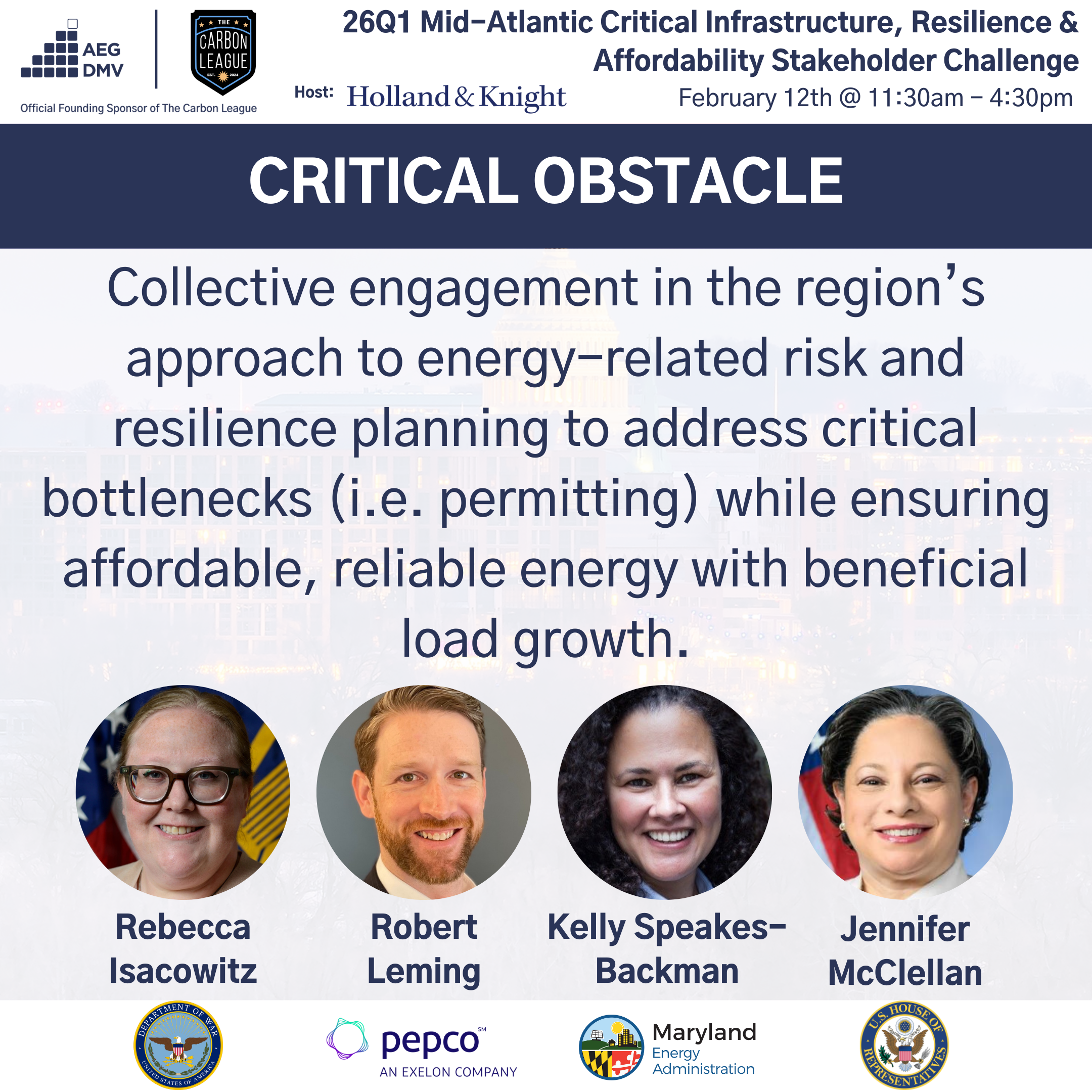
Inspired by the statements provided by Rebecca Isacowitz (United States Department of War), Robert Leming (Pepco Holdings), Kelly Speakes-Backman (Maryland Energy Administration) and Jennifer McClellan (Congresswoman, Virginia 4th District), participants agreed to prioritize this selected obstacle statement: “Collective engagement in the region’s approach to energy-related risk and resilience planning to address critical bottlenecks (i.e. permitting) while ensuring affordable, reliable energy with beneficial load growth.” Participants then designed, and pitched a 90-day sprint and 12-month goal to best address this critical obstacle.
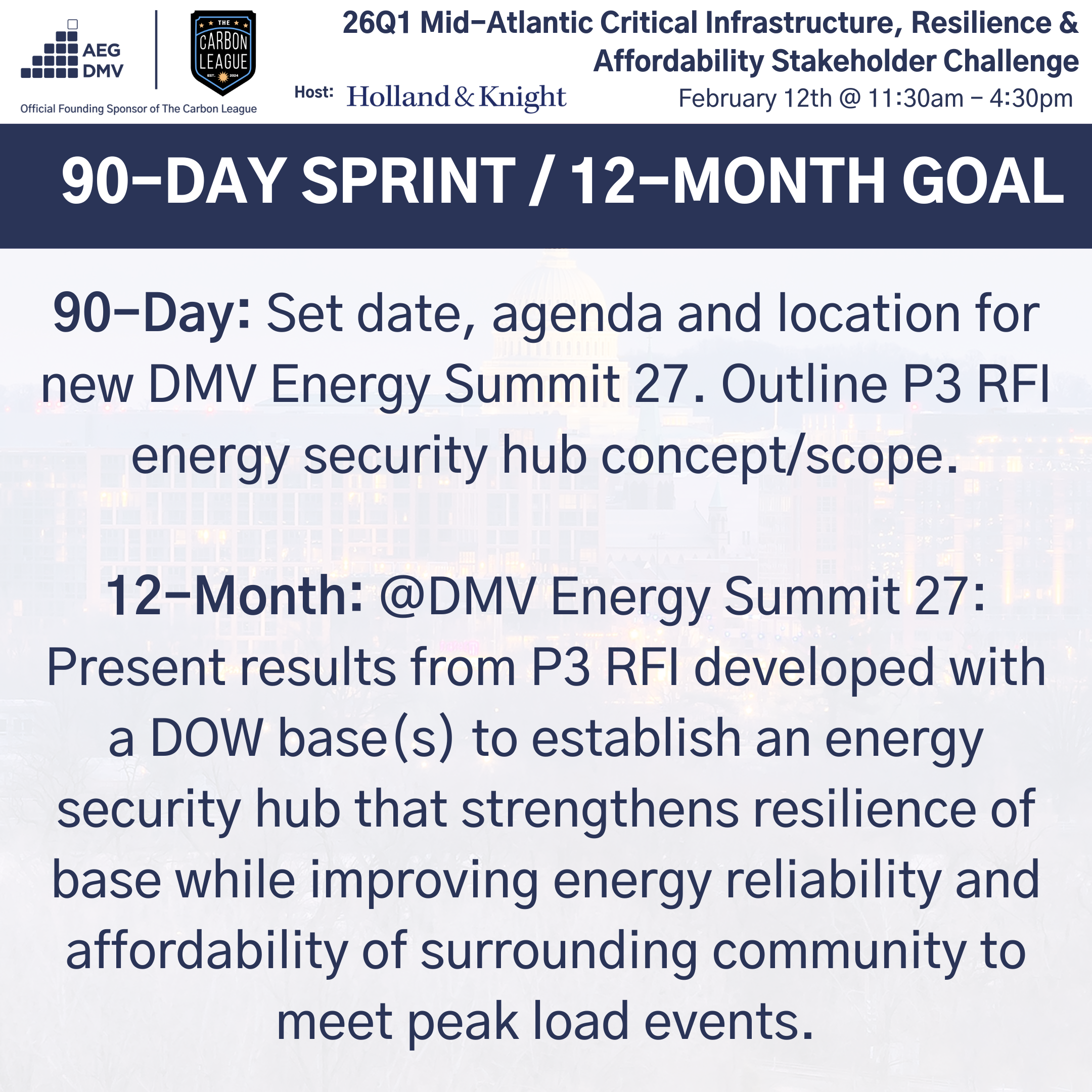
9 leaders formed a volunteer Task Force to complete a 90-day sprint.
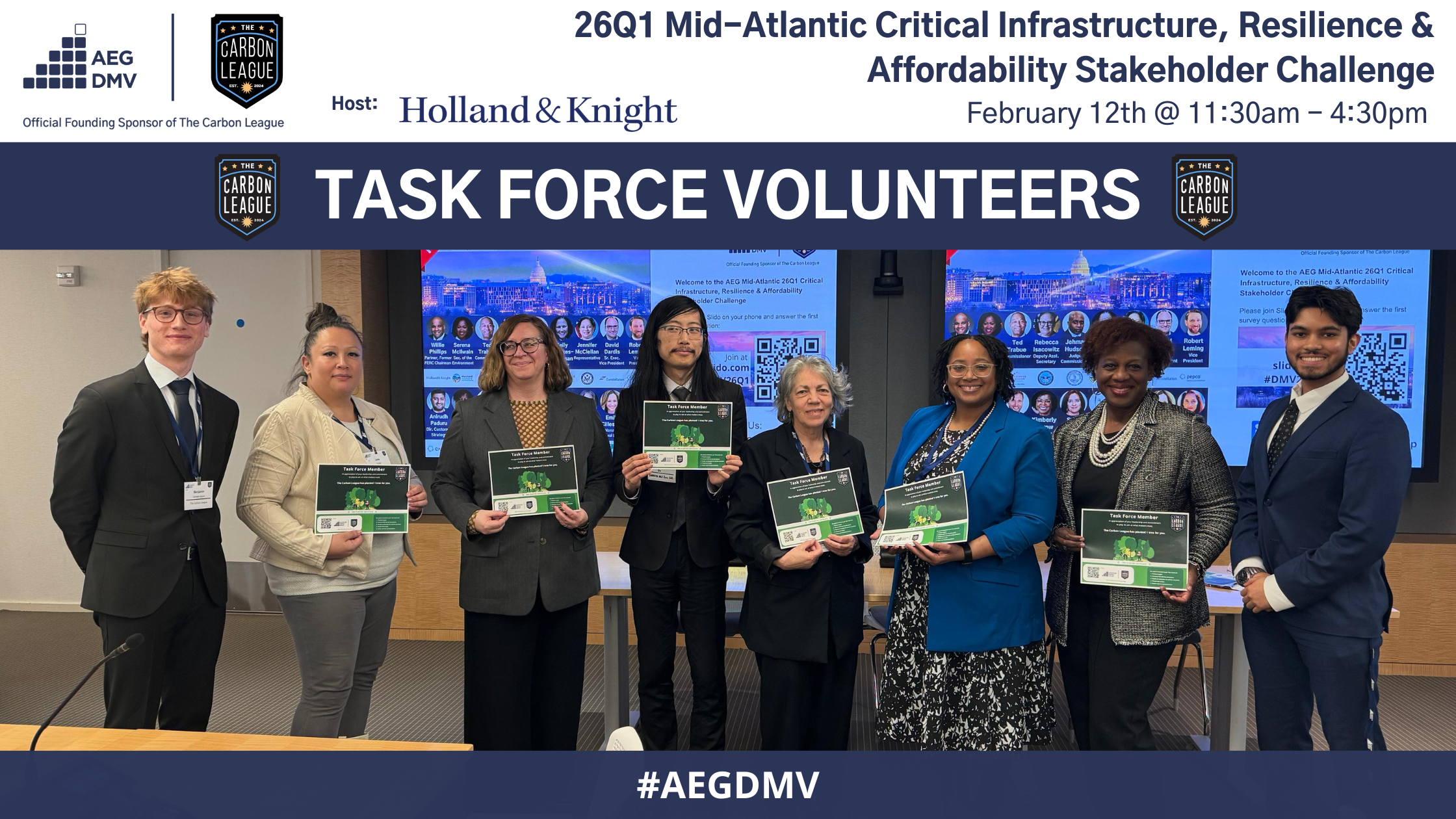
Task Force Volunteers: Sara Mochrie, WSP USA, Mike Doniger, Chaberton Energy, Kerene Tayloe, Green Kerene LLC, Valerie Amor, Office of Climate Action, City of Alexandria, Yangbo Du, PLACE Initiative, Jade Garrett, Positive Deviancy, Shannon Pierce, Virginia Natural Gas, Saiyam Shah, The Carbon League, Benjamin Gorisek-Gazze, The Carbon League
To join this group of volunteers, please contact us at info@goadvancedenergy.com.
Conclusion
The AEG Mid-Atlantic 26Q1 Critical Infrastructure, Resilience & Affordability Stakeholder Challenge convened regional leaders and federal partners to bridge the gap in energy-related risk and resilience planning. The discussion emphasized that true energy security requires cleaner, more affordable, and more reliable systems achieved through collective regional engagement.
Moving forward, stakeholders are advancing a 90-day sprint to establish a proof of concept for cross-sector communication, working towards a 12-month outcome to launch a collaborative energy security hub at a regional military installation. This pilot will integrate base resilience with community-wide physical and cyber protections. This Challenge provides a clear pathway for the DMV to accelerate infrastructure solutions that safeguard national security and public health.
Advanced Energy Group is a sponsor supported organization that facilitates quarterly challenges for high-impact stakeholders to deliver on health, energy and prosperity commitments for U.S. cities and vulnerable regions. To become an AEG Sponsor, learn more here: https://aeg.team/engage