Executive Summary: January 29th AEG New York 26Q1 Critical Infrastructure, Resilience & Affordability Stakeholder Challenge
Overview
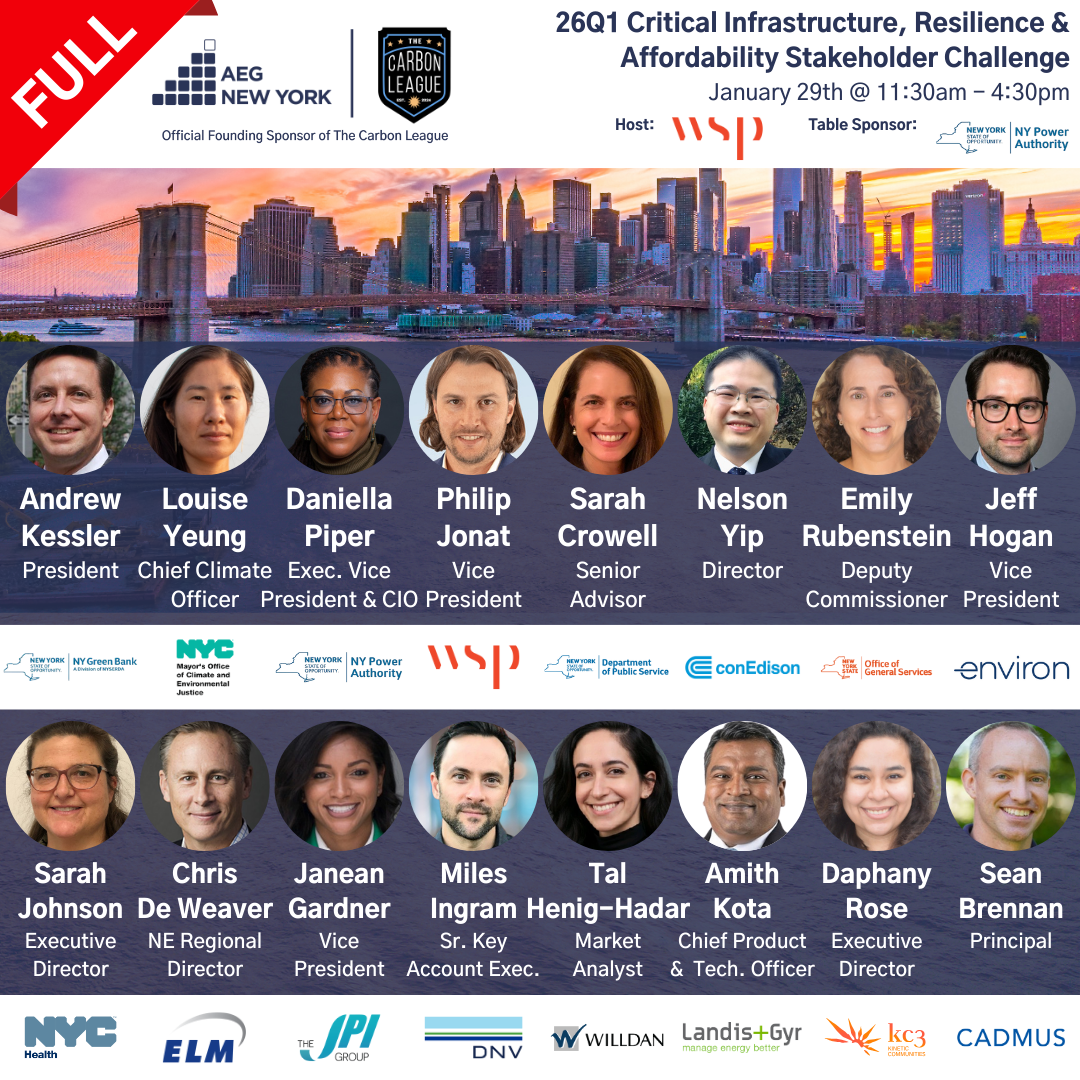
Held on January 29th, 2026 at WSP USA in New York, eighty public and private industry leaders convened for the AEG New York 26Q1 Critical Infrastructure, Resilience & Affordability Stakeholder Challenge. The purpose of this challenge was to: 1.) Align on a critical obstacle regarding Critical Infrastructure, Resilience & Affordability for New York; 2.) Engage as cross sector teams to agree on a 90-day sprint and 12-month goal; 3.) Empower leaders to deliver the solution and present the outcome in 12 months.
Andrew Kessler, President, NY Green Bank, Louise Yeung, Chief Climate Officer, NYC Mayor's Office of Climate and Environmental Justice, and Philip Jonat, Vice President, WSP USA, provided opening remarks to frame the discussion surrounding critical infrastructure, resilience & affordability for New York.
Opening remarks were followed by the Speaker Challenge, where each speaker provided a presentation that concluded with this completed statement: "Regarding Critical Infrastructure, Resilience & Affordability, to achieve New York's climate, health & energy goals, a critical obstacle to collectively overcome in 12 months is _________."
5 Key Themes
1. Cross-Sector Coordination and Asset Alignment
Fragmentation among infrastructure owners remains a primary barrier, requiring a consistent forum to align on a shared baseline of data, climate-risk frameworks, and actionable policies. Success depends on identifying opportunities for cross-collaboration between public and private entities to deliver reliable services.
"Our challenge is better and faster coordination with other asset and infrastructure owners so we can strengthen public and private infrastructure... and advance the State’s decarbonization goals." — Nelson Yip, Director of Strategic Planning, Con Edison
2. Community Trust and Narrative Shift
Local opposition to large-scale renewable projects and battery energy storage systems (BESS) creates avoidable delays and costs ultimately borne by ratepayers. Establishing a "positive narrative" and building deep-rooted community trust are essential to accelerating project deployment.
"Lack of community trust in, and support of, renewable energy and battery storage projects." — Sarah Crowell, Senior Advisor for Policy and Communications, NYS DPS Office of Renewable Energy Siting and Electric Transmission
3. Nuclear Literacy and Regulatory Certainty
Expanding the role of advanced nuclear energy is a critical pathway for meeting surging electricity demand affordably. This requires closing knowledge gaps regarding the technology’s safety features while resolving the regulatory uncertainty that currently hinders scaling development in New York State.
“Lack of knowledge of advanced nuclear, its economic development benefits, safety features, and regulatory uncertainty for scaling advanced nuclear development in NYS." — Daniella Piper, EVP, Chief Innovation Officer, New York Power Authority
4. Proactive Resilience Integration
Resilience must move beyond emergency response toward the proactive integration of climate-risk into long-range business planning. This includes adopting shared datasets and agreed-upon risk-tolerance levels to guide infrastructure investments against intensifying extreme weather events.
"Projections indicate an increase in frequency and intensity of certain extreme weather events... we can provide insights and perspectives based on our experiences." — Nelson Yip, Director of Strategic Planning, Con Edison
5. Community Well-being and Action-Oriented Pilots
Addressing energy burdens and tenant protections requires operationalizing progress through multidisciplinary pilot frameworks and "catalytic" 90-day actions. Utilizing "trusted messengers" and streamlining municipal RFP processes are key to delivering immediate, tangible benefits to local residents.
"Our first 90-Day Sprint to address the selected critical obstacle is to identify and convene key infrastructure and asset owners to define shared challenges to building trust in and benefiting communities." — AEG NY 26Q1 Participants
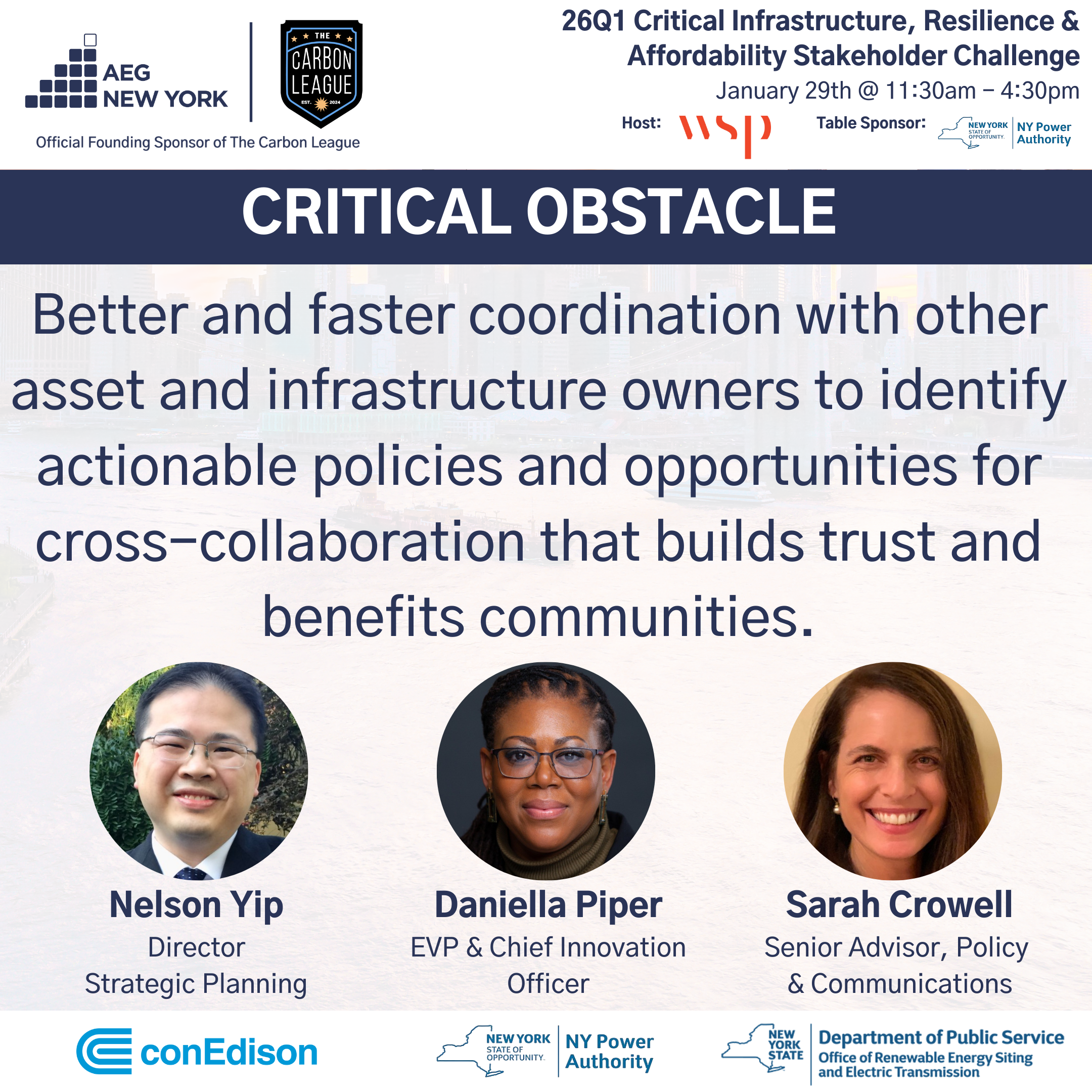
Inspired by the statements provided by Nelson Yip (Con Edison), Daniella Piper (NYPA) and Sarah Crowell (NYS DPS), participants agreed to prioritize this selected obstacle statement: “Better and faster coordination with other asset and infrastructure owners to identify actionable policies and opportunities for cross-collaboration that builds trust and benefits communities.” Participants then designed, and pitched a 90-day sprint and 12-month goal to best address this critical obstacle.
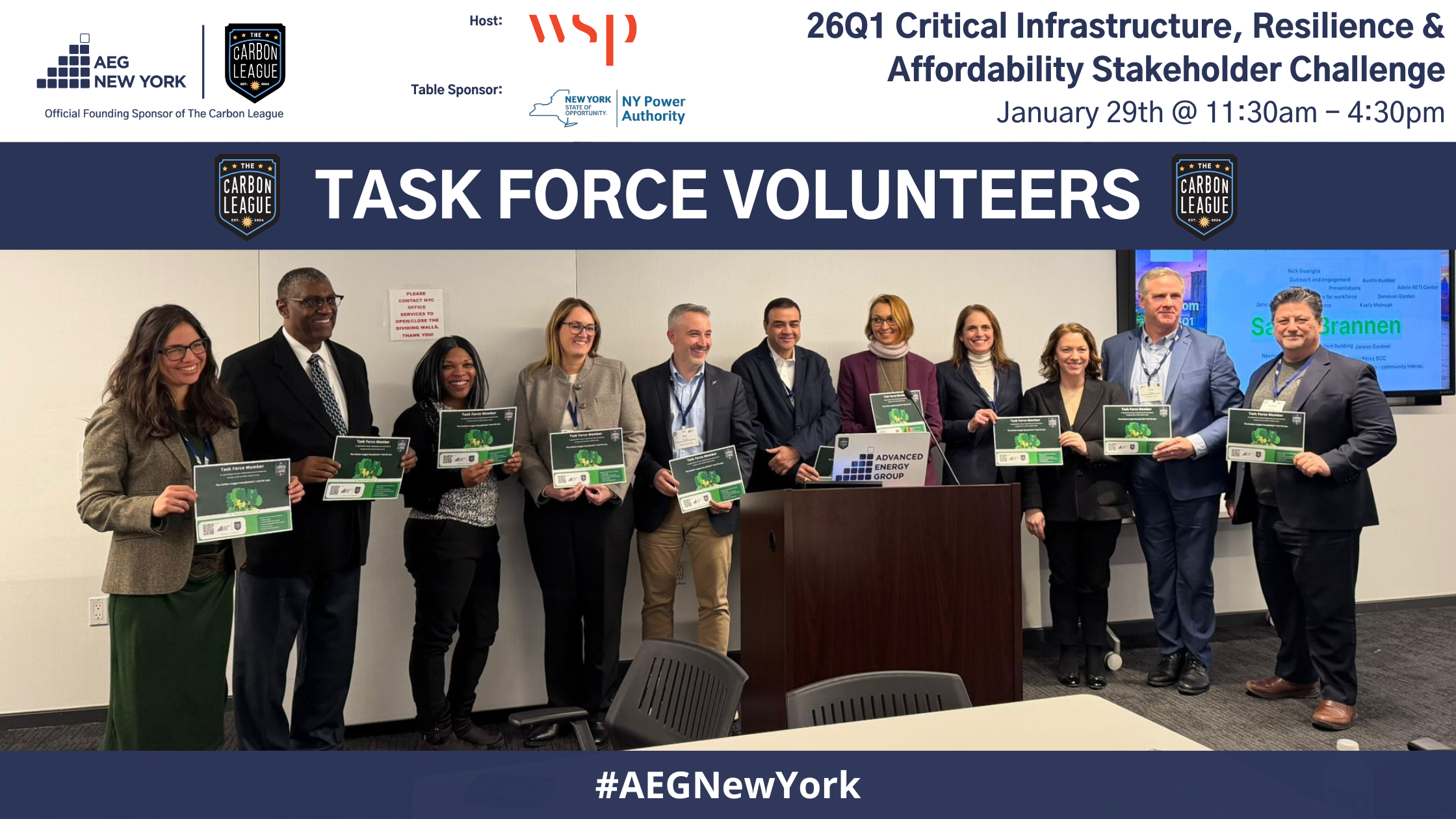
14 leaders formed a volunteer Task Force to complete a 90-day sprint and 12-month objective.
Task Force Volunteers: Nick Guariglia, New York Offshore Wind Alliance, Anya Eydman, Arya Energy, Elena Perez, Bronx Community College, Beny Poy, Con Edison, Salvatore Prestano, CSA Group, Donovan Gordon, DHG Consulting, LLC, Sarah Brannen, NYPA, Phillip Ellison, NYPA, Kaela Mainsah, NYPA, Sarah Crowell, NYS Department of Public Service, Office of Renewable Energy Siting and Electric Transmission, Adelle Anderson, RETI Center, Austin Kuebler, Schneider Electric, Janean Gardner, The JPI Group, Navneet Trivedi, Vrinda
To join this group of volunteers, please contact us at info@goadvancedenergy.com.
Conclusion
The AEG New York 26Q1 Critical Infrastructure, Resilience & Affordability Stakeholder Challenge convened State and City leadership, utilities, asset owners, and community advocates to confront the structural barriers slowing the deployment of a resilient energy system. The focus centered on proactive resilience integration into long-range planning and securing community well-being through action-oriented pilots and 90-day collaborative sprints. As stakeholders advance these sprints—focused on launching social media campaigns with trusted messengers, convening BESS safety experts, and identifying shared infrastructure challenges —this Challenge establishes a clear pathway for New York to accelerate infrastructure solutions that advance health, prosperity, and community resilience while positioning the region for long-term climate leadership.
Access to private resource pages, which include speaker presentations, and survey responses, from AEG Stakeholder Challenges is reserved for Signature Sponsors and City/Government Partners. To become a Signature Sponsor, learn more here: https://aeg.team/engage