Executive Summary: May 14th AEG Chicago Stakeholder Challenge: Campus & Building Decarbonization
Overview
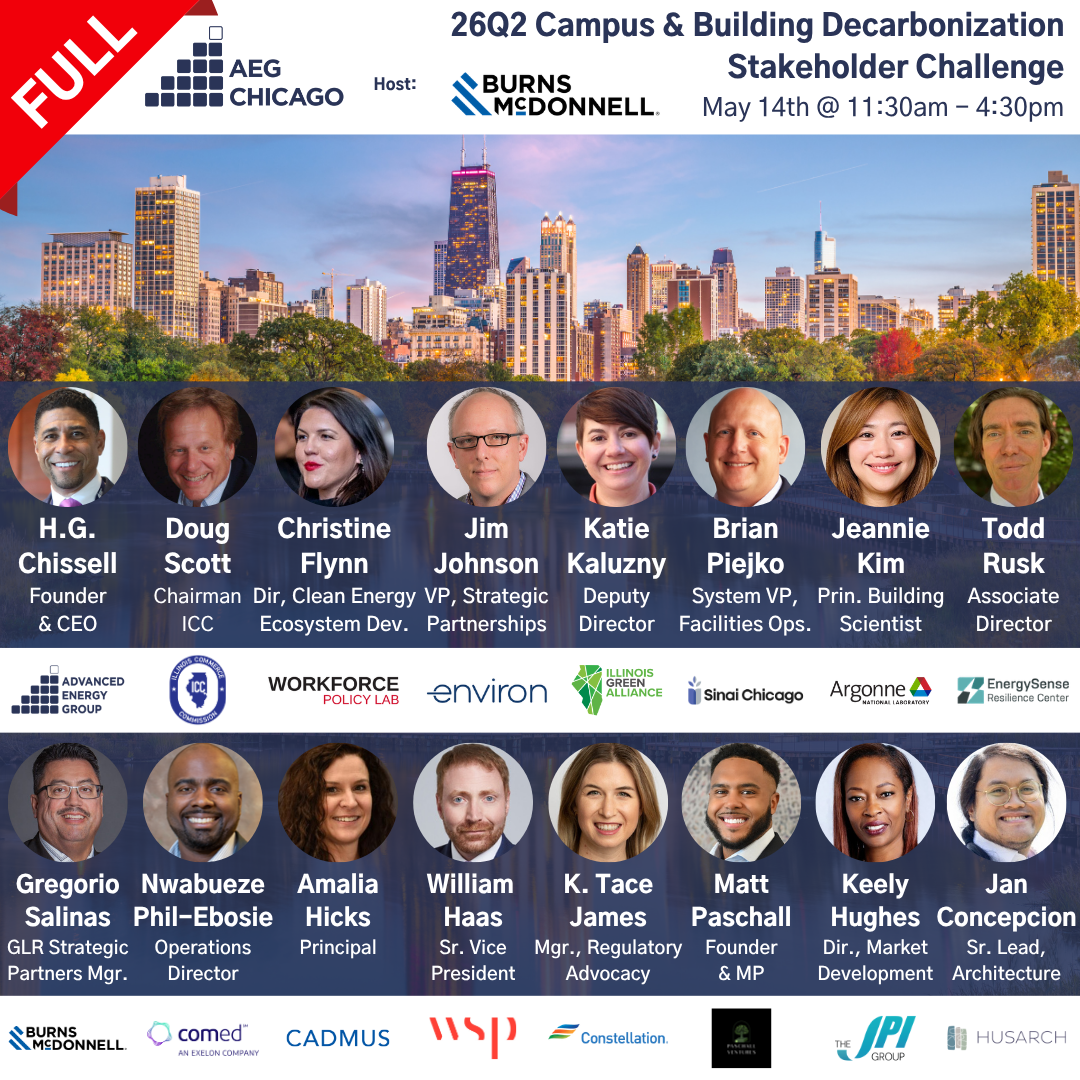
Held on May 14th, 2026 at Burns & McDonnell in Chicago, forty-eight public and private industry leaders convened for the AEG Chicago 26Q2 Campus & Building Decarbonization Stakeholder Challenge. The purpose of this challenge was to: 1.) Align on a critical obstacle regarding Campus & Building Decarbonization for Chicagoland; 2.) Engage as cross sector teams to agree on a 90-day sprint and 12-month goal; 3.) Empower leaders to deliver the solution and present the outcome in 12 months with 90 day sprints.
HG Chissell, Founder & CEO, Advanced Energy Group, Doug Scott, Chairman, Illinois Commerce Commission, and Timothy Faber, Vice President and Great Lakes Region GM provided opening remarks to frame the discussion surrounding campus & building decarbonization for Chicagoland.
Opening remarks were followed by the Speaker Challenge, where each speaker provided a presentation that concluded with this completed statement: "Regarding Campus & Building Decarbonization, to achieve Chicagoland's health, prosperity & energy goals, a critical obstacle to collectively overcome in 12 months is _________."
5 Key Themes
1. Accessible Financing for Safety-Net Infrastructure
Safety-net healthcare facilities operate on razor-thin margins due to a heavy reliance on Medicaid and Medicare reimbursements, leaving no internal capital available for clean energy retrofits. Providing accessible, no-capital financing options allows these critical institutions to achieve deep utility savings and redirect vital funds directly back into uncompensated community care.
"A critical obstacle to collectively overcome in 12 months is creating accessible, no-capital-required financing pathways for safety-net hospitals like Sinai Chicago so that the institutions serving our most vulnerable communities—where pollution is highest and health disparities are deepest—can lead the clean energy transition, not be left behind." - Brian Piejko, System Vice President, Facilities Operations, Design and Construction, and Real Estate, Sinai Chicago & Jim Johnson, Vice President, Strategic Partnerships, Environ Energy
2. Workforce Pipeline Development and Contractor Upskilling
Achieving state goals requires a massive acceleration in building retrofits, yet the current regional ecosystem suffers from a critical shortage of qualified workers and contractors equipped with advanced decarbonization skills. Establishing a comprehensive workforce pipeline is necessary to meet both immediate deployment demands and long-term electrification targets.
"Illinois needs to quintuple its annual rate of building decarbonization by 2035, translating to decarbonizing 440 million square feet annually"- Christine Flynn, Director of Clean Energy Ecosystem Development, Workforce Policy Lab
3. Early-Stage Capital Project Intervention
Budget constraints do not stop the continuous cycle of building maintenance and emergency machinery replacements when facility equipment fails. Intervening early during the pre-design phase ensures sustainability practices are integrated directly into routine replacement schedules, preventing projects from defaulting to status-quo fossil-fuel systems.
"Regarding Campus & Building Decarbonization to achieve Chicagoland's health & energy and prosperity goals, a critical obstacle to collectively overcome in 12 months is to intervene in capital projects and equipment replacements, inserting decarbonization practices."- Todd Rusk, Associate Director, EnergySense Resilience Center
4. Usable Building Data Infrastructure for Advanced Analytics
Scaling AI-enabled building optimization models requires a fundamental shift away from simply collecting "more data" toward generating usable, connected, standardized, and privacy-safe data infrastructure. Resolving information fragmentation is a critical first step to enabling smarter retrofit prioritization across the region.
"AI does not only need 'more data.' It needs usable, connected, validated, and privacy-safe data." - Jeannie (Ji-Hyun) Kim, Principal Building Scientist, Argonne National Laboratory
5. Financial Stack and Resource Assessment Co-location
Institutions need dedicated technical assistance to assess their long-term capital plans against the complex web of available federal tax credits, state bank funding, and utility incentives. Co-locating resource identification with direct capital plans ensures that proposed clean energy modernizations secure full upfront funding.
"Assess Sinai capital plans and identify financing, grants, incentives, and technical assistance for energy projects." - AEG Chicago 26Q2 Stakeholder Challenge Participant
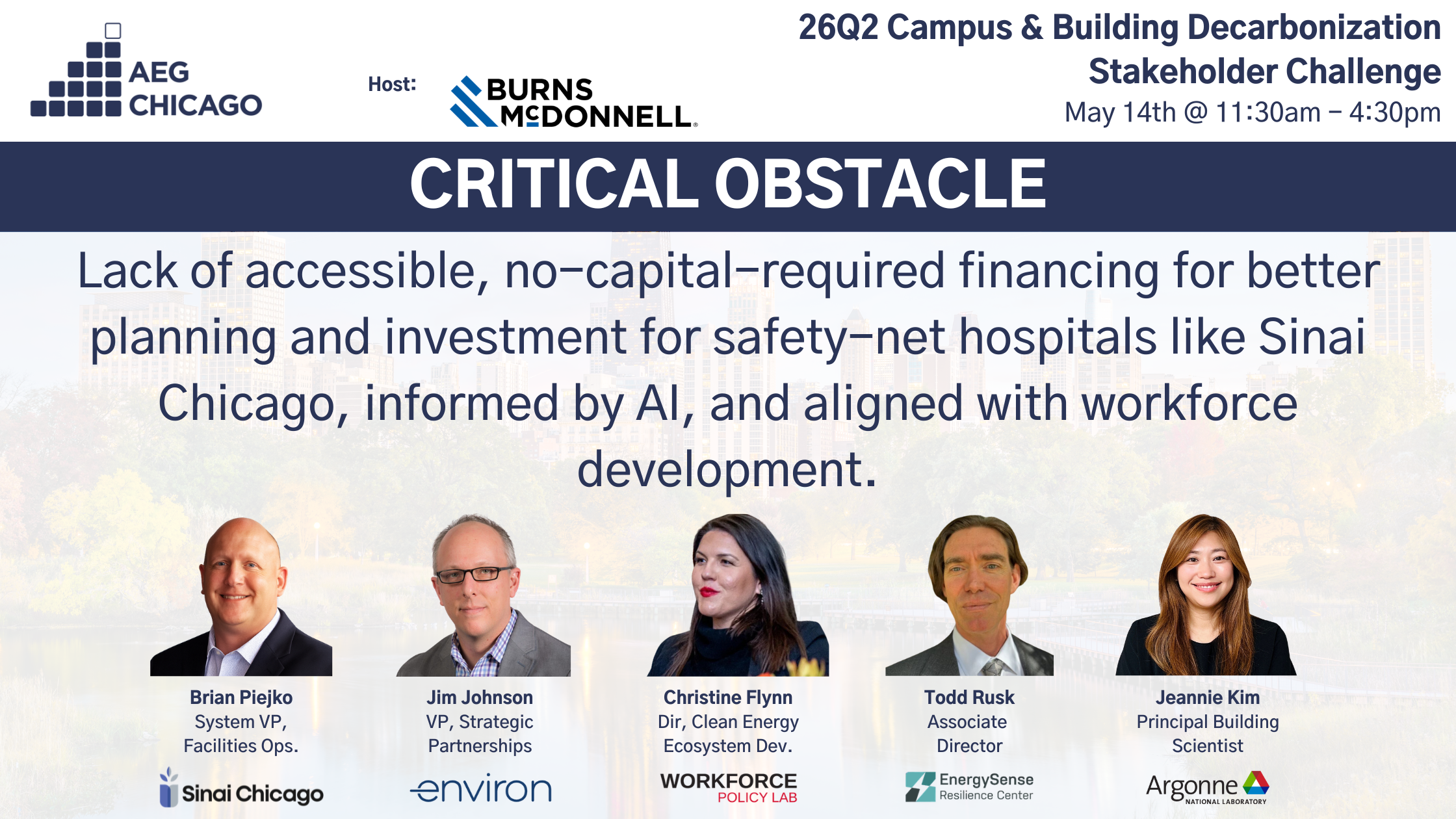
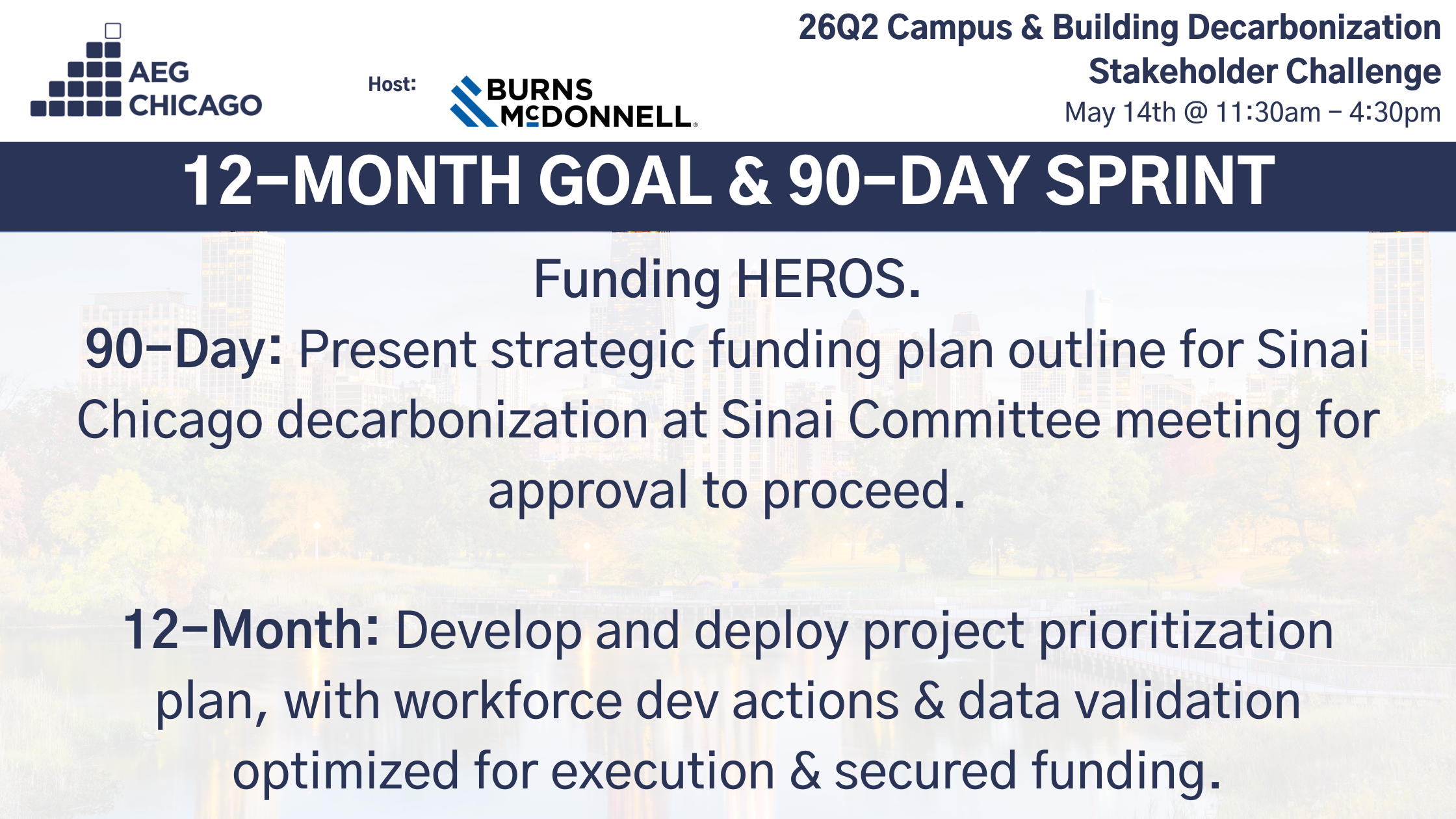
Inspired by the statements provided by all speakers, Brian Piejko (Sinai Chicago), Jim Johnson (Environ Energy), Christine Flynn (Workforce Policy Lab), Todd Rusk (EnergySense Resilience Center), and Jeannie Kim (Argonne National Lab), participants agreed to prioritize this selected obstacle statement: “Lack of accessible, no-capital-required financing for better planning and investment for safety-net hospitals like Sinai Chicago, informed by AI, and aligned with workforce development.” Participants then designed, and pitched a 90-day sprint and 12-month goal to best address this critical obstacle.
17 leaders formed a volunteer Task Force to complete a 90-day sprint.
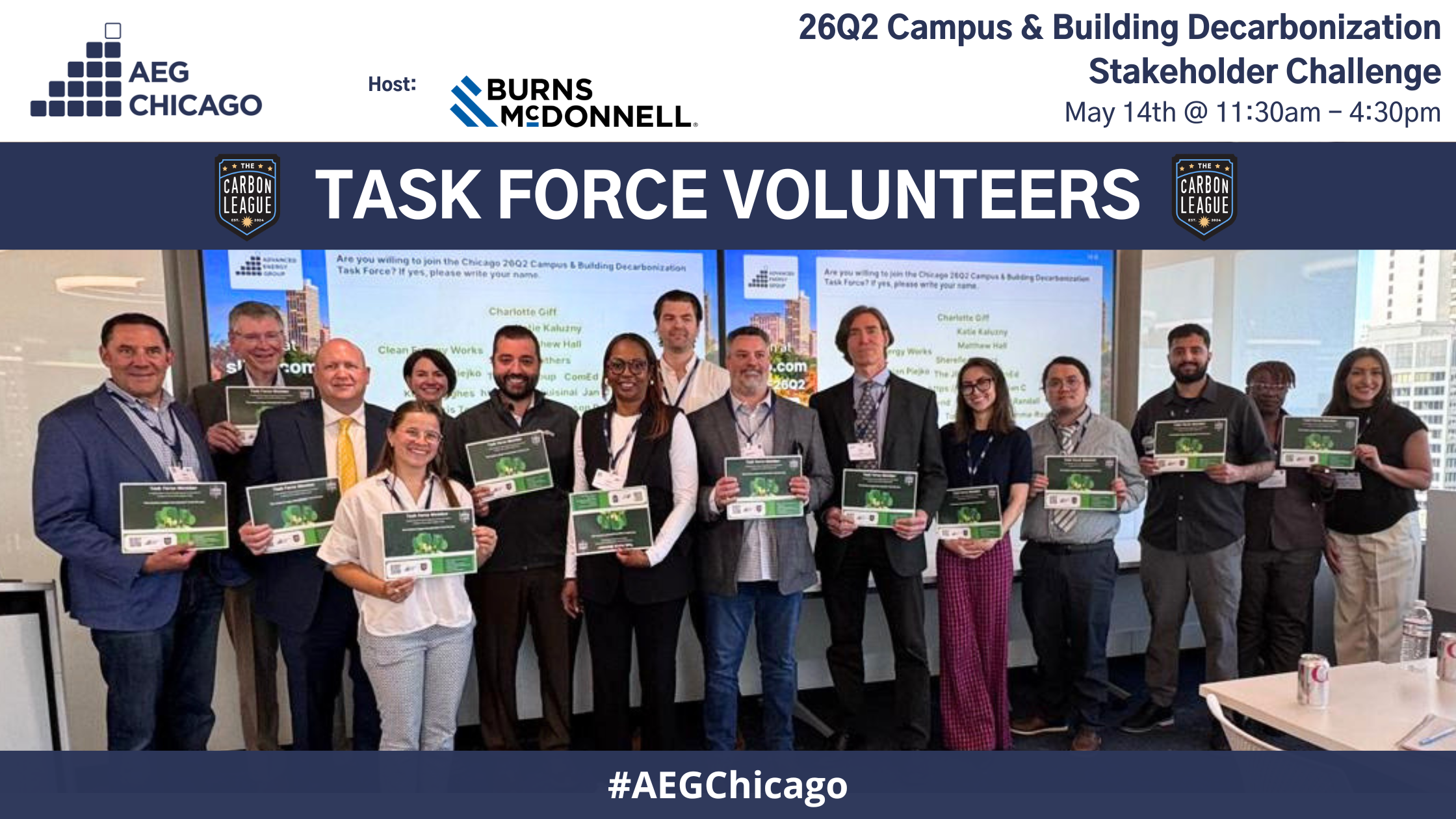
Task Force Volunteers: Ahmad Shams, CenTrio Energy, John Holton, Chicago Cook Workforce Partnership, Chris Townsend, CJT Energy Law, LLC, Charlotte Giff, Climate Reality Chicago & MESA Institute, Jason Randall, ELM, Todd Rusk, EnergySense, University of Illinois, Alek Jaunzemis, Hispanic American Construction Industry Association, Jan Concepcion, HUSarchitecture Inc., Katie Kaluzny, Illinois Green Alliance, Sherelle Withers, Innovation Metropolis SMART Tech District, Matthew Hall, Johnson Controls, Brian Piejko, Sinai Chicago, Keely Hughes, The JPI Group, Tim Condon, Verde Advisory, Nadiruddin Khan, Quinn Ruiz, University of Illinois Chicago, Emma-Rose Newmeyer, The Carbon League
To join this group of volunteers, please contact us at info@goadvancedenergy.com.
Conclusion
The AEG Chicago 26Q2 Campus & Building Decarbonization Stakeholder Challenge convened safety-net healthcare executives, clean energy workforce advocates, and building scientists to confront the structural barriers slowing the modernization of critical community infrastructure. The focus centered on establishing accessible, no-capital financing pathways for safety-net hospitals and embedding carbon-reduction practices directly into early-stage capital asset replacement cycles. Stakeholders will advance 90-day sprints, focused on assessing healthcare facility capital plans to systematically isolate available financing, utility incentives, and technical assistance, and work toward 12-month outcomes centered on securing project funding and launching workforce-linked energy efficiency and decarbonization initiatives. This Challenge establishes a clear pathway for Chicagoland to accelerate building solutions that advance health equity, operational cost savings, and community resilience in neighborhoods facing disproportionate pollution burdens.
Access to private resource pages, which include speaker presentations, and survey responses, from AEG Stakeholder Challenges is reserved for Signature Sponsors and City/Government Partners. To become a Signature Sponsor, learn more here: https://aeg.team/engage
Advanced Energy Group is a sponsor supported organization that facilitates quarterly challenges for high-impact stakeholders to deliver on health, energy and prosperity commitments for U.S. cities and vulnerable regions.