Overview
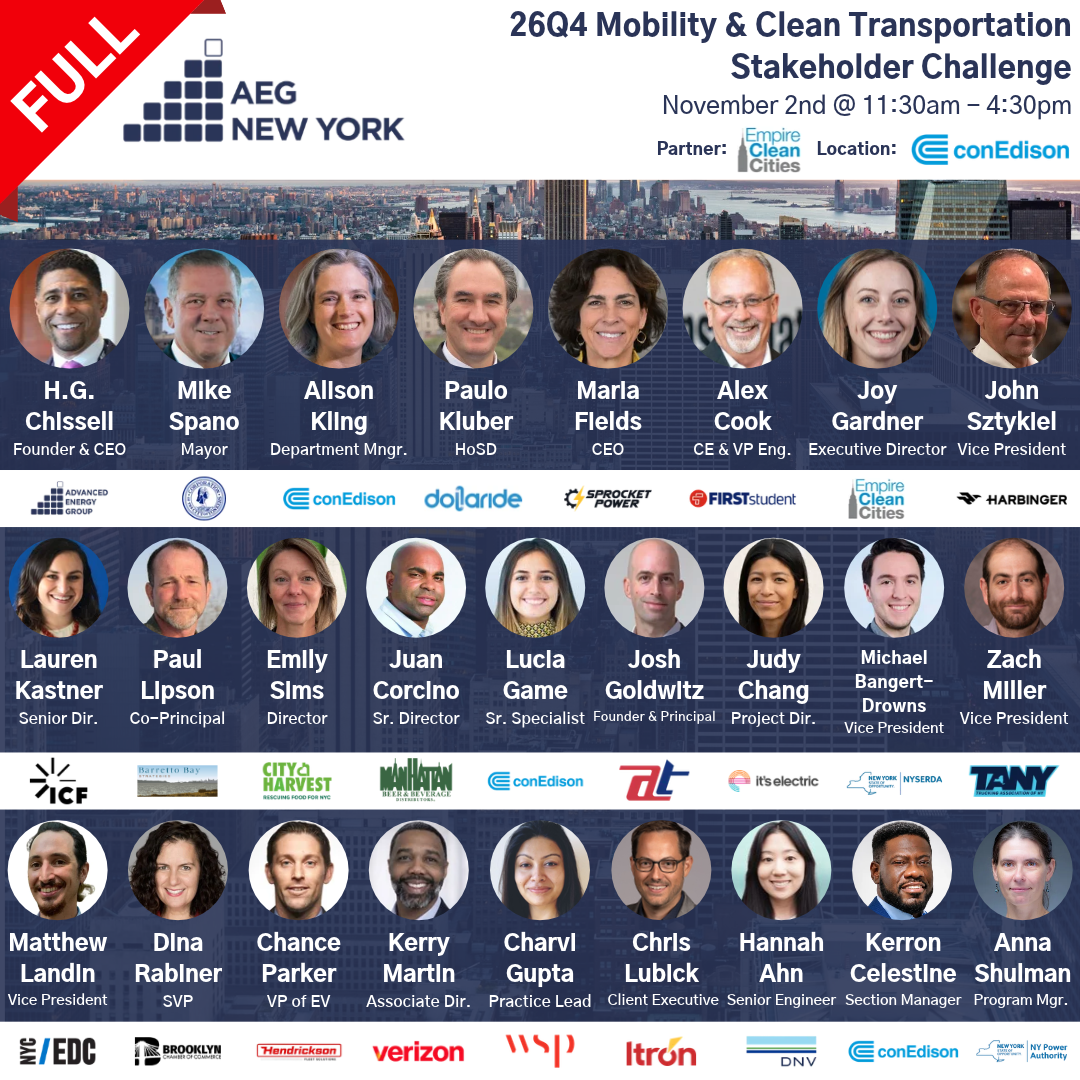
Held on November 2nd, 2026 at ConEdison in New York City, ninety public and private industry leaders convened for the New York 26Q4 Mobility & Clean Transportation Stakeholder Challenge. The purpose of this challenge was to: 1.) Align on a critical obstacle regarding Mobility & Clean Transportation for New York City; 2.) Engage as cross sector teams to agree on a 90-day sprint and 12-month goal; 3.) Empower leaders to deliver a solution and present their ideal outcome in 12 months with 90 day sprints.
Alison Kling, Department Manager E-mobility Infrastructure at Con Edison, Ari Kahn, Chief Transportation and Grid Modernization at NYS DPS, and Mike Spano, Mayor of the City of Yonkers, opened the conversation, providing diverse perspectives to frame the discussion.
Following the opening remarks, participants moved into the Project in Motion: COFE Panel, where industry leaders explored key challenges and opportunities surrounding clean transportation and mobility in New York. The discussion brought together diverse perspectives to identify practical solutions, encourage cross-sector collaboration, and advance actionable strategies toward the region’s clean transportation goals.
Project in Motion: COFE Panel Highlight
The event opened its technical proceedings with an interactive panel titled "Project in Motion: COFE" (Cost Optimization for Fleet Electrification). Moderated across key implementation disciplines, this panel brought together leading practitioners to examine live, on-the-ground deployments designed to overcome real-world energization barriers:
Con Edison (Lucia Game, Senior Specialist): Outlined utility-side innovation, grid-interconnection strategies, and managed charging programs aimed at mitigating load spikes and reducing make-ready timelines.
First Student (Alex Cook, Chief Engineer & VP of Engineering): Shared operational insights from large-scale electric school bus deployments, focusing on depot charging reliability, proprietary no-trenching above-ground EVSE architectures (FlexCharge), and onsite solar-plus-storage microgrids.
it’s electric (Judy Chang, Project Director): Discussed modular, curbside, and neighborhood-integrated charging models that bypass traditional grid-trenching bottlenecks in dense urban rights-of-way.
Sprocket Power (Maria Fields, CEO & Co-Founder): Examined structured financing, behind-the-meter distributed energy resources (DERs), and microgrid economics necessary to make fleet electrification financeable.
The panel demonstrated that viable, field-tested pathways already exist to overcome the financial and operational obstacles confronting New York’s clean mobility transition. By uniting the utility, major fleet operators, infrastructure providers, and distributed energy innovators on a single stage, the discussion proved that mitigating energization delays and shielding fleets from demand charge spikes requires coordinated, behind-the-meter solutions.
The Panel was followed by the Speaker Challenge, where each speaker provided a presentation that concluded with this completed statement: "Regarding Fleet Electrification, a critical obstacle to collectively overcome in 12 months is _________."
5 Key Themes
1. Urban Real Estate and Depot Infrastructure Constraints
Finding suitable real estate with long-term lease viability, physical space for medium- and heavy-duty turning and bays, and sufficient electrical capacity are primary roadblocks to developing freight hubs.
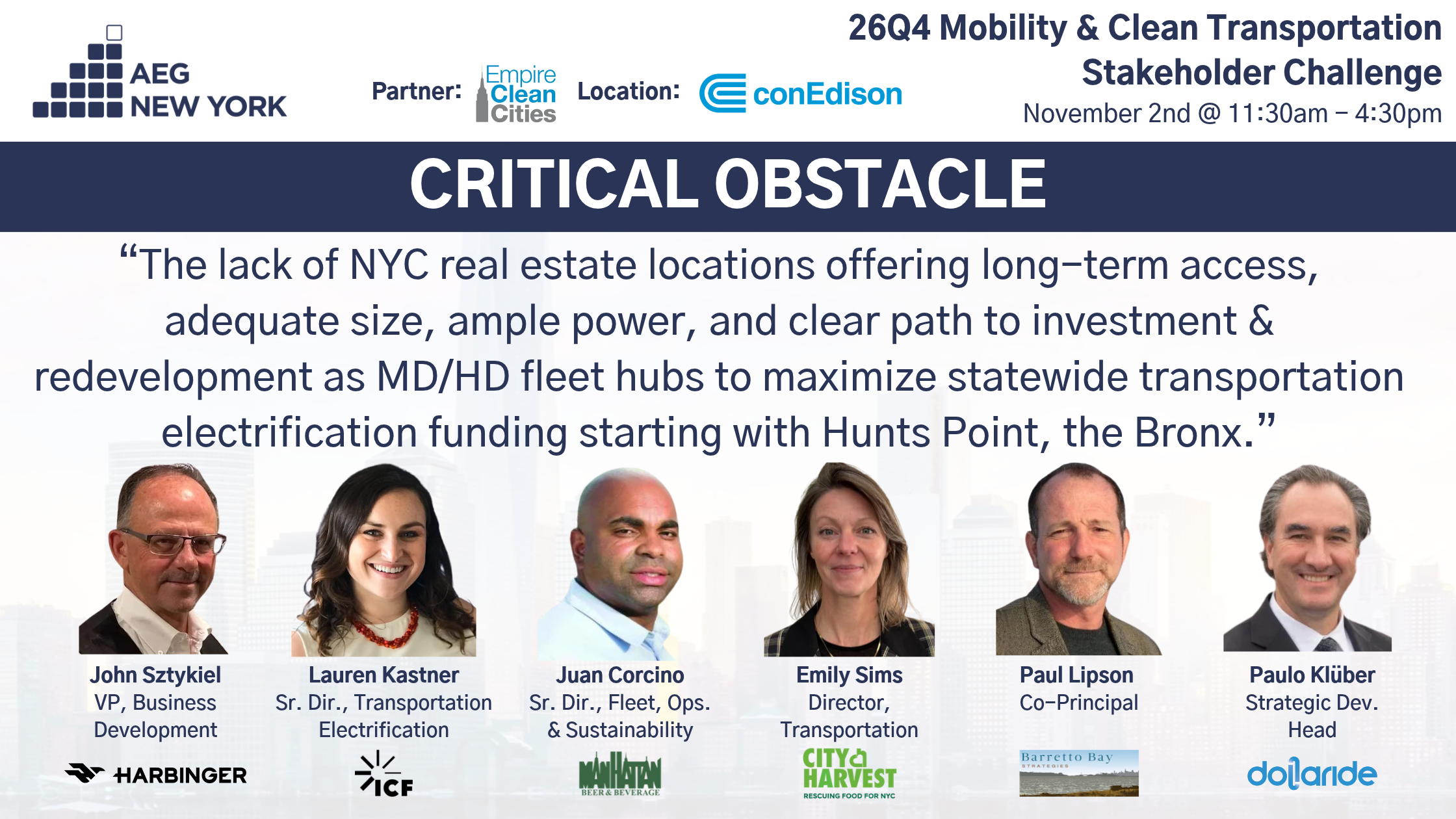
"The lack of suitable NYC real estate offering long-term access, adequate size, ample power, and a clear path to investment & redevelopment as MD/HD freight charging hubs." — Paul Lipson, Co-Principal, Barretto Bay Strategies
2. Fragmentation, Complexity, and the Need for Incentive Braiding
Public and private fleet operators face a fragmented funding landscape where programs operate with disparate timelines, redundant administrative requirements, and mismatched qualification rules, highlighting the critical need for a centralized, unified clearinghouse platform.
"Create a platform that serves as a single-pane of glass or clearinghouse for EV and charging incentive programs - qualifying participants in upfront screening and providing a reliable external reference without replacing existing programs." — Lauren Kastner, Senior Director, Transportation Electrification, ICF
3. High-Impact Freight and Diesel Elimination in Environmental Justice Corridors
Communities like Hunts Point in the South Bronx endure heavy particulate and pollution burdens from constantly idling diesel equipment, requiring targeted zero-emission pilots such as battery-powered electric transport refrigeration units (eTRUs).
"The technology is ready. What we need is partners to help fund and launch the first deployment." — Juan Corcino, Sr. Director of Fleet Operations & Sustainability, Manhattan Beer & Beverage Distributors
4. Equitable Access, Shared Charging Hubs, and Capital for Small Fleets
Disadvantaged communities (DACs) and small businesses operating commuter, paratransit, and dollar vans often lack upfront capital, depot access, and electrical service, requiring shared charging hubs that serve fleets overnight and the public by day.
"Getting shared, financeable charging hubs sited, energized and built in disadvantaged communities, so the small fleets serving NY's most vulnerable riders can go electric." — Paulo Klüber, Head of Strategic Development – EV Charging Infrastructure, Dollaride
5. Operational Economics, Demand Charge Volatility, and Grid Integration
Nonprofits and fleet operators face acute financial uncertainty around utility demand charges and long energization timelines, risking scenarios where electric operations become more costly than diesel.
"Regarding fleet electrification, to achieve NY's health & energy and inclusive prosperity goals, a critical obstacle is a lack of available infrastructure and uncertainty around demand charges." — Emily Sims, Director of Transportation, City Harvest
Participants agreed to prioritize the following obstacle statement inspired by all speakers and synthesized from workshop discussion: “Regarding Fleet Electrification, a critical obstacle to collectively overcome in 12 months is the lack of NYC real estate locations offering long-term access, adequate size, ample power, and clear path to investment & redevelopment as MD/HD fleet hubs to maximize statewide transportation electrification funding starting with Hunts Point, the Bronx.” Participants then designed and pitched a 90-day sprint and 12-month goal to best address this critical obstacle.
23 leaders formed a volunteer Task Force to complete a 90-day sprint.
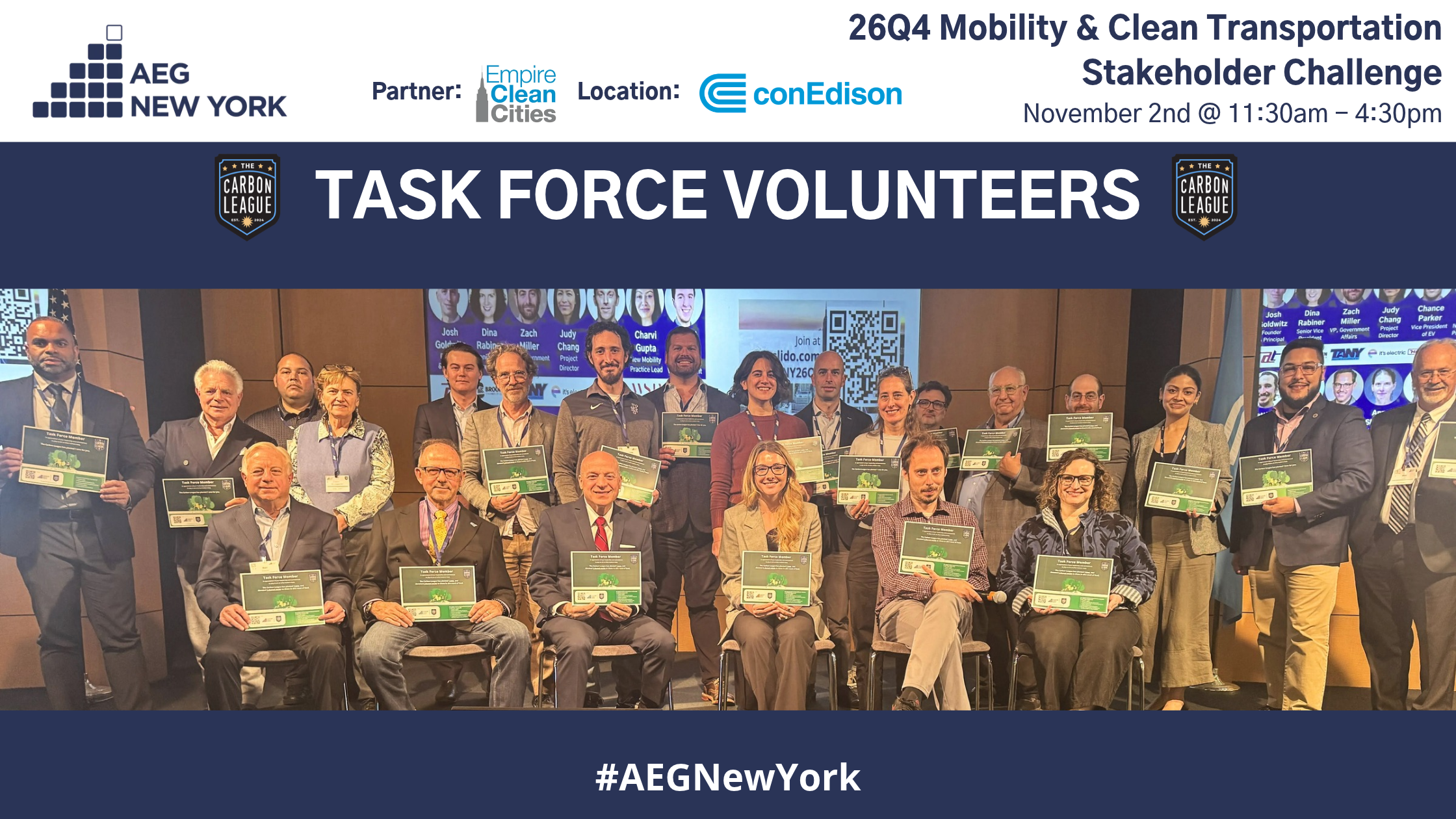
Task Force Volunteers (Listed A-Z): Alex Cook (First Student), Alexandra Ehrett (Harbinger), Ben Kriegler (Sprocket Power), Beny Poy (Con Edison), Charvi Gupta (WSP USA), Daniel Gatti (Acadia Center), Eleni Petrow (TRC Companies), Harris Schaer (GM Energy), John Heaton IV (WSP USA), John Sztykiel (Harbinger), Josh Goldwitz (Applied Transport), Juan Corcino (Manhattan Beer & Beverage Distributors), Lauren Kastner (ICF), Mark Simon (US DOE), Matthew Landin (NYC EDC), Rene Luciano (NYC DOT), Robert Venuti (Atlantic Coast Energy Group, LTD), Sam Plunkett (Nivalis Energy Systems), Susan McSherry (NYC DOT), Trevor MacDermid (Ten Mississippi), William Serratore (City of Yonkers) and Zach Miller (Trucking Association of New York).
To join this group of volunteers, please contact us at info@goadvancedenergy.com.
Conclusion
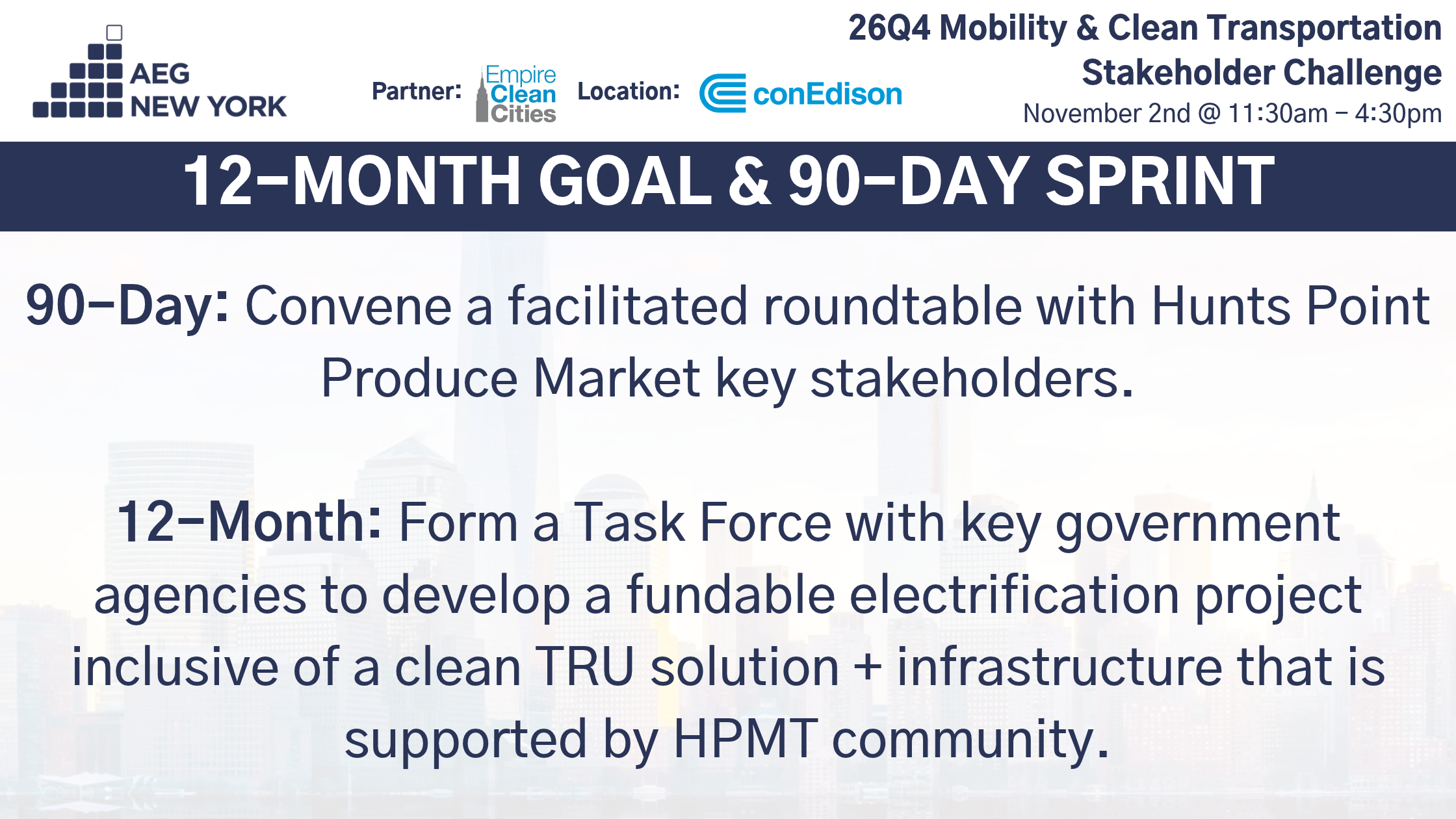
The AEG New York 26Q4 Mobility & Clean Transportation Stakeholder Challenge convened clean transportation, utility, public sector, fleet management, and community leaders to address critical barriers in New York’s clean mobility transition. Stakeholders selected as their priority 12-month obstacle the lack of NYC real estate locations offering long-term access, adequate size, ample power, and a clear path to investment and redevelopment as medium- and heavy-duty (MD/HD) fleet hubs to maximize statewide transportation electrification funding starting with Hunts Point, the Bronx. To solve this, stakeholders committed to a 90-day sprint to let vendors be heard, convene a stakeholder roundtable to air grievances, and collaboratively engage experts to capture and address concerns. This directly feeds into the 12-month goal of developing a conceptual design for a fundable electrification project, backed by the Hunts Point Market Tenants (HPMT) community. Ultimately, this Challenge establishes a replicable pathway to accelerate freight electrification, align grid and capital resources, and build inclusive health, energy, and economic prosperity across NYC.
Access to private resource pages, which include speaker presentations, and survey responses, from AEG Stakeholder Challenges is reserved for Signature Sponsors and City/Government Partners. To become a Signature Sponsor, learn more here: https://aeg.team/engage
Advanced Energy Group is a sponsor supported organization that facilitates quarterly challenges for high-impact stakeholders to deliver on health, energy and prosperity commitments for U.S. cities and vulnerable regions.