Overview
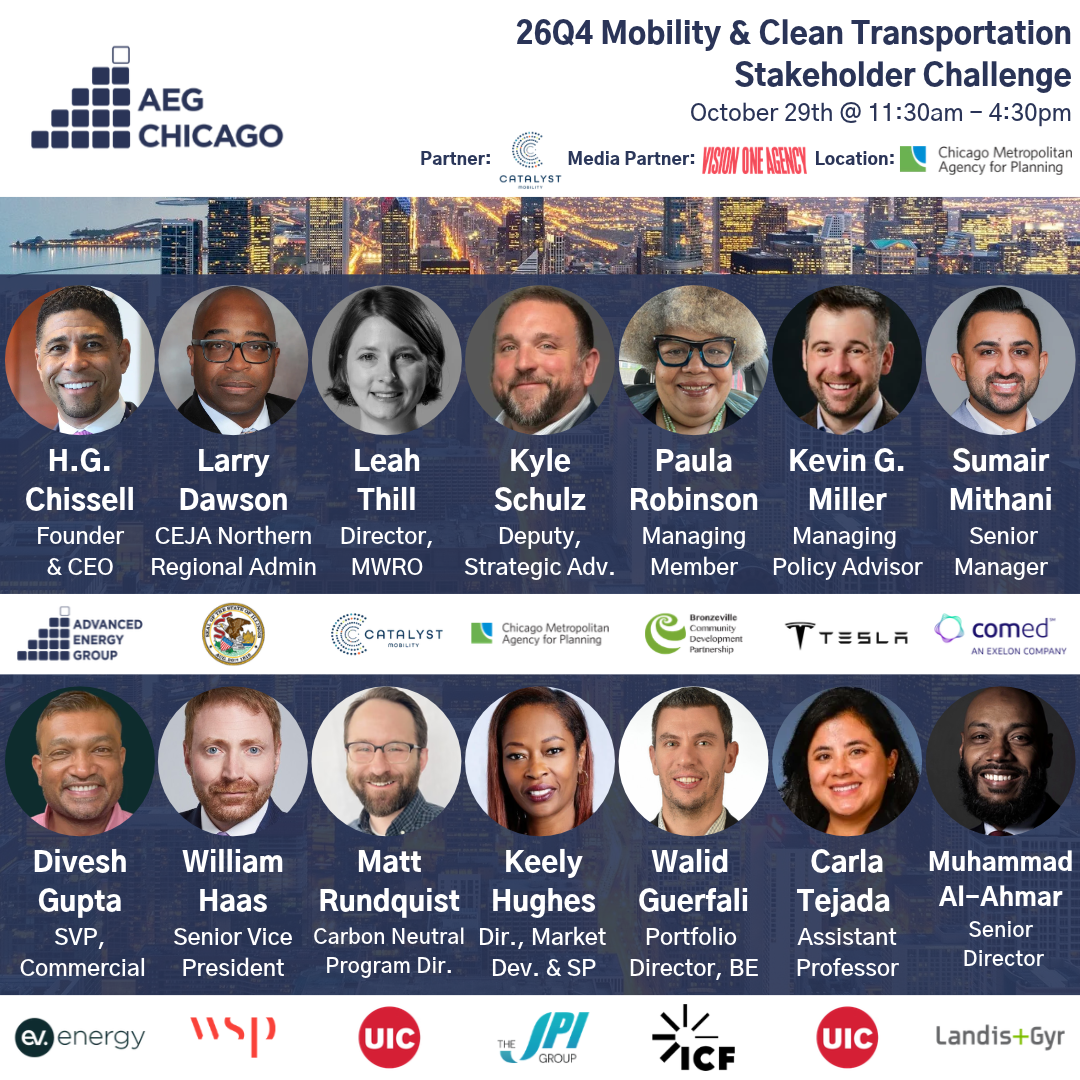
Held on October 29th, 2026 at Chicago Metropolitan Agency for Planning, thirty-five public and private industry leaders convened for the AEG Chicago 26Q4 Mobility & Clean Transportation Stakeholder Challenge. The purpose of this challenge was to: 1.) Align on a critical obstacle regarding Mobility & Clean Transportation for the Chicagoland region; 2.) Engage as cross-sector teams to agree on a 90-day sprint and 12-month goal; 3.) Empower leaders to deliver the solution and present the outcome in 12 months with 90 day sprints.
Kyle Schulz, Deputy of Strategic Advancement at the Chicago Metropolitan Agency for Planning, Larry Dawson, CEJA Northern Regional Administrator for the Office of Employment & Training, Illinois Department of Commerce & Economic Opportunity, and Leah Thill, Director of Catalyst Mobility’s Midwest Regional Office, opened the conversation. Their insight provided diverse perspectives to frame the following discussion surrounding Mobility & Clean Transportation.
The Speaker Challenge gave leaders the opportunity to provide a presentation which concluded in answering: "Regarding Mobility & Clean Transportation in Chicago / Illinois a critical obstacle to collectively overcome in 12 months is _________."
5 Key Themes
1. Specialized Workforce Pipelines & Industry Alignment
Meeting ambitious state EV targets requires closing the gap between general workforce training initiatives and immediate employer demands. Clean transportation companies face a severe shortage of certified personnel equipped for high-voltage battery diagnostics, EV maintenance, and charging station commissioning.
“Misalignment between clean-transportation employer needs and the readiness, specialization, and volume of workforce program graduates." - Larry Dawson, CEJA Northern Regional Administrator, Illinois Department of Commerce & Economic Opportunity
2. Customer Navigation & Program Accessibility
A major barrier is the disconnect between behind-the-scenes institutional planning and direct customer usability. Fleets, building owners, and municipalities frequently struggle to sequence decisions, locate entry points, and navigate fragmented utility and state programs.
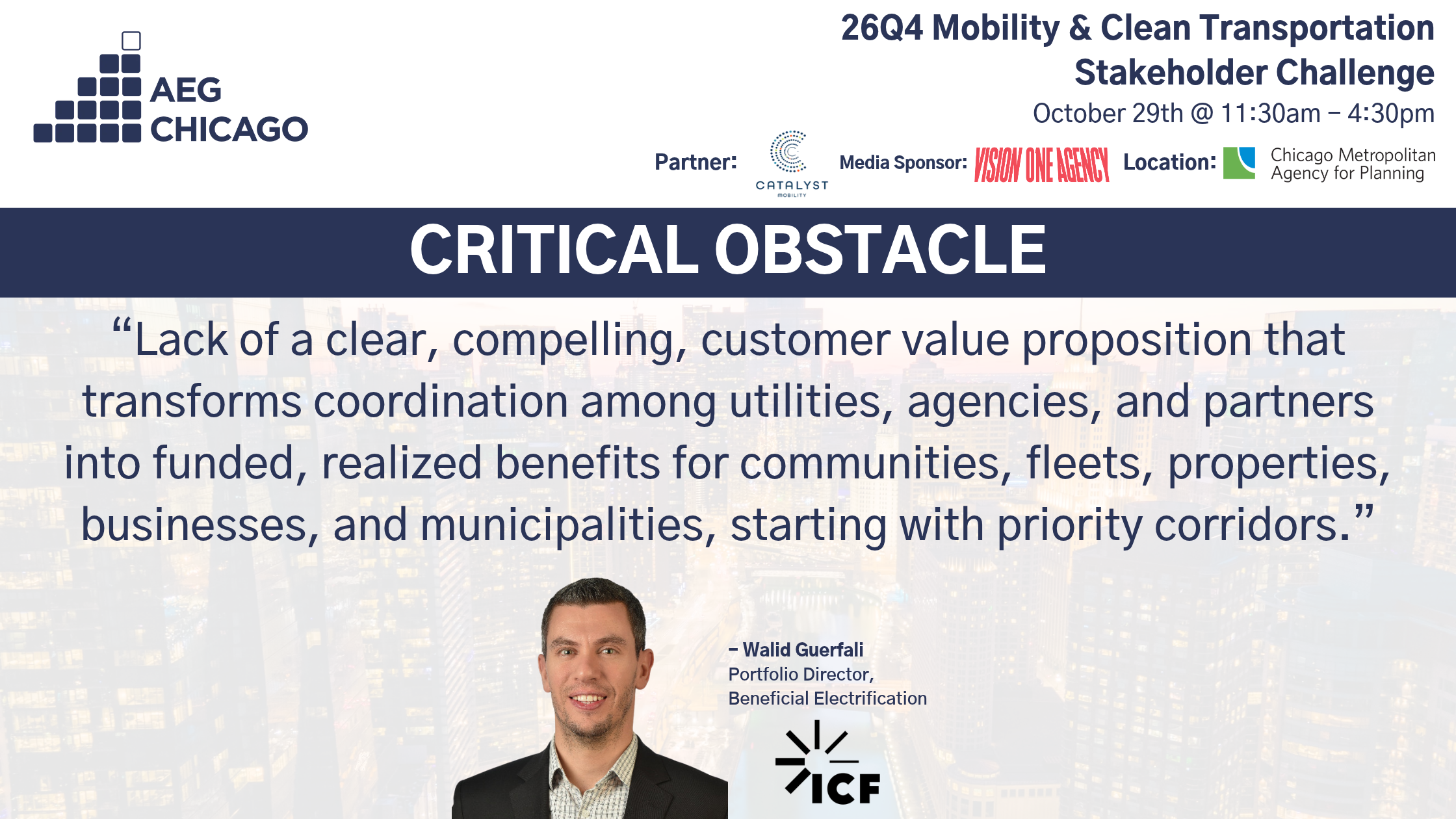
"A critical obstacle to collectively overcome in 12 months is the lack of a visible, customer-facing pathway that translates coordination among utilities, state agencies, and other program partners into clear, usable guidance for communities, fleets, multifamily properties, businesses, and municipalities." - Walid Guerfali, Portfolio Director, Beneficial Electrification, ICF
3. High-Capacity Grid Infrastructure & Make-Ready Funding
Front-end electrical make-ready work represents the single steepest capital hurdle for prospective charging site hosts. With customer demand exceeding available utility rebates threefold and program budgets facing steep regulatory reductions, viable shovel-ready projects risk stalling.
"Getting these shovel-ready sites energized is what gives consumers the confidence to make the switch to electric vehicles." - Sumair Mithani, ComEd
4. Policy Mechanisms for Fleet Operating Cost Parity
High capital requirements, demand charges, and low initial charger utilization threaten depot economics and discourage commercial fleet electrification. Adopting durable market-based policies is essential to assign value to clean electricity delivery and lower operational costs relative to diesel.
"Adopt a sustainable policy mechanism that would add market-value to the cleanest fuels, reduce lifecycle emissions, and limit impacts to ratepayers and the grid." - Kevin George Miller, Tesla
5. Equitable Urban Freight & Community-Led Curb Policy
The proliferation of logistics facilities and last-mile diesel deliveries concentrates harmful emissions and traffic safety hazards in historically vulnerable neighborhoods. Overcoming this impact requires turning isolated delivery pilots into enforceable curb management and low-emission zones co-designed with front-line residents.
"The goal: Re-think urban freight as a zero-emission, safe, and equitable system, Designed with the communities on the front line." - Dr. Carla Tejada Lopez, UIC
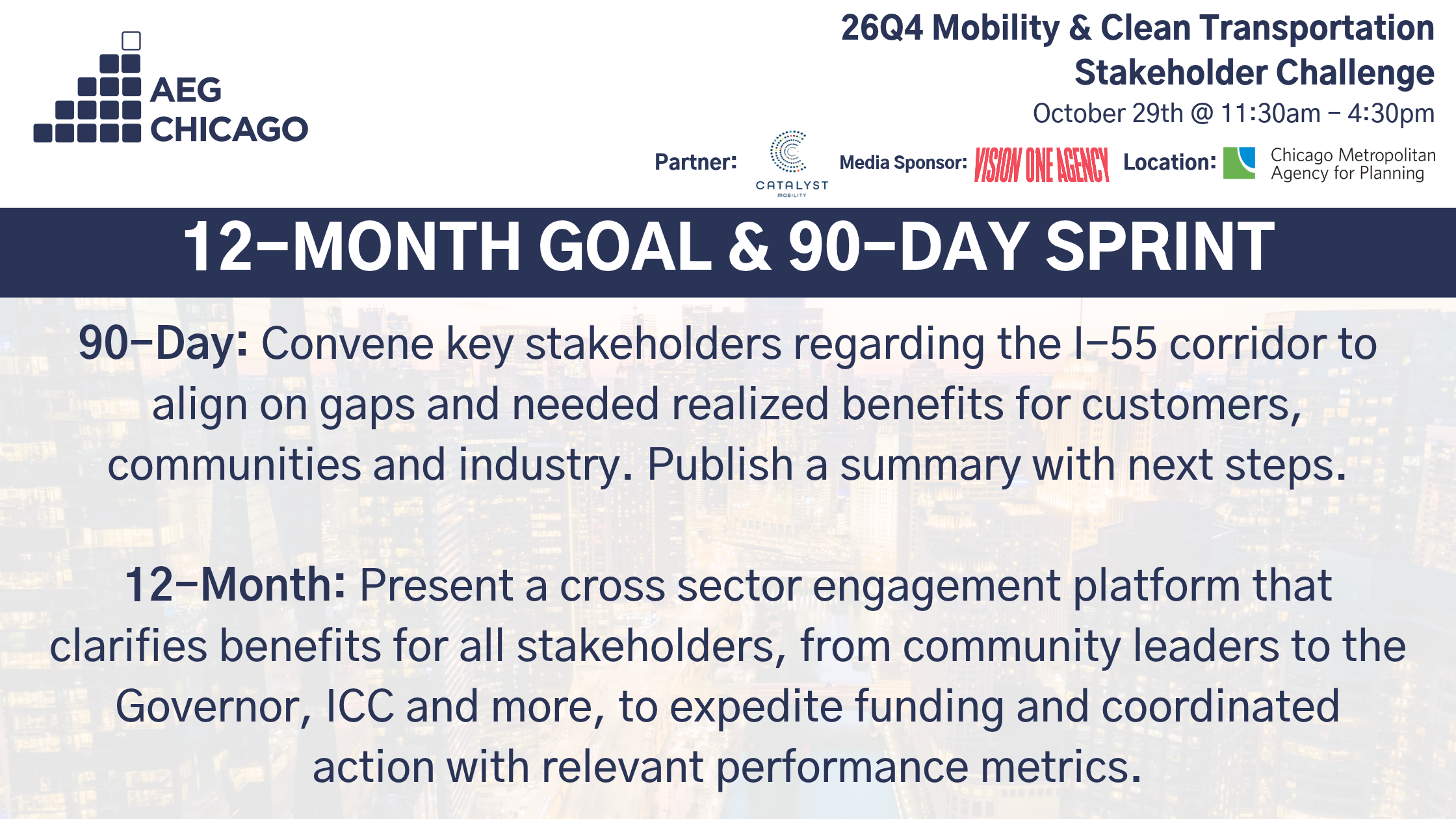
Participants agreed to prioritize the obstacle statement provided by Walid Guerfali (ICF), and aligned on this statement: “Regarding Mobility & Clean Transportation in Chicago / Illinois a critical obstacle to collectively overcome in 12 months is lack of a clear, compelling, customer value proposition that transforms coordination among utilities, agencies, and partners into funded, realized benefits for communities, fleets, properties, businesses, and municipalities, starting with priority corridors.” Participants then designed, and pitched a 90-day sprint and 12-month goal to best address this critical obstacle.
15 leaders formed a volunteer Task Force to complete a 90-day sprint
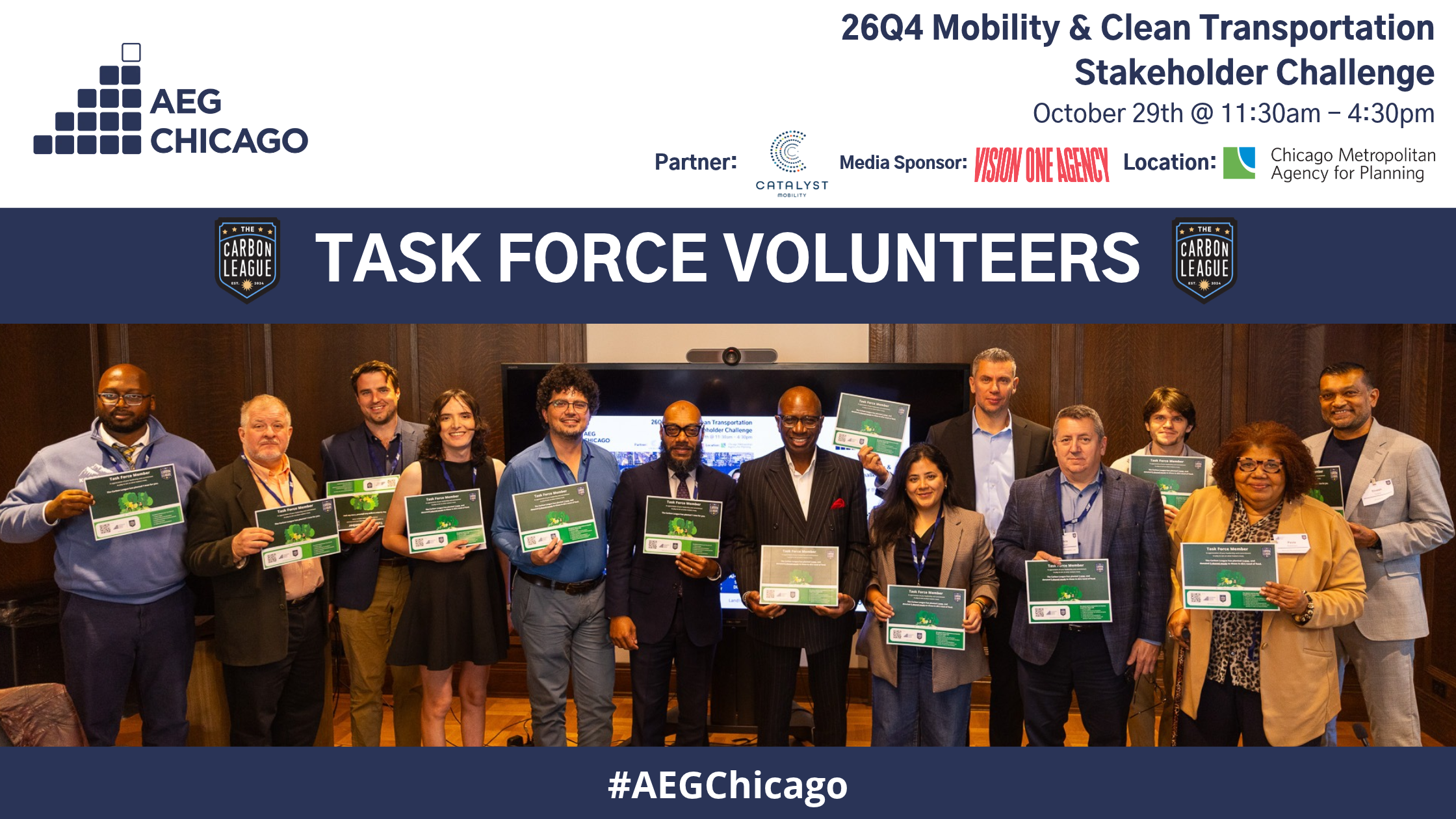
Task Force Volunteers (Listed A-Z): Brendan Connelly (WSP USA), Brian Urbaszewski (Respiratory Health Association), Carla Tejada Lopez (UIC), Chris Perzan (Kyndenos Sustainability Law), Divesh Gupta (ev.energy), Kevin George Miller (Tesla), Ladi Ogunnubi (Kootanla), Lennox Jackson (Urban Equities, Inc), Muhammad Al-Ahmar (Landis+Gyr), Ömer Verbas (Argonne National Laboratory), Parker Watts (The Carbon League), Paula Robinson (Bronzeville Partners LLC), Pete Kelly (Redtree Engineering), Sophie Thuis (The Carbon League) y Walid Guerfali (ICF).
To join this group of volunteers, please contact us at info@goadvancedenergy.com.
Conclusion
The AEG Chicago 26Q4 Mobility & Clean Transportation Stakeholder Challenge convened regional planning, utility, clean tech, academic, and community leaders to address critical obstacles to accelerating clean mobility across the region. Leaders identified the primary obstacle as the lack of a clear, customer-facing pathway to transform cross-sector coordination into funded, actionable guidance for communities, fleets, properties, businesses, and municipalities. To solve this in the next 12 months, participants committed to a 90-day sprint to compile successes, reports, and studies along the I-55 corridor, assess current conditions, compile recommendations, and convene key public agencies and community partners. This directly supports the team’s 12-month goal to exert coordinated pressure on agencies, share actionable policy recommendations, and implement a cohesive, cross-sector solution. Ultimately, the Challenge establishes a replicable, collaborative blueprint to accelerate charging and fleet deployment equitably, reduce freight and tailpipe emissions, and advance health, energy, and economic prosperity across Chicago and Illinois.
Access to private resource pages, which include speaker presentations, and survey responses, from AEG Stakeholder Challenges is reserved for Signature Sponsors and City/Government Partners. To become a Signature Sponsor, learn more here: https://aeg.team/engage
Advanced Energy Group is a sponsor supported organization that facilitates quarterly challenges for high-impact stakeholders to deliver on health, energy and prosperity commitments for U.S. cities and vulnerable regions.