Executive Summary: September 23rd AEG NYC Health, Energy & Resilience Action Challenge
Overview
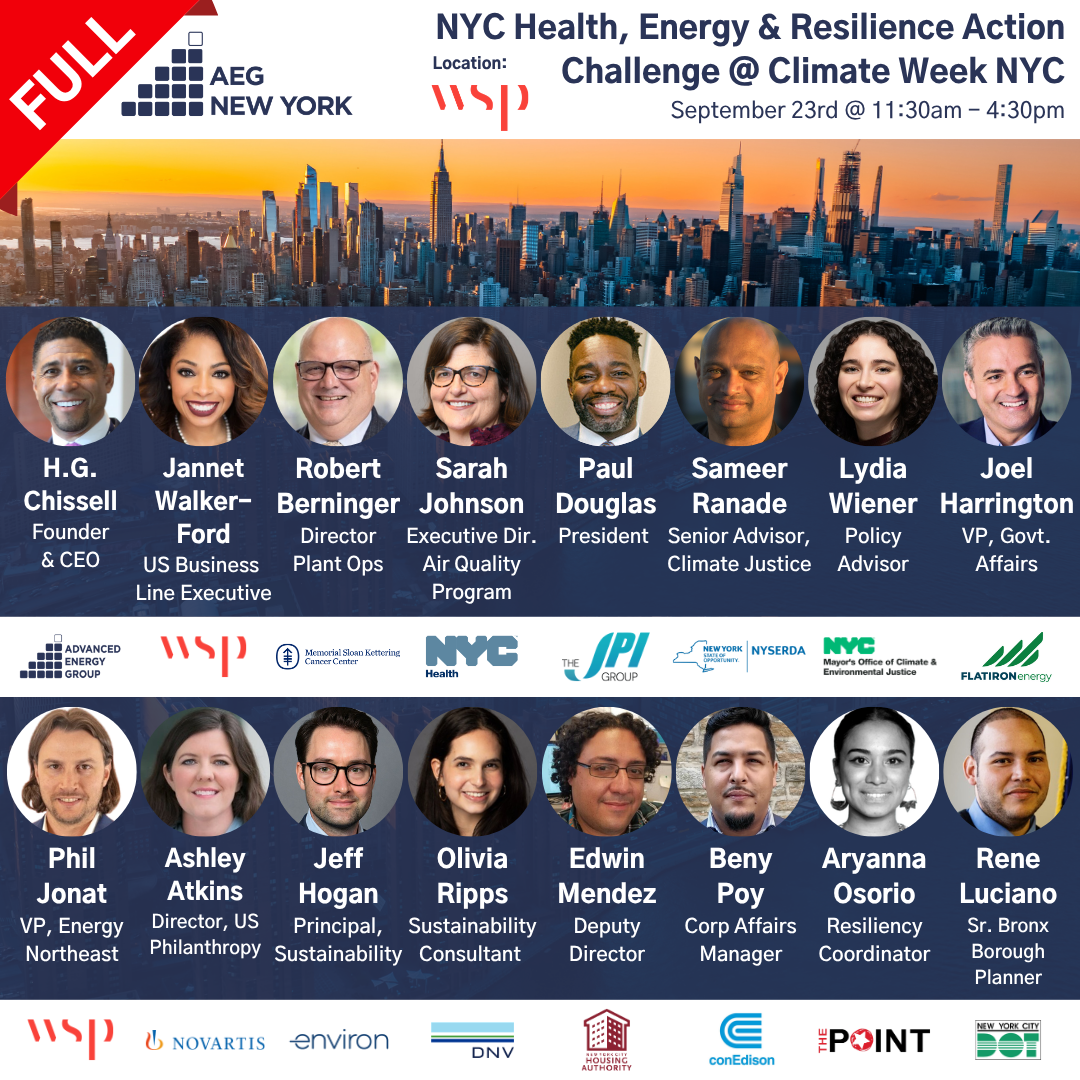
Held on September 23rd, 2026 at WSP in New York, forty-eight public and private industry leaders convened for the AEG NYC Health, Energy & Resilience Action Challenge. The purpose of this challenge was to: 1.) Align on a critical obstacle regarding Health, Energy & Resilience for New York City; 2.) Engage as cross sector teams to agree on a 90-day sprint and 12-month goal; 3.) Empower leaders to deliver the solution and present the outcome in 12 months with 90 day sprints.
Jannet Walker-Ford, US Advisory and Planning Business Line Executive, WSP USA and SarahJohnson, Executive Director, NYC Department of Health Air Quality Program, opened the conversation, providing diverse perspectives to frame the discussion surrounding Health, Energy & Resilience for New York City.
Opening remarks were followed by the Speaker Challenge, where each speaker provided a presentation that concluded with this completed statement: "To achieve NYC’s Health, Energy & Resilience goals, a critical obstacle to collectively address in 12 months is __________."
5 Key Themes
1. Closed-Loop Referral Systems & Cross-Sector Handoffs
Transitioning from fragmented, program-specific distributed energy resource (DER) management to a repeatable local operating model coordinates buildings, batteries, EVs, and solar around real-time local grid constraints. Rather than relying solely on expanding physical infrastructure, orchestrating local energy ecosystems maximizes existing capacity to lower peak demand and avoid costly system upgrades.
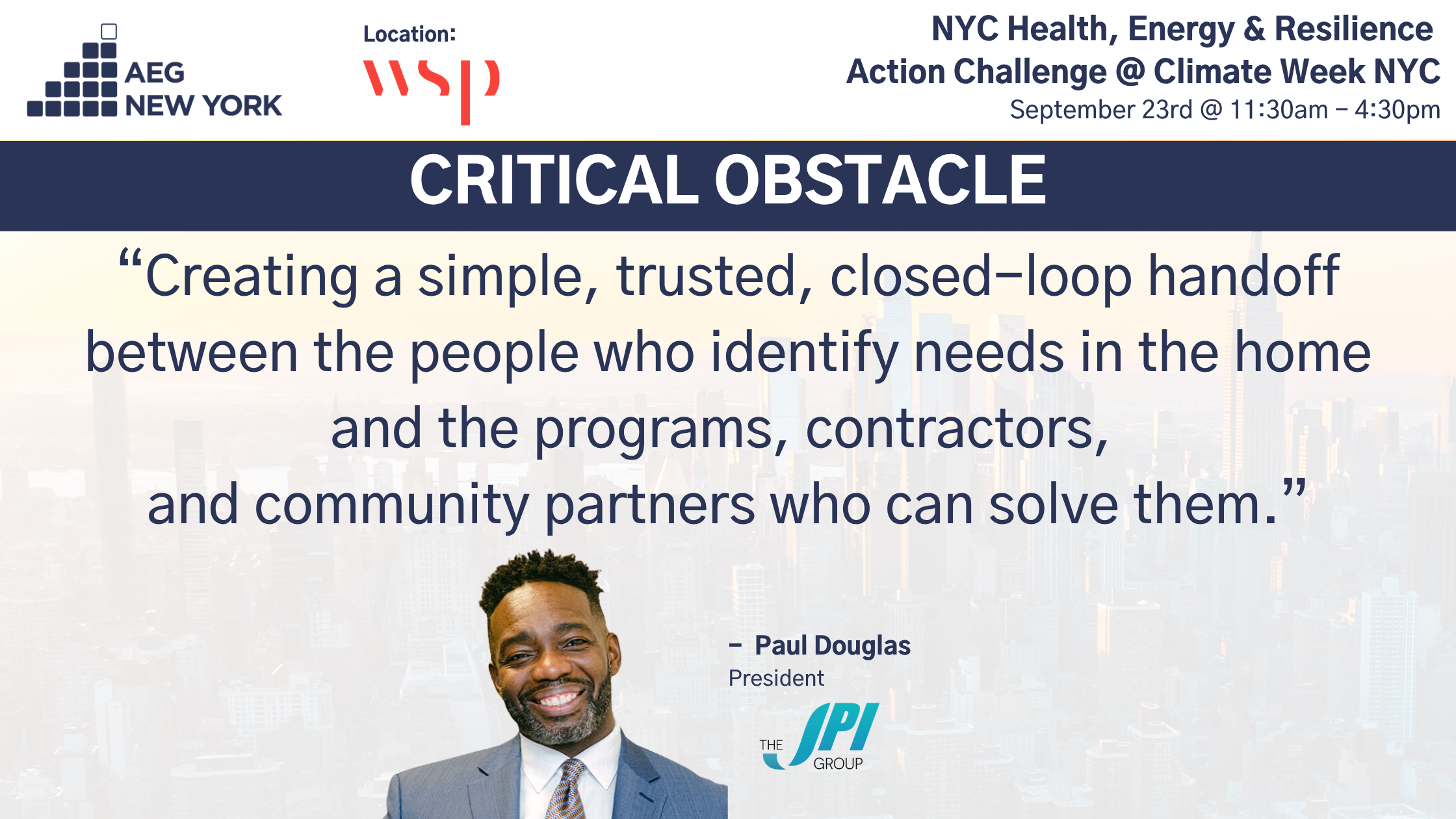
"To achieve NYC's Health, Energy, and Resilience goals, a critical obstacle to collectively address in 12 months is creating a simple, trusted, closed-loop handoff between the people who identify needs in the home and the programs, contractors, and community partners who can solve them." — Paul Douglas, President, The JPI Group
2. Multi-Year Financial & Incentive Realignment
Large-scale decarbonization and energy efficiency projects for complex facilities (such as hospitals) require multi-year planning and construction. Current annual utility rebate cycles create financial unpredictability and capital constraints that slow down major resilience upgrades.
"Larger projects usually take two to three years: feasibility study, obtain approval and capital, engineering design, construction, M&V." — Robert Berninger, Director of Plant Operations, Energy & Engineer, Memorial Sloan Kettering Cancer Center
3. Interagency Timeline Alignment & Regulatory Financing Mechanisms
Extreme heat is the deadliest climate hazard in NYC, disproportionately impacting vulnerable populations lacking home air conditioning. Overcoming this obstacle requires targeted, localized cooling interventions and policy changes (such as maximum summer indoor temperature standards) to prevent avoidable heat deaths.
"Reduce emissions that contribute to climate change and environmental injustice through the development of large-scale urban energy storage projects." — Joel Harrington, Vice President of Government Affairs, Flatiron Energy
4. Addressing Extreme Heat Vulnerability as a Public Health Priority
Extreme heat is the top weather-related cause of death in NYC, disproportionately impacting Black New Yorkers due to structural inequities. Because mortality risk increases on warm days and deaths occur primarily at home, public health strategies must combine individual risk identification with policies like a maximum summer indoor temperature standard.
"Lack of access to home air conditioning (AC) is the most important risk factor for heat-stress death. Among those who died from heat stress, the place of death was most often an un-air-conditioned home." — Sarah Johnson, Executive Director, Air Quality Program, NYC Department of Health
5. Financial Standardization & Asset Class Scaling
Based on participant polling and discussion, New York's energy transition remains severely hindered by fragmented information and disconnected proceedings. Overcoming this requires centralizing state resources, funding channels, and policy proceedings into open, shared platforms that align CBOs, developers, agencies, and capital providers
"New York is moving fast. The ecosystem is still fragmented. Residents, CBOs, government, developers and capital providers often have to piece together programs, policy, funding, organizations and engagement opportunities from separate places." — John Joshi, Principal Consultant, CapUtility Advisors (AEG NY 26Q1 Critical Infrastructure Task Force Report
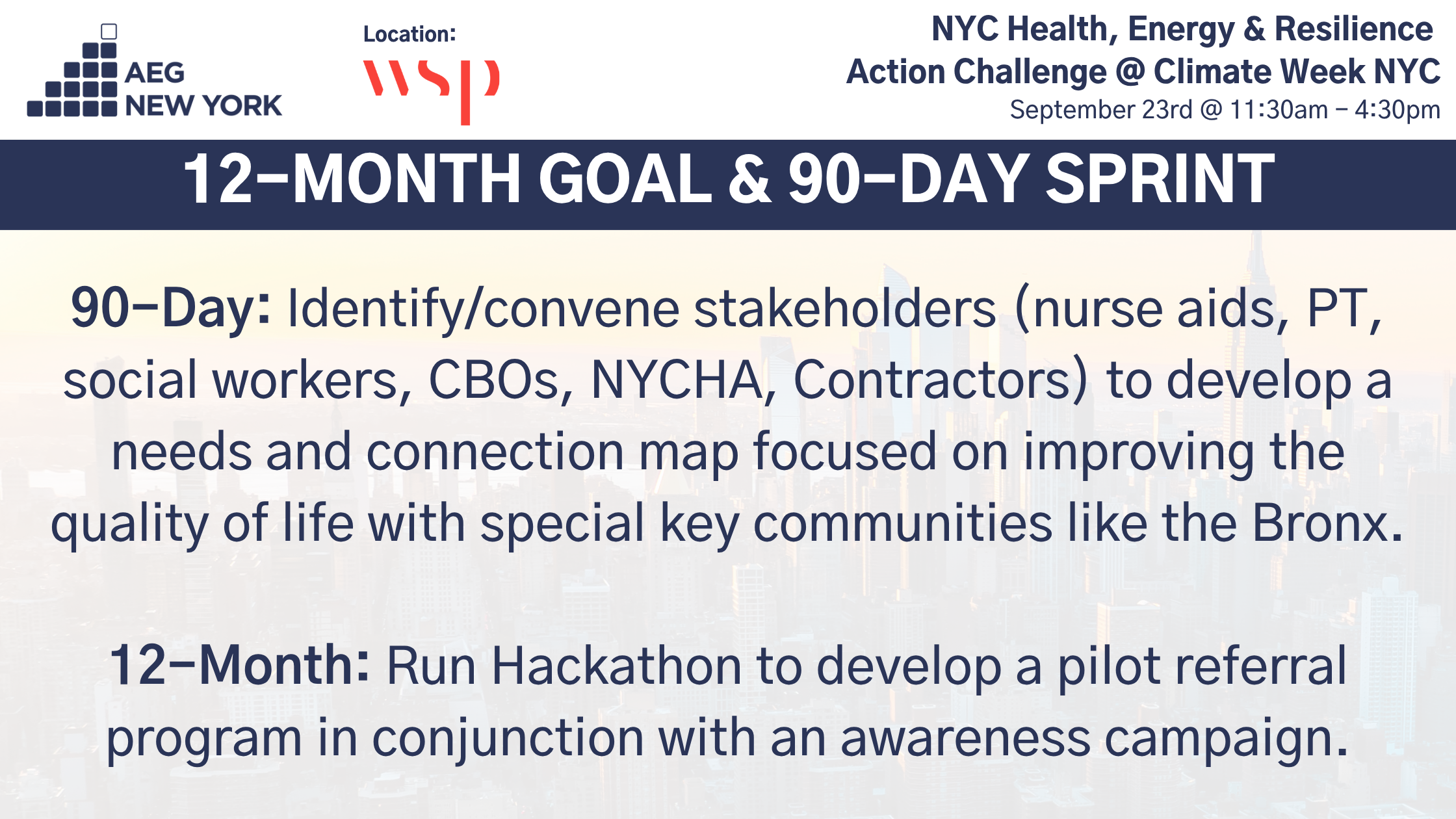
Participants agreed to prioritize this selected obstacle statement provided by Paul Douglas (The JPI Group): “Creating a simple, trusted, closed-loop handoff between the people who identify needs in the home and the programs, contractors, and community partners who can solve them.” Participants then designed, and pitched a 90-day sprint and 12-month goal to best address this critical obstacle.
9 leaders formed a volunteer Task Force to complete a 90-day sprint.
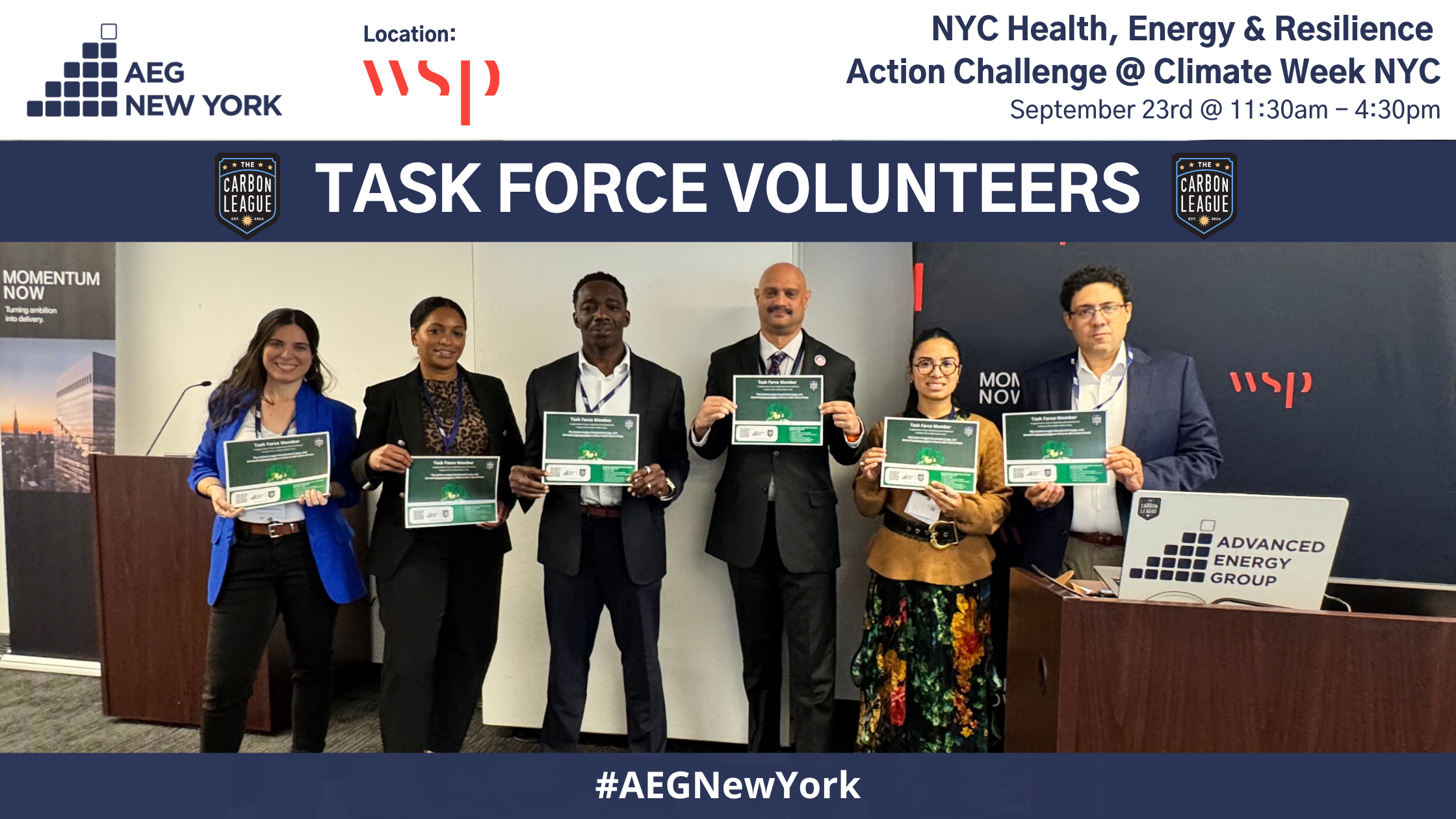
Task Force Volunteers (Listed A-Z): Aryanna Osorio (The Point CDC), Beny Poy (Con Edison), Edwin Mendez (NYCHA), Janean Thomas (The JPI Group), Nadya Daulay (Columbia Mailman SPH), Pamela Silva (Catapult Design), Paul Douglas (The JPI Group), Sameer Ranade (NYSERDA), Sarah Salem (Flatiron Energy)
To join this group of volunteers, please contact us at info@goadvancedenergy.com.
The Carbon Leagues (TCL) Task Force Updates
12-Month Task Force Win: The Carbon League’s NYC Cooling Task Force "Too Hot To Handle"
The 2025 NYC Health, Energy & Equity Task Force, also known as the “NYC Cooling Task Force” / "Too Hot To Handle", focused on mobilizing political will, private industry, utilities, and resources to provide affordable and accessible cooling to New Yorkers most vulnerable to extreme heat risks. Co-led by Sarah Johnson (NYC Department of Health), Beny Poy (Con Edison), and Anya Eydman (Arya Energy), the initiative targeted heat-vulnerable South Bronx neighborhoods, including Hunts Point, Mott Haven, Morrisania, Claremont, and West Farms. To execute this vision, the team collaborated with key community stakeholders—including The Point CDC, South Bronx Unite, Bronx Independent Living Services, and House of Good Deeds—alongside partners such as Flatiron Energy, Daikin, and The Carbon League. As their 12-month achievement, the task force established a successful proof-of-concept pilot by securing a $2,500 donation from Flatiron Energy, which enabled The Point CDC to procure and install 12 air conditioning units directly in the homes of high-risk residents, while also issuing a vendor Request for Information (RFI) to lay the groundwork for broader future deployment.
2-Year Task Force Impact: AEG NYC Health, Energy & Equity Task Force’s "The Bronx Decarbonization Roadmap" Permanent Community Energy Mural
Two years after its inception in 2024, the AEG NYC Health, Energy & Equity Task Force—driven by key leadership and cross-sector contributors including Antuan Cannon (Willdan), Franchesca Diaz (Con Edison), and Brandon Mohammed (ALIA Ltd.)—demonstrated the enduring impact and expansion of its vision through the September 23, 2026 unveiling of "The Bronx Decarbonization Roadmap." Originally created in 2025 as the task force’s 12-month deliverable—a collaborative "paint-by-numbers" community energy mural led by multidisciplinary artist Tijay Mohammed to champion equitable energy access and climate resilience—the project has evolved from a temporary artwork into a permanent public landmark and educational initiative. Now professionally sealed and permanently mounted at Lorillard Place and Fordham Road, the 12-foot by 6-foot mural stands as a physical testament to community-led action. By reuniting residents, clean energy stakeholders, and local partners during Climate Week NYC to launch an ongoing public education campaign, the task force proved that its initial creative spark has grown into a lasting foundation for decarbonization and climate engagement across the Bronx.
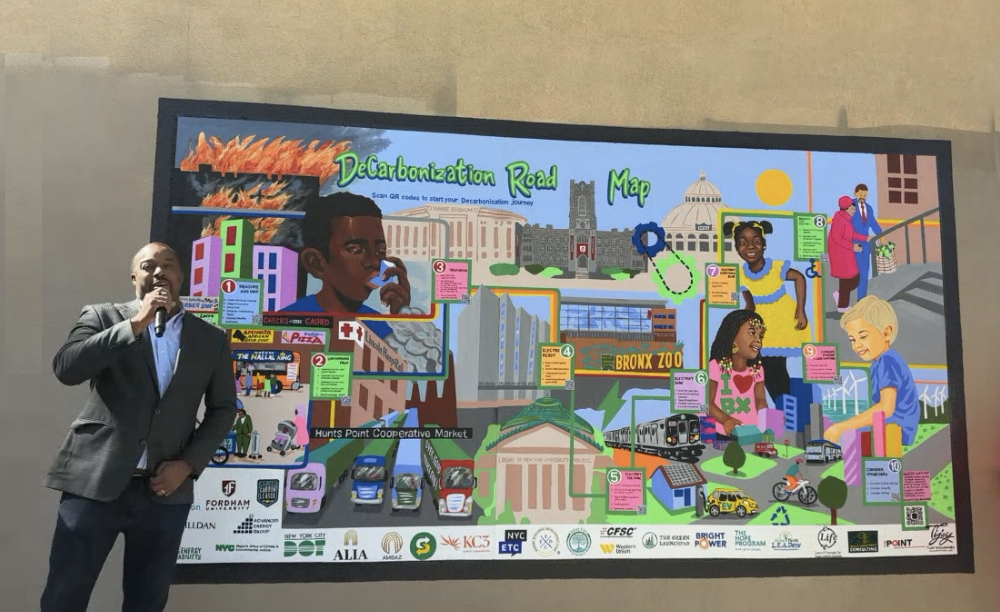
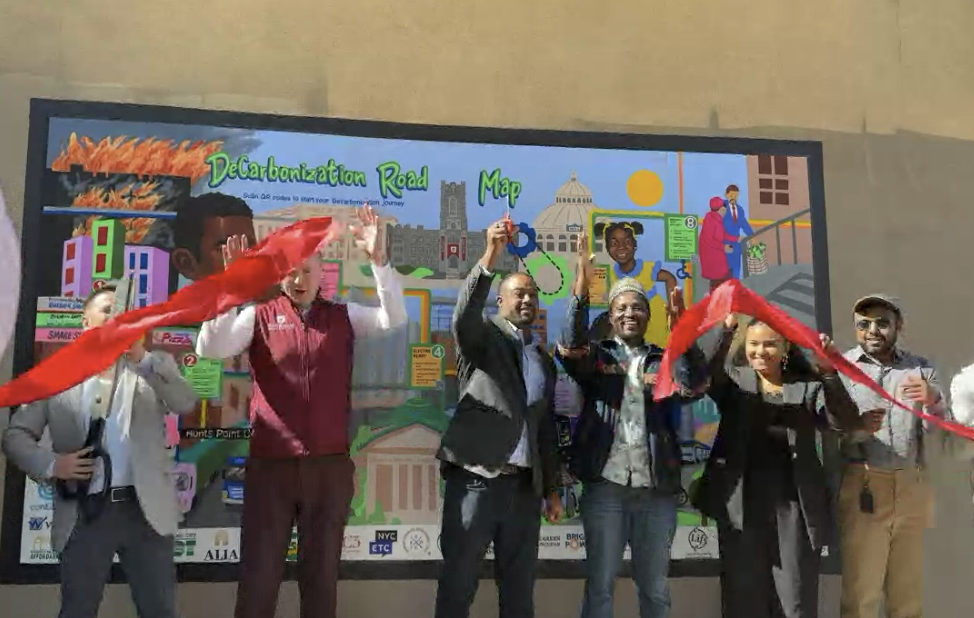
Photos from livestream of September 23rd The Bronx Decarbonization Roadmap Community Mural ribbon cutting ceremony at Lorillard Place and Fordham Road.
Community Hub Platform for Centralized Resources & Ecosystem Alignment: AEG NY 26Q1 Critical Infrastructure Update
Tackling the challenge of "Better and faster coordination with other asset and infrastructure owners to identify actionable policies and opportunities for cross-collaboration that builds trust and benefits communities." AEG NY 26Q1 Task Force launched the Community Hub Platform to centralize state resources, policy, and funding by location. The Task Force’s next steps center on gathering user feedback and recruiting partners for pilot working groups.
The TEN Business Models & TAPC Task Force: AEG NY 26Q2 Building Decarbonization Update
To address the need to "research and present business models for TEN pilots within North America building toward an open-source business-model tool and best-practices resource for the industry" the AEG NY 26Q2 Task Force analyzed 18 projects to launch the 3-year Thermal Access to Public Capital (TAPC) initiative. Next steps include drafting standard TESA contracts and building the oTherm database—join by taking the TAPC Consortium Survey.
Conclusion
The AEG NYC Health, Energy & Resilience Action Challenge convened public health, utility, healthcare, energy storage, and community leaders to address key barriers in New York’s clean energy and health transition. Stakeholders selected as their priority 12-month obstacle the need to create a simple, trusted, closed-loop handoff between home assessors, contractors, programs, and community partners. To solve this, stakeholders committed to a 90-day sprint to convene key actors—including nurse aides, physical therapists, social workers, NYCHA, CBOs, and contractors—to build a needs and connection map for vulnerable communities like the South Bronx. This directly feeds into the 12-month goal of hosting a Hackathon to build a referral program and awareness campaign, ensuring at-risk residents seamlessly connect to vital services. Ultimately, this Challenge establishes a replicable pathway to mitigate extreme heat, align infrastructure, and build long-term health and energy resilience across NYC.
Access to private resource pages, which include speaker presentations, and survey responses, from AEG Stakeholder Challenges is reserved for Signature Sponsors and City/Government Partners. To become a Signature Sponsor, learn more here: https://aeg.team/engage
Advanced Energy Group is a sponsor supported organization that facilitates quarterly challenges for high-impact stakeholders to deliver on health, energy and prosperity commitments for U.S. cities and vulnerable regions.