Executive Summary: August 20th AEG New York Affordability & Grid Optimization Stakeholder Challenge
Overview
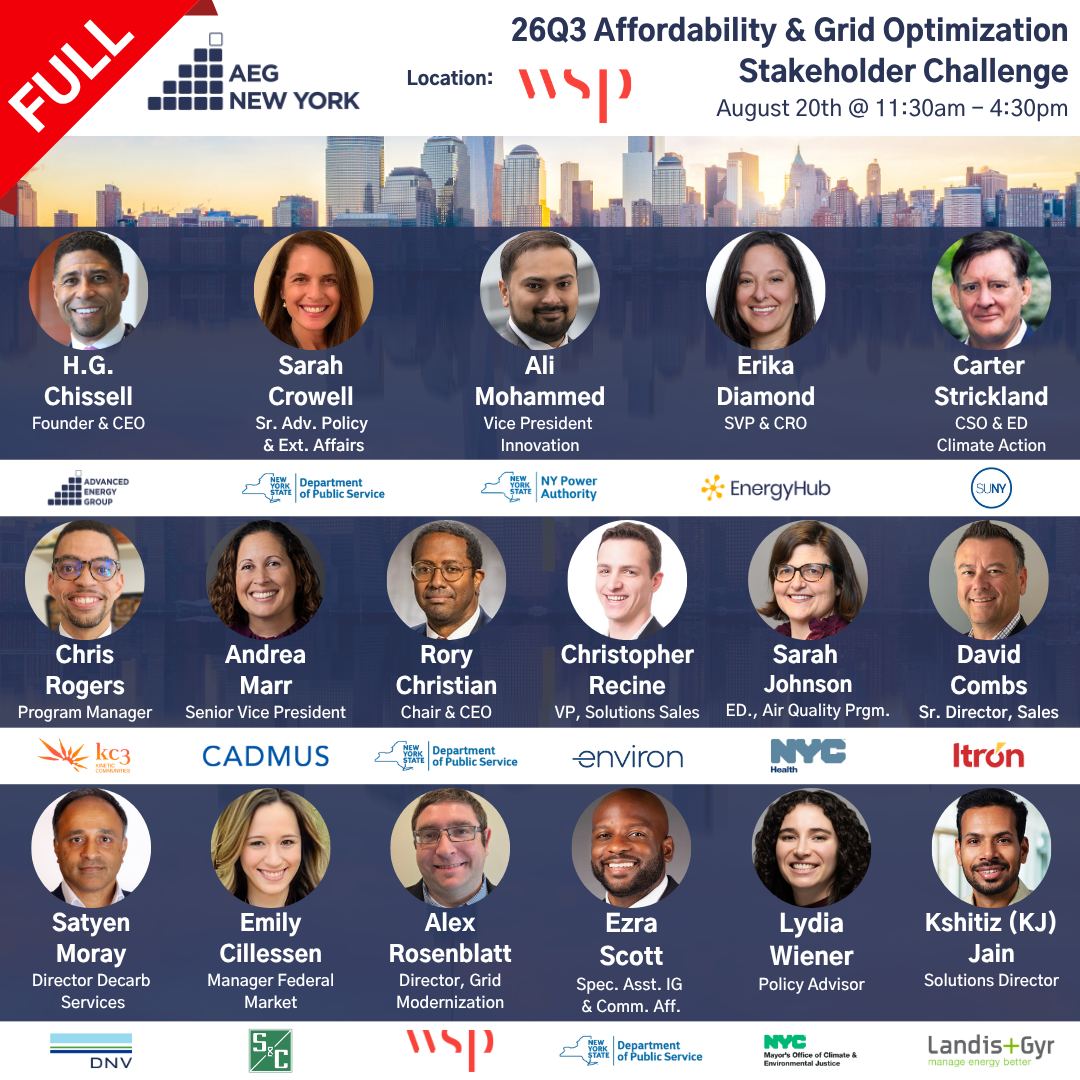
Held on August 20th, 2026 at WSP in New York, sixty public and private industry leaders convened for the AEG New York 26Q3 Affordability & Grid Optimization Stakeholder Challenge. The purpose of this challenge was to: 1.) Align on a critical obstacle regarding Affordability & Grid Optimization for New York; 2.) Engage as cross sector teams to agree on a 90-day sprint and 12-month goal; 3.) Empower leaders to deliver the solution and present the outcome in 12 months with 90 day sprints.
Alex Rosenblatt, Director, Grid Modernization Program,WSP and Sarah Crowell, Senior Advisor for Policy and External Affairs, NYS Department of Public Service, Office of Renewable Energy Siting and Electric Transmission, opened the conversation, providing diverse perspectives to frame the discussion surrounding Affordability & Grid Optimization for New York.
Opening remarks were followed by the Speaker Challenge, where each speaker provided a presentation that concluded with this completed statement: "Regarding Affordability & Grid Optimization, to achieve New York's energy, health and prosperity goals, a critical obstacle to collectively overcome in 12 months is _________."
5 Key Themes
1. Local Energy Ecosystem Orchestration
Transitioning from fragmented, program-specific distributed energy resource (DER) management to a repeatable local operating model coordinates buildings, batteries, EVs, and solar around real-time local grid constraints. Rather than relying solely on expanding physical infrastructure, orchestrating local energy ecosystems maximizes existing capacity to lower peak demand and avoid costly system upgrades.
"Shift from managing individual DERs and efficiency programs to orchestrating local energy ecosystems around when and where the grid needs flexibility." — Ali Mohammed, Vice President Innovation, NY Power Authority
2. Inclusive Dynamic Rate Design for Affordable Housing
Unlocking the full peak-shaving and load-shifting potential of the grid requires expanding dynamic rate structures to rent-stabilized and affordable housing tenants. Overcoming the lack of interval load shapes and tenant household data will allow utilities to craft protective, flexible rate models that prevent bill instability for fixed-income residents while integrating a major unserved block of demand into grid optimization.
"The existing TOU rate signal does not reach affordable housing tenants, and the utility loses that flexibility." — Chris Rogers, Program Manager, Kinetic Communities Consulting (KC3)
3. Streamlined University-to-Utility Innovation Pathways
Accelerating grid modernization and reducing technology investment risk requires establishing a clear, structured bridge between academic research capabilities and utility operational needs. By systematically mapping priority grid constraints to applied university research and demonstration sites, state stakeholders can rapidly model, validate, and deploy cost-effective solutions.
"The challenge is not generating more ideas. It is creating a faster, more credible path from research to grid impact." — Carter Strickland, Chief Sustainability Officer & Executive Director of Climate Action, SUN
4. Equitable Extreme Heat Relief & Vulnerable Resident Cooling
Scaling Virtual Power Plant (VPP) participation across New York demands moving past fragmented utility programs toward a cohesive statewide brand and simplified program design. Aligning incentives around clear grid value across all DER asset types keeps customer enrollment high while supplying critical bulk capacity and distribution-level reliability.
"Unified brand and program design across utilities and DERs grows VPPs faster." — Erika Diamond, SVP & Chief Revenue Officer, EnergyHub
5. Equitable Extreme Heat Relief & Vulnerable Resident Cooling
Protecting vulnerable New Yorkers from climate risks like extreme heat requires direct, targeted interventions for low-income and fixed-income households. Focusing political will and cross-sector resources to deploy cooling infrastructure in heat-vulnerable communities addresses immediate public health threats while embedding equity into the broader energy transition.
"To focus political will, private industry, utilities and resources on providing affordable, accessible cooling for the most vulnerable New Yorkers." — Sarah Johnson, Executive Director, Air Quality Program, NYC Department of Health
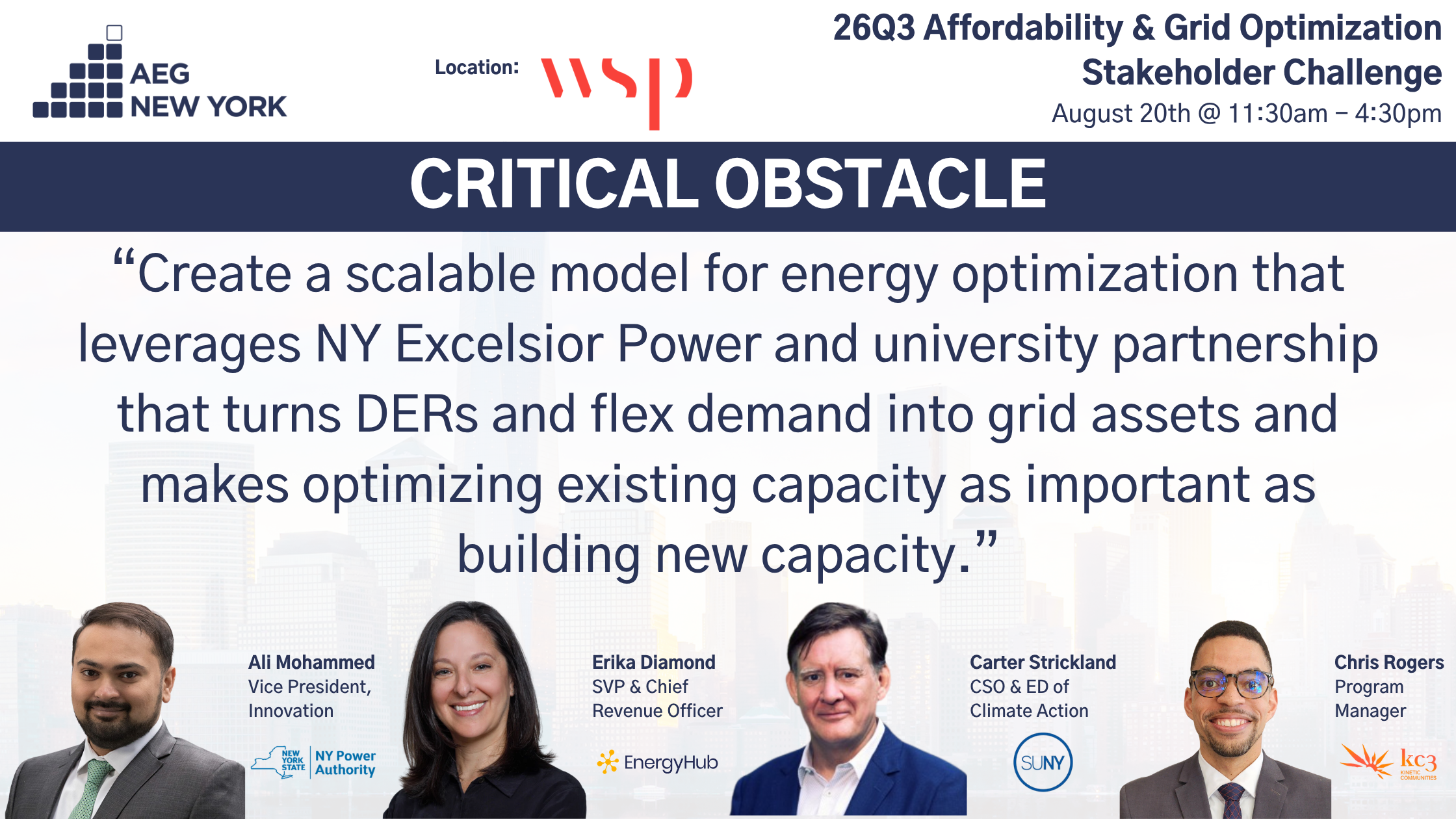
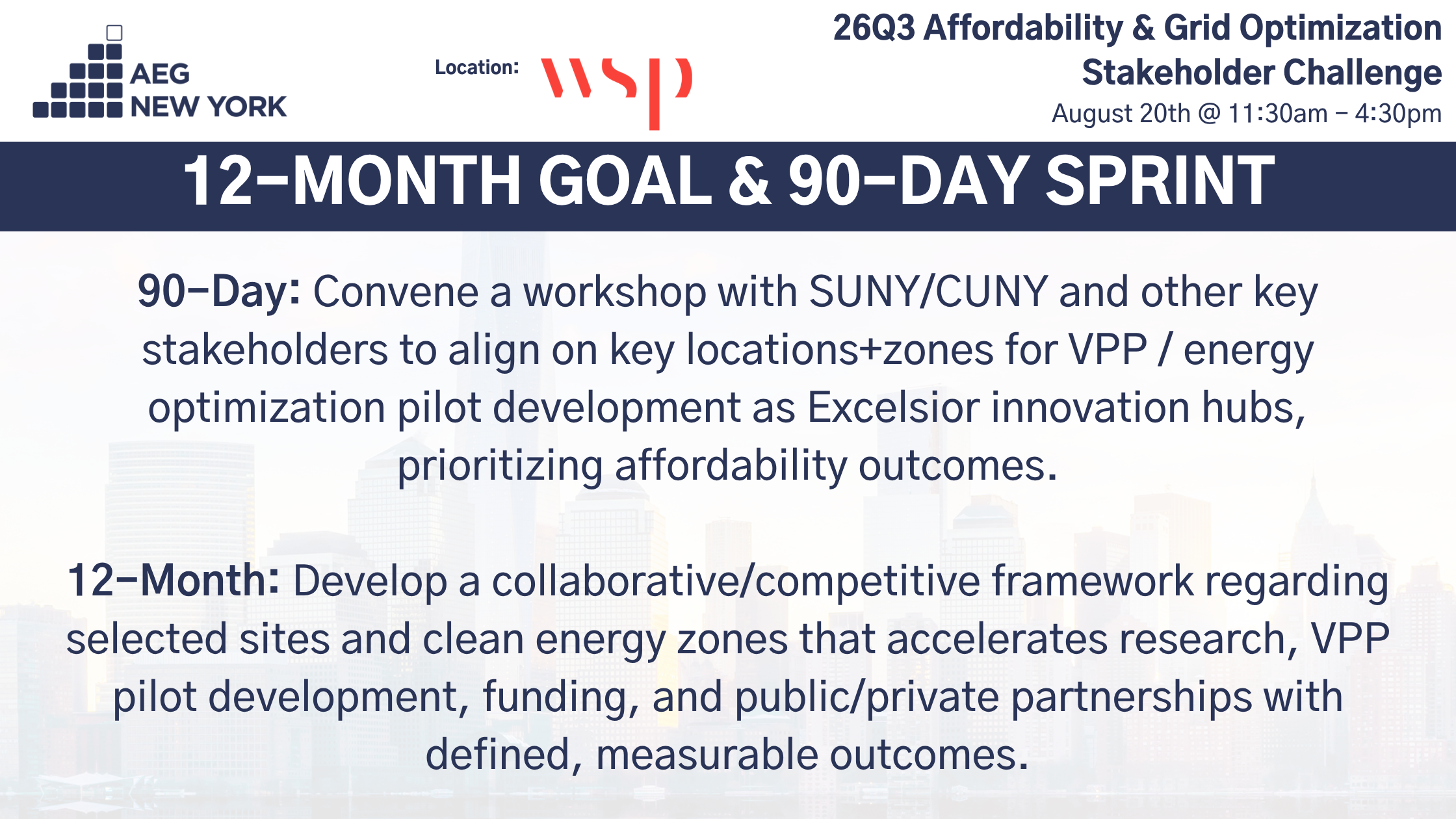
Inspired by the statements provided by Ali Mohammed (NY Power Authority), Erika Diamond (EnergyHub), Carter Strickland (SUNY), and Chris Rogers (Kinetic Communities Consulting - KC3) participants agreed to prioritize this selected obstacle statement: “Create a scalable model for energy optimization that leverages NY Excelsior Power and university partnership that turns DERs and flex demand into grid assets and makes optimizing existing capacity as important as building new capacity.” Participants then designed, and pitched a 90-day sprint and 12-month goal to best address this critical obstacle.
18 leaders formed a volunteer Task Force to complete the 90-day sprint and 12-month goal.
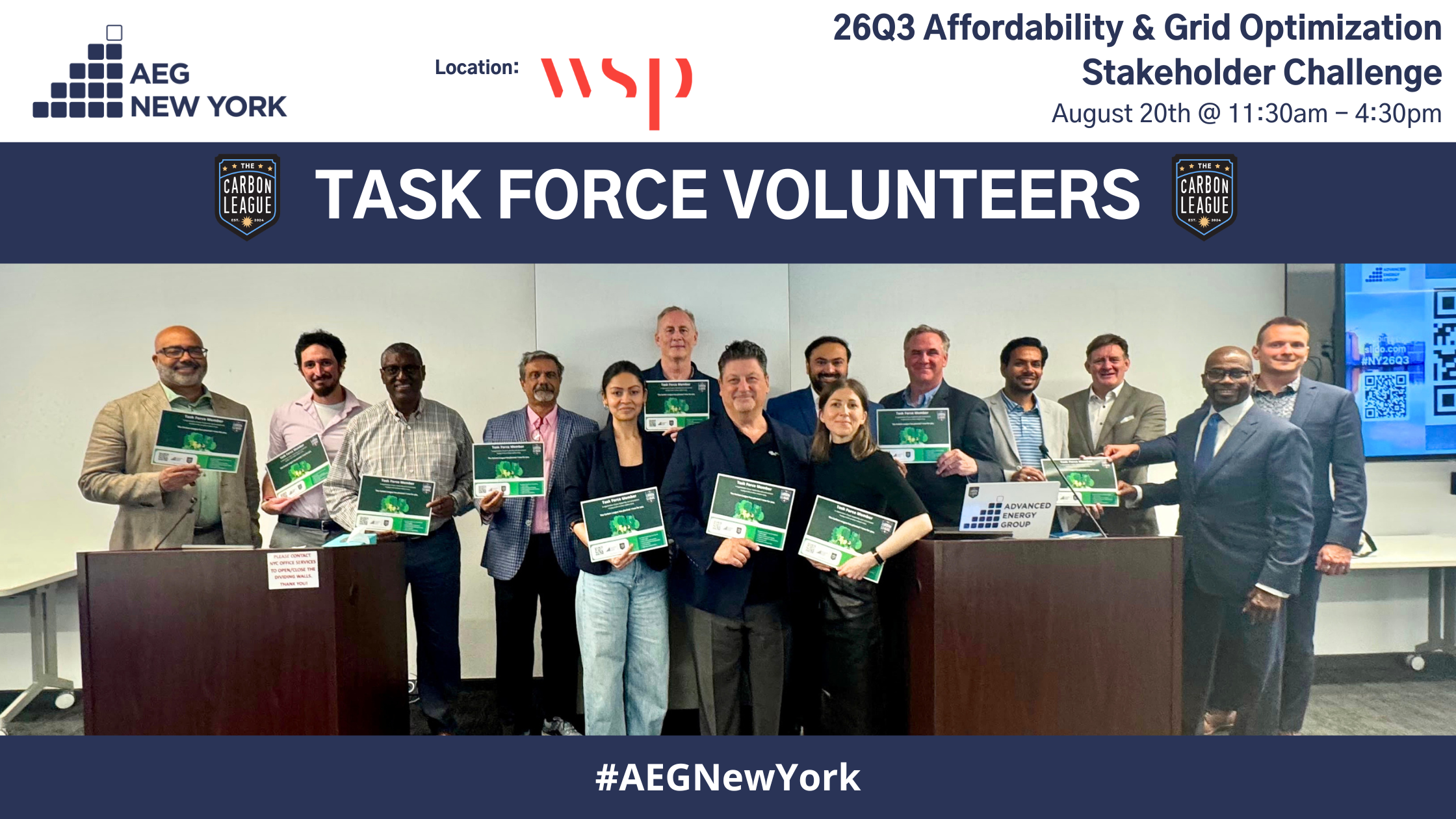
Task Force Volunteers (Listed A-Z): Alexandra Skibitskaya (Altanova), Ali Mohammed (NYPA) - Co-Lead, Andrea Marr (The Cadmus Group) - Co-Lead, Austin Kuebler (Schneider Electric), Carter Strickland (SUNY), Charvi Gupta (WSP USA), Chris DeWeaver (ELM), Chris Rogers (Kinetic Communities Consulting - KC3), Devin Young (Anthos), Donovan Gordon (DHG Consulting, LLC), Joe Stilin (ev.energy), John Joshi (CapUtility), KJ Jain (Landis+Gyr), Mark Handy (C+C), Matthew Landin (NYC EDC), Salvatore Prestano (CSA Group), Sarah Crowell (NYS Department of Public Service), and Tracey Woods (Alliance to Save Energy).
To join this group of volunteers, please contact us at info@goadvancedenergy.com.
The Carbon Leagues (TCL) Task Force Updates
During the session, leaders from ongoing TCL Task Forces delivered their 12-month and 90-day progress reports:
AEG NY 25Q3 EE + Grid Optimization (12-Month Update): Addressing the obstacle that "weatherization is not reaching Queens 2-12 unit buildings at scale. Two co-equal barriers: contractor participation economics and BPI-certified workforce supply," the task force engaged utilities and NYSERDA, drafted a segment concept paper, and secured endorsement from Queens Borough President Donovan Richards. Next steps: focus on hosting a DAC barriers session and contractor roundtable to enter the 2–12 unit gap into the public record before November 1.
AEG NY 25Q3 Health, Energy & Equity (330-Day Update): To address the barrier "to focus political will, private industry, utilities and resources on providing affordable, accessible cooling for the most vulnerable New Yorkers," the team partnered with local CBOs and installed 12 donated AC units in South Bronx homes. Next steps focus on securing funding and discounted units to reach 100 total installations—support the effort via The Carbon League Newsroom or Cooling Update Donation Campaign.
AEG NY 26Q1 Critical Infrastructure (270-Day Update): Tackling the challenge that "New York is moving fast. The ecosystem is still fragmented. Residents, CBOs, government, developers and capital providers often have to piece together programs, policy, funding, organizations and engagement opportunities from separate places," the team launched the Community Hub Platform to centralize state resources, policy, and funding by location. Next steps center on gathering user feedback and recruiting partners for pilot working groups.
AEG NY 26Q2 Building Decarbonization (90-Day Update): To address the need to "research and present business models for TEN pilots within North America building toward an open-source business-model tool and best-practices resource for the industry" the task force analyzed 18 projects to launch the 3-year Thermal Access to Public Capital (TAPC) initiative. Next steps include drafting standard TESA contracts and building the oTherm database—join by taking the TAPC Consortium Survey.
Conclusion
The AEG New York 26Q3 Affordability & Grid Optimization Stakeholder Challenge convened state regulators, utility executives, higher education leadership, grid technology providers, and community partners to confront the operational, rate design, and market infrastructure barriers slowing New York’s clean energy transition. The strategic focus centered on creating scalable models for local energy optimization, tailoring dynamic rate designs for affordable housing tenants, accelerating utility-university research validation pathways, scaling virtual power plant (VPP) participation statewide, and structuring thermal energy networks into bankable asset classes. Moving forward, stakeholders will advance a focused 90-day sprint dedicated to convening a workshop with SUNY, CUNY, and key stakeholders to align on priority locations and clean energy zones for VPP and energy optimization pilot development as Excelsior innovation hubs, prioritizing energy affordability outcomes. This collaborative alignment directly supports the overarching 12-month goal to establish a collaborative and competitive framework for selected sites and clean energy zones—accelerating applied research, VPP pilot deployment, public-private partnerships, and targeted capital delivery with defined, measurable outcomes. Ultimately, this Challenge establishes a coordinated, replicable pathway for New York to optimize existing grid capacity, lower energy costs, and ensure long-term, equitable prosperity for all residents.
Access to private resource pages, which include speaker presentations, and survey responses, from AEG Stakeholder Challenges is reserved for Signature Sponsors and City/Government Partners. To become a Signature Sponsor, learn more here: https://aeg.team/engage
Advanced Energy Group is a sponsor supported organization that facilitates quarterly challenges for high-impact stakeholders to deliver on health, energy and prosperity commitments for U.S. cities and vulnerable regions.