Executive Summary: August 5th AEG Philadelphia 26Q2 Campus & Building Decarbonization: Task Force Roundtable
Overview
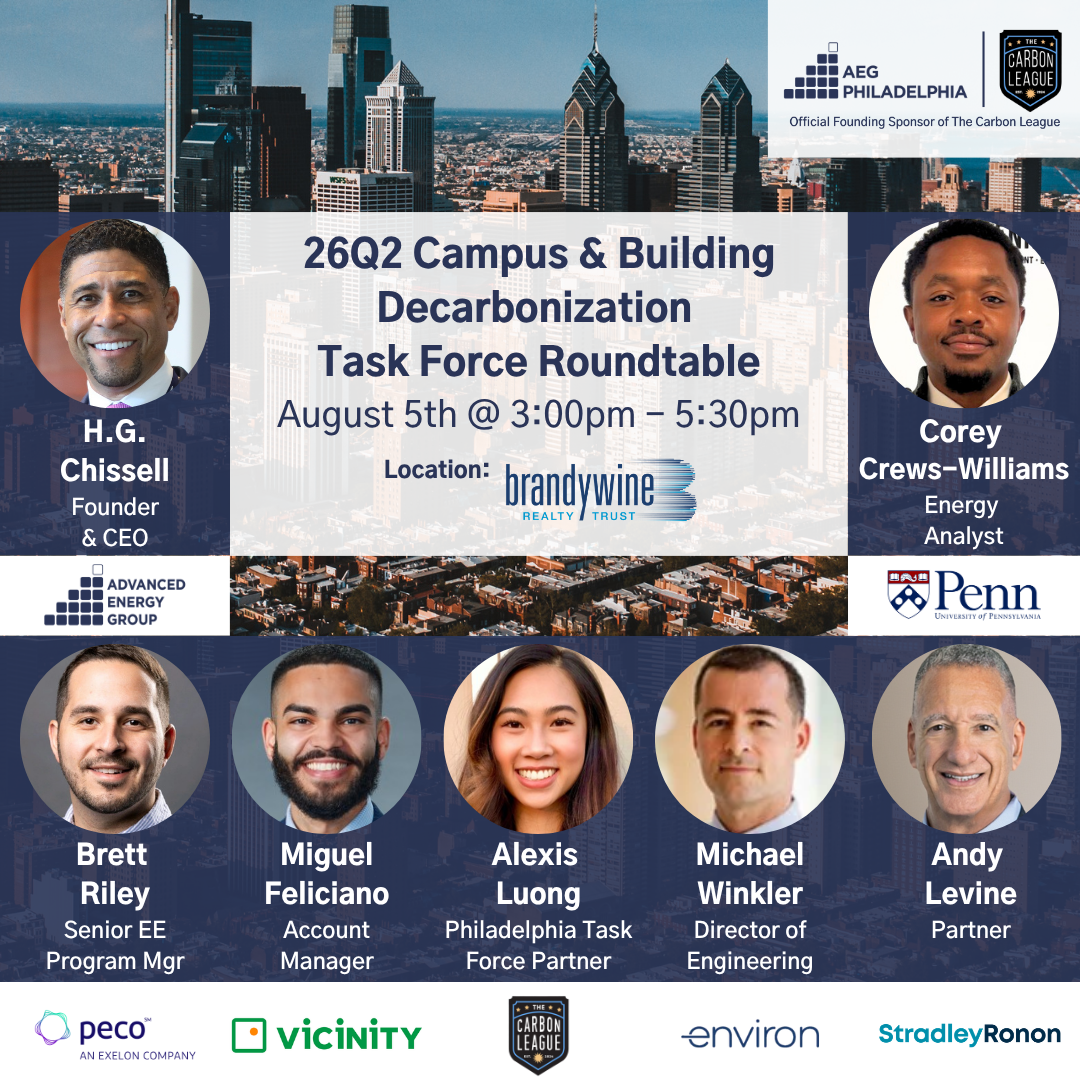
Held on August 5th, 2026 at Brandywine in Philadelphia, PA, seventeen public and private industry leaders convened for the AEG Philadelphia 26Q3 26Q2 Campus & Building Decarbonization: Task Force Roundtable. The purpose of this Roundtable was to: 1.) Present the AEG Philadelphia 26Q2 Task Force’s first 90-day milestone; 2.) Align on the next 90-day sprint to overcome a critical obstacle regarding Campus & Building Decarbonization.
H.G. Chissell, Founder & CEO, Advanced Energy Group provided welcome remarks for this session. Corey Crews-Williams, Energy Analyst, University of Pennsylvania - Task Force Co-Lead provided a Task Force Overview presentation, which summarized the core mission of the Task Force, their first 90-day sprint, and how they will work towards their 12-month objective. Brett Riley, Senior Energy Efficiency Program Manager, PECO, presented PECO's energy efficiency incentives and programs, highlighting how utility partnerships and Strategic Energy Management (SEM) can overcome fragmented priorities to achieve cost-effective building decarbonization and grid readiness.
TASK FORCE OVERVIEW
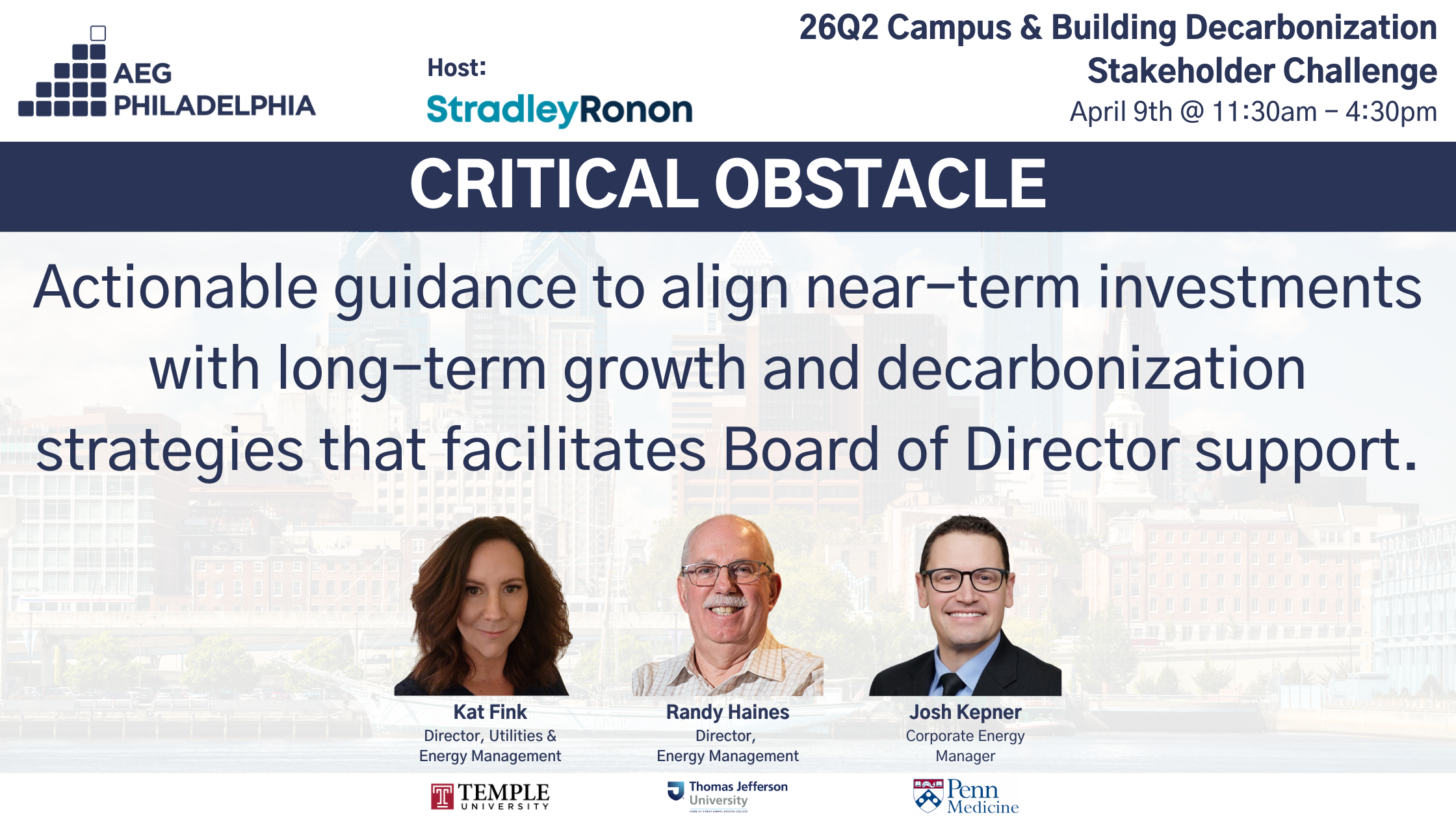
The AEG Philadelphia 26Q2 Task Force on Campus & Building Decarbonization was formed by 14 public and private leaders in April 2026 to address the critical obstacle inspired by Kat Fink (Temple University), Randy Haines (Thomas Jefferson University), and Joshua Kepner (Penn Medicine): “Actionable guidance to align near-term investments with long-term growth and decarbonization strategies that facilitates Board of Director support.”
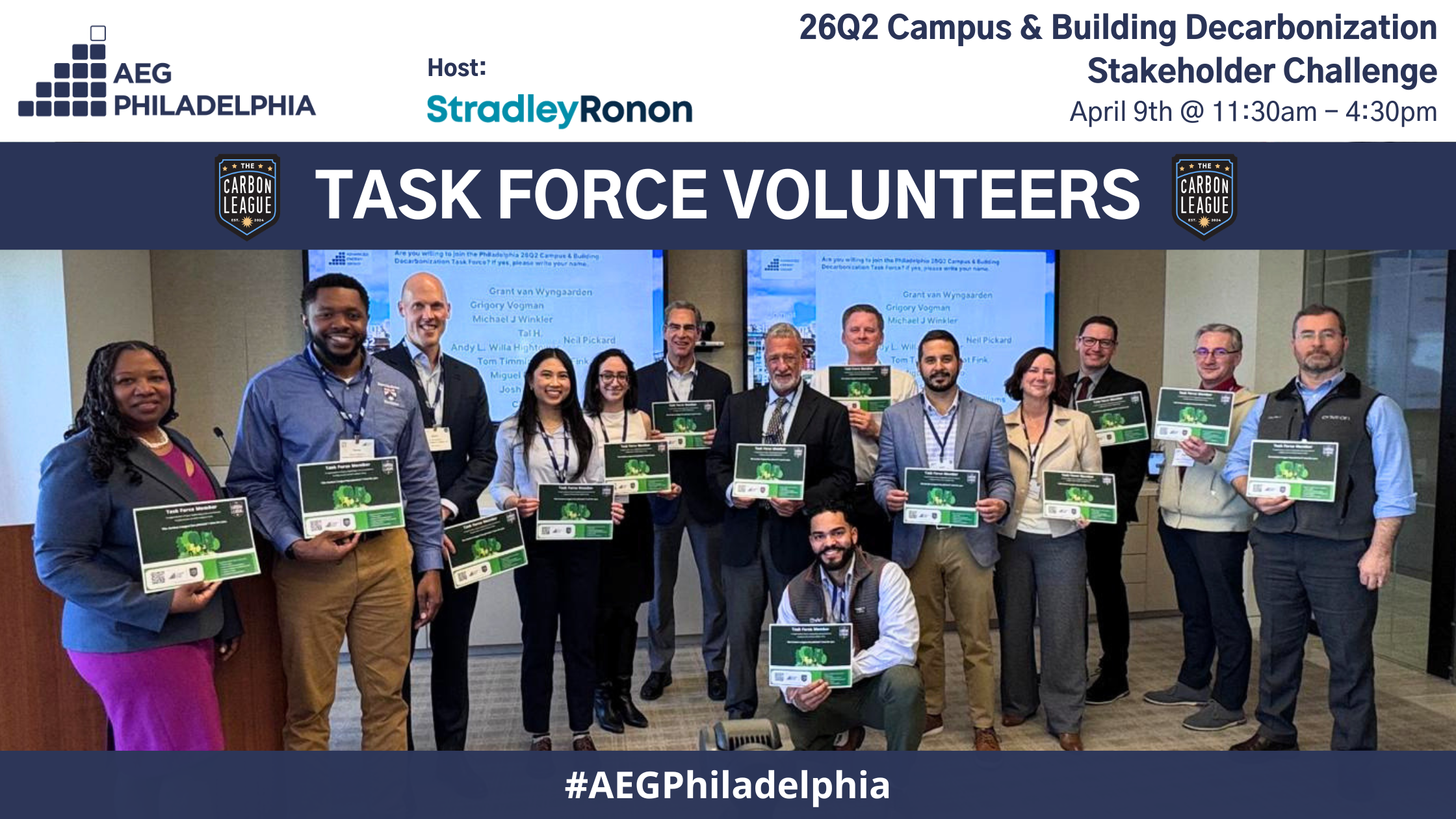
Task Force Volunteers (Listed A-Z): Eric Bayliss, (Constellation Energy); Nick Beale, (CHOP); Corey Crews-Williams, (Penn Medicine); Kat Fink, (Temple University); Miguel Feliciano, (Vicinity Energy); Willa Hightower, (WJ Hightower & Associates); Tal Henig-Hadar, (Willdan); Josh Kepner, (Penn Medicine); Alexis Luong, (The Carbon League); Andy Levine, (Stradley Ronon); Labaron Lenard-Palmer, (Green Building United); Neil Pickard, (The Cadmus Group); Brett Riley, (PECO/Exelon); Tom Timmins, (Ecosave); Grant Van Wyngaarden, (Bandorie); Grigory Vogman, (Temple University); Michael Winkler, (Environ Energy).
To address this critical obstacle, the Task Force committed to working together in 90-day sprints for 12-months. As the Task Force’s first 90-day sprint, they executed the “AEG Philadelphia 26Q2 Campus & Building Decarbonization: Task Force Roundtable”, which focused on convening regional leaders to build a board-ready value proposition that connects decarbonization directly to cost control, resilience, financial stability, and risk mitigation. This foundational effort directly feeds into their overarching 12-month objective to develop and present a unified "No Regrets Playbook" in collaboration with students to Temple University, the University of Pennsylvania, and Thomas Jefferson University, ultimately securing near-term capital funding and long-term board commitment.
ROUNDTABLE RESULTS
Participants were tasked to identify 3 key ingredients to develop an effective value proposition for campus boards. From this exercise, the below 3 key ingredients were identified:
1. Financial Stability and Risk Mitigation
Frame sustainable energy investments as an essential buffer for institutional operating margins, providing long-term protection against rising energy volatility, predictable capital outlays, and asset-level risk management.
2. Proactive Policy Leadership and Peer Benchmarking
Position decarbonization as a proactive strategy to stay ahead of evolving regulatory compliance mandates while leveraging peer benchmarking and higher education rankings to maintain competitive institutional standing.
3. Institutional Value Creation and Stakeholder Engagement
Highlight how visible sustainability commitments create cultural and strategic value by energizing campus communities, alleviating climate anxiety, and strengthening recruitment and retention across students, faculty, and alumni networks.
Proposed Next 90-Day Sprint
Participants brainstormed what would be an ideal 90 day next step for this Task Force effort. The general consensus was to convene higher education board members, executive institutional leadership, utility partners, and key industry stakeholders to establish a comprehensive, board-ready framework that equips Boards of Trustees with the strategic, financial, and governance insights required to evaluate, prioritize, and capital-fund long-term campus decarbonization, infrastructure modernization, and climate resilience strategies.
Potential Key Action Items & Deliverables:
Board Listening Sessions & Forums: Host targeted listening sessions with trustees and establish a joint forum with developers and architects to align campus master planning with sustainability goals.
Board Leadership Briefing Paper: Publish a board-ready brief outlining how governance structures can elevate decarbonization while addressing risk, cost control, and resilience.
Industry Panels & Network Alignment: Organize a governance-focused panel at major industry conferences and partner with higher education networks (APPA/AASHE) for peer mentorship.
Conclusion
The AEG Philadelphia 26Q2 Campus & Building Decarbonization Task Force Roundtable convened higher education, utility, and industry leaders to overcome governance, financial, and departmental barriers to campus decarbonization. Strategic priorities centered on framing decarbonization as a board-ready financial asset, bridging internal operational silos, mitigating rate volatility risks, and asserting proactive policy leadership. Moving forward, stakeholders will execute a 90-day sprint focused on board listening sessions, a leadership briefing paper, and university association partnerships to embed sustainability into institutional governance. This work directly drives the 12-month goal to deliver a unified "No Regrets Playbook" to Temple, Penn, and Thomas Jefferson University to secure near-term funding and long-term board commitments. Ultimately, this initiative provides a replicable pathway for Philadelphia campuses to stabilize budgets, protect assets, and accelerate grid-ready resilience.
Access to private resource pages, which include speaker presentations, and survey responses, from AEG Stakeholder Challenges is reserved for Signature Sponsors and City/Government Partners. To become a Signature Sponsor, learn more here: https://aeg.team/engage
Advanced Energy Group is a sponsor supported organization that facilitates quarterly challenges for high-impact stakeholders to deliver on health, energy and prosperity commitments for U.S. cities and vulnerable regions.