Executive Summary: August 6th AEG Philadelphia Affordability & Grid Optimization Stakeholder
Overview
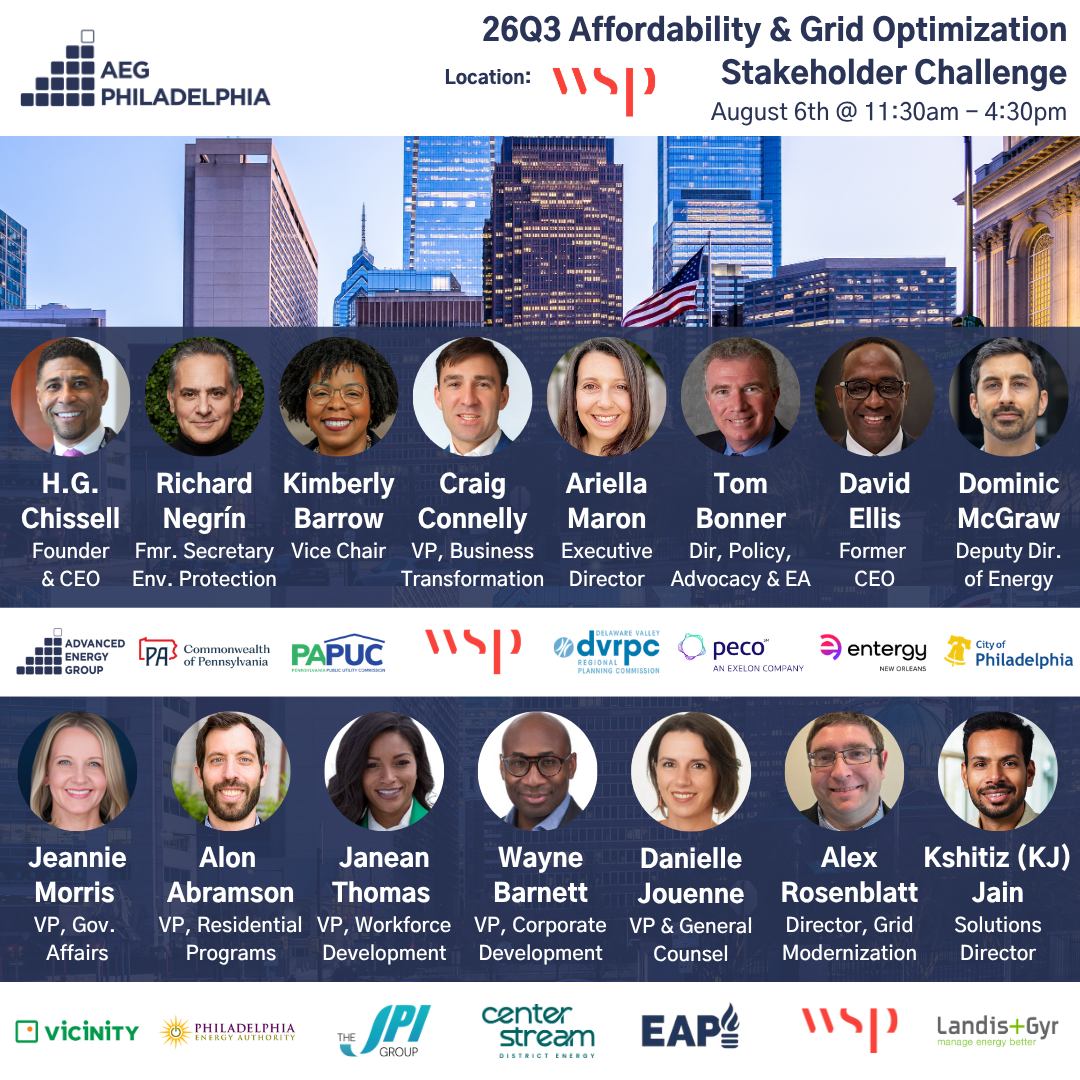
Held on August 6th, 2026 at WSP USA in Philadelphia, PA, thirty-eight public and private industry leaders convened for the AEG Philadelphia 26Q3 Affordability & Grid Optimization Stakeholder Challenge. The purpose of this challenge was to: 1.) Align on a critical obstacle regarding Affordability & Grid Optimization for Greater Philadelphia; 2.) Engage as cross sector teams to agree on a 90-day sprint and 12-month goal; 3.) Empower leaders to deliver the solution and present the outcome in 12 months with 90 day sprints.
Craig Connelly, Vice President of Business Transformation Energy & Innovation, WSP, Kimberly Barrow, Vice Chair, Pennsylvania Public Utility Commission, Richard Negrín, Fmr. PA Secretary of Environmental Protection, Commonwealth of Pennsylvania, opened the conversation, providing diverse perspectives to frame the discussion surrounding Affordability & Grid Optimization for Greater Philadelphia.
Opening remarks were followed by the Speaker Challenge, where each speaker provided a presentation that concluded with this completed statement: "Regarding Affordability & Grid Optimization, to achieve Greater Philadelphia's energy, health and prosperity goals, a critical obstacle to collectively overcome in 12 months is _________."
5 Key Themes
1. Consumer Protection and Retail Energy Market Reform
Mitigating energy burdens across Greater Philadelphia requires reforming predatory retail electric supplier practices that inflate customer bills when contracts expire. Rather than limiting clean energy access, stakeholders emphasized establishing policy protections that prevent above-market price spikes while preserving transparent green power options for consumers.
"Lack of consensus on policy related to retail clean energy products is the most significant barrier to retail market reforms that could save Pennsylvania consumers hundreds of millions of dollars each year." - Tom Bonner, Director, Policy, Advocacy & External Affairs, PECO
2. Cross-Utility Integrated Planning and Co-Location
Eliminating redundant capital expenses and repeated street excavations depends on breaking down the planning silos between Philadelphia's electric, gas, water, and steam utilities. Establishing a shared utility planning framework enables coordinated infrastructure placement, unlocking cross-system synergies like microgrids and waste-heat recovery to reduce overall ratepayer burdens.
"Bring Philadelphia's utilities into a shared planning process — so infrastructure gets sited once, in the place that serves everyone best." - Dominic McGraw, Deputy Director, Energy & Administration, City of Philadelphia
3. Eliminating Supply and Demand Delivery Bottlenecks
Accelerating clean power delivery requires dismantling the administrative delays, permitting backlogs, and transmission constraints currently bottlenecking energy projects. Concurrently, regional initiatives must equip local municipalities with the technical capacity, funding, and administrative support needed to deploy demand-side optimizations without delay.
"The market is ready to provide more supply; but transmission infrastructure and regulatory hurdles have blocked progress." - Ariella Maron, Executive Director, DVRPC
4. Pathways for Privately Financed Infrastructure & Large Load Growth
Managing sudden load growth from data centers and institutional expansions demands a structured framework that accommodates rising demand while shielding residential customers from PJM capacity price spikes. Establishing a clear Pennsylvania regulatory pathway alongside large-load tariffs allows private capital to fund integrated energy assets without shifting development risks onto local ratepayers.
"The choice is not whether privately financed energy infrastructure will grow — it is whether this region shapes that growth, or reacts to it.” - Wayne Barnett, Vice President, Corporate Development, Strategy & External Affairs, Centerstream
5. Multi-Stakeholder Coalition Building and Policy Execution
Overcoming grid capacity constraints and regulatory inertia necessitates active, structured collaboration among state regulators, utility leadership, municipal authorities, and community advocates. Mobilizing key partners into action-oriented working groups ensures the region moves beyond analytical reports to enact enforceable rules and legislative reforms during active regulatory windows.
"Convene a Greater Philadelphia working group this fall... The output has to be rules, not a report — and the window is open: tariff filings are live now; the fall 2026 session is ahead." - Wayne Barnett, Vice President, Development, Strategy & External Affairs, Centerstream
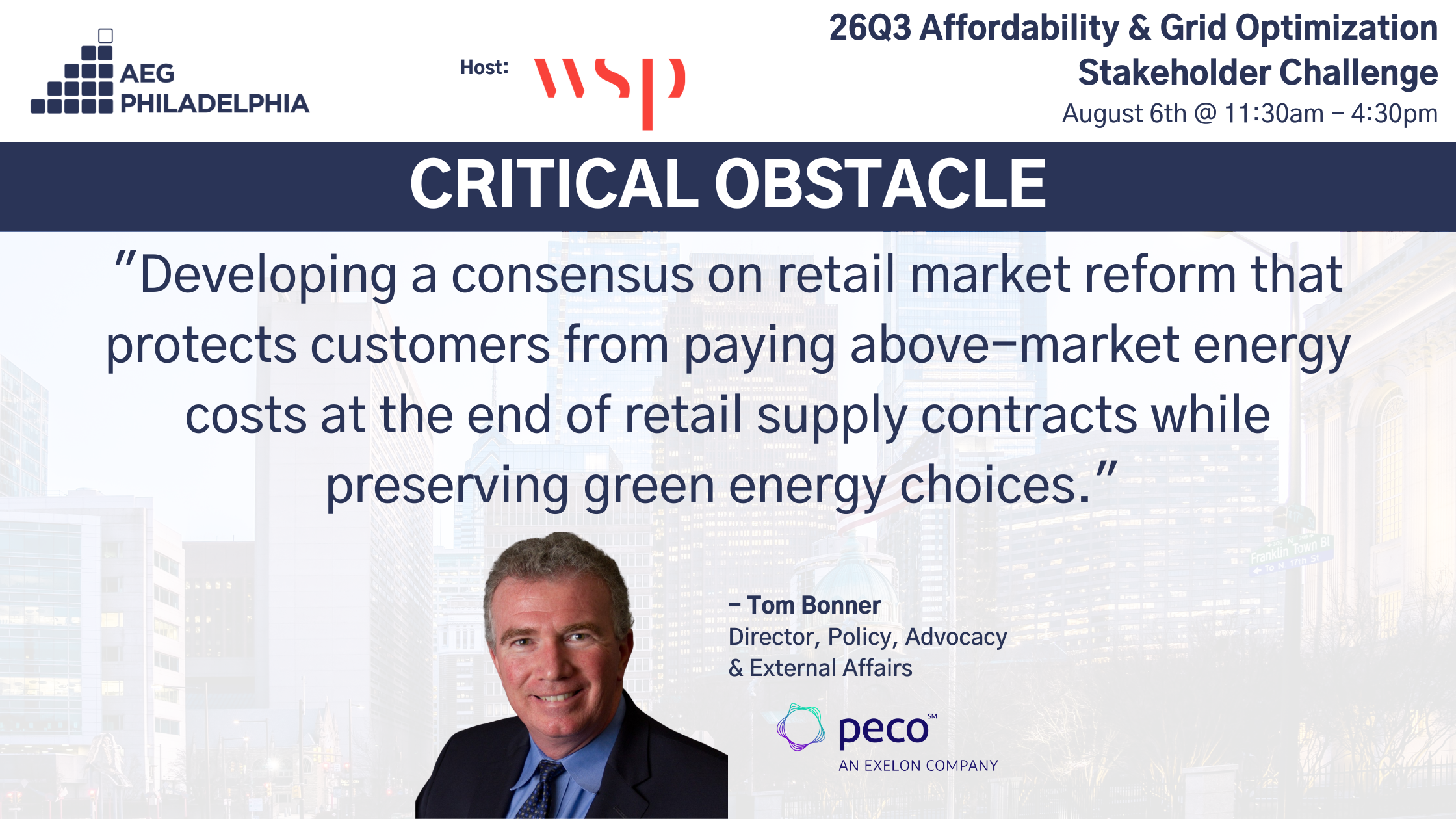
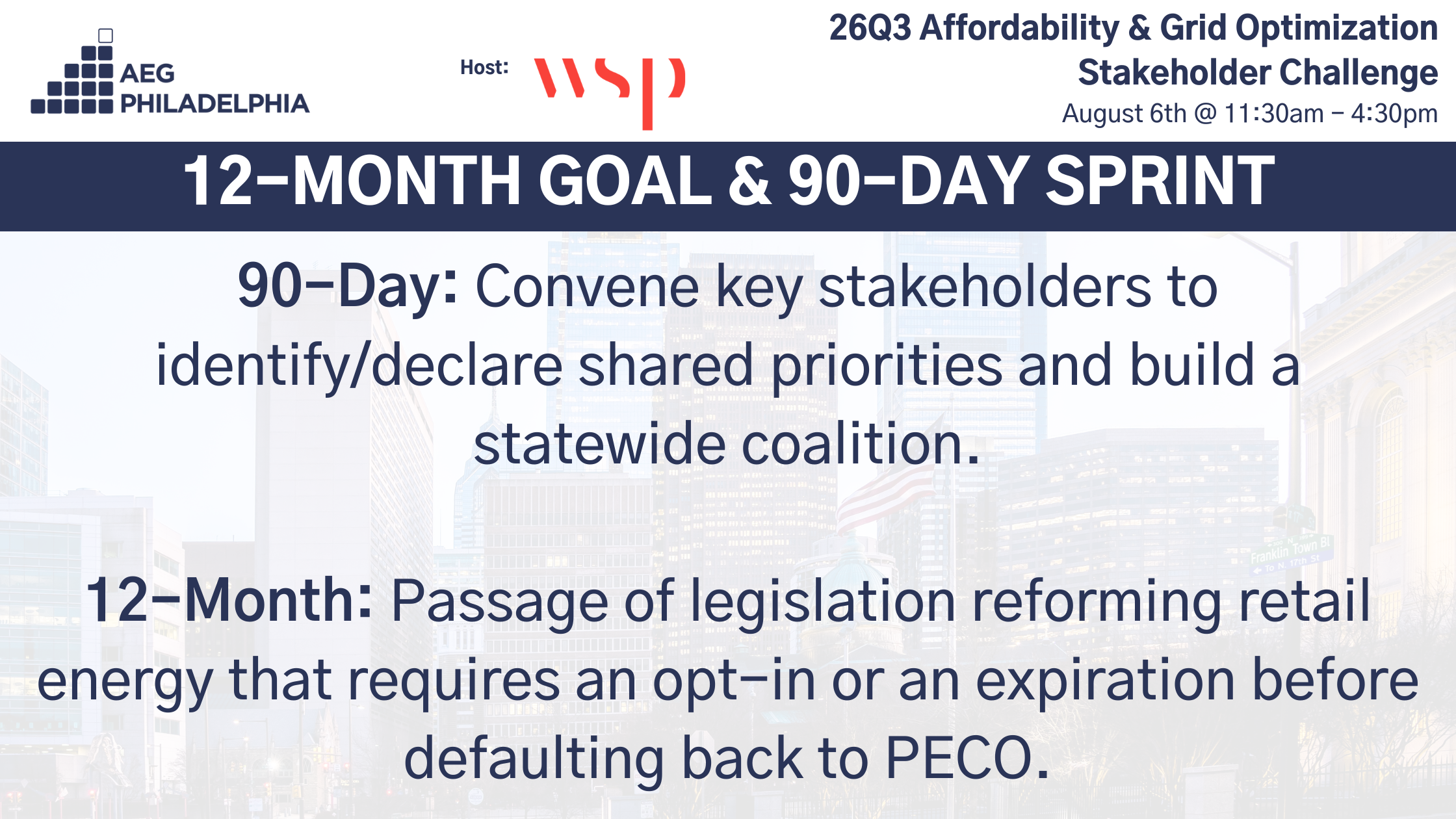
Inspired by the statement provided by Tom Bonner (PECO) participants agreed to prioritize this selected obstacle statement: “Developing a consensus on retail market reform that protects customers from paying above-market energy costs at the end of retail supply contracts while preserving green energy choices.” Participants then designed, and pitched a 90-day sprint and 12-month goal to best address this critical obstacle.
10 leaders formed a volunteer Task Force to complete the 90-day sprint and 12-month goal.
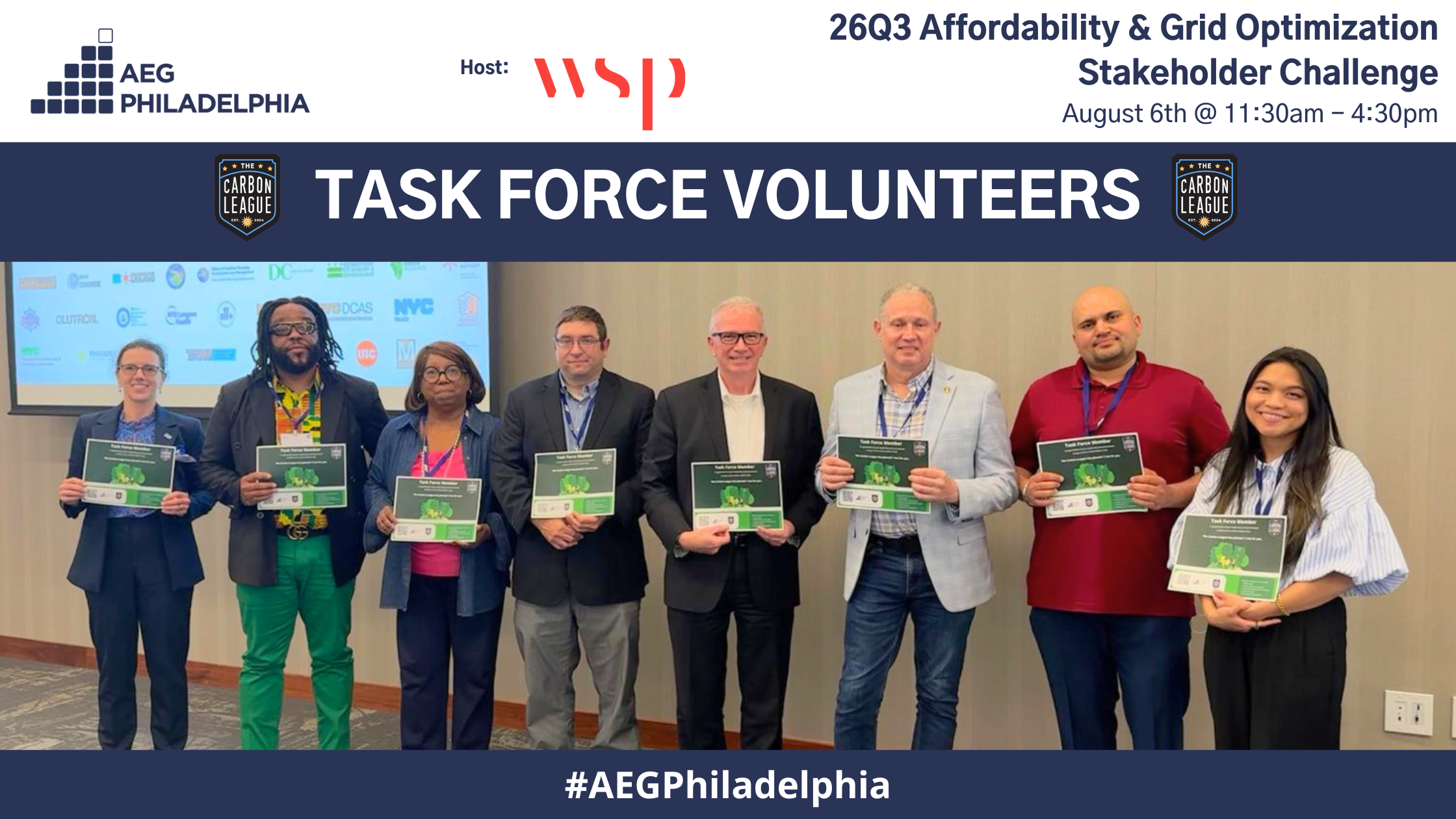
Task Force Volunteers (Listed A-Z): Alex Rosenblatt (WSP), Danielle Jouenne (Energy Association of Pennsylvania), John Tull (W8less), Keith Henderson (PECO), Kristen Palma (CLEAResult), Liz Compitello (DVRPC), Nancy Mifflin (LLC), Shelby Langlois (PECO), Tom Bonner (PECO), Varun Thakkar (CLEAResult)
To join this group of volunteers, please contact us at info@goadvancedenergy.com.
Conclusion
The AEG Philadelphia 26Q3 Affordability & Grid Optimization Stakeholder Challenge convened state regulators, utility executives, regional planners, grid technology leaders, and community partners to confront the regulatory, inter-utility, and market barriers slowing the clean energy transition. The strategic focus centered on reforming predatory retail energy supplier practices, breaking down capital planning silos between electric, gas, water, and steam utilities, accelerating project delivery schedules, and establishing clear regulatory pathways for privately financed infrastructure. Moving forward, stakeholders will advance a focused 90-day sprint dedicated to convening key stakeholders to identify shared priorities and build a statewide coalition to evaluate policy terms, align advocacy groups, and build momentum around customer protection and market reform. This collaborative alignment will directly support the overarching 12-month goal to pass legislation reforming retail energy that requires an opt-in or an expiration before defaulting back to PECO, elevating customer voices and making retail market improvements a statewide priority. Ultimately, this Challenge establishes a coordinated, replicable pathway for Greater Philadelphia to eliminate redundant utility costs, protect consumers from severe rate burdens, and ensure long-term, equitable prosperity for all residents.
Access to private resource pages, which include speaker presentations, and survey responses, from AEG Stakeholder Challenges is reserved for Signature Sponsors and City/Government Partners. To become a Signature Sponsor, learn more here: https://aeg.team/engage
Advanced Energy Group is a sponsor supported organization that facilitates quarterly challenges for high-impact stakeholders to deliver on health, energy and prosperity commitments for U.S. cities and vulnerable regions.