Executive Summary: July 23rd AEG Chicago Stakeholder Challenge: Affordability & Grid Optimization
Overview
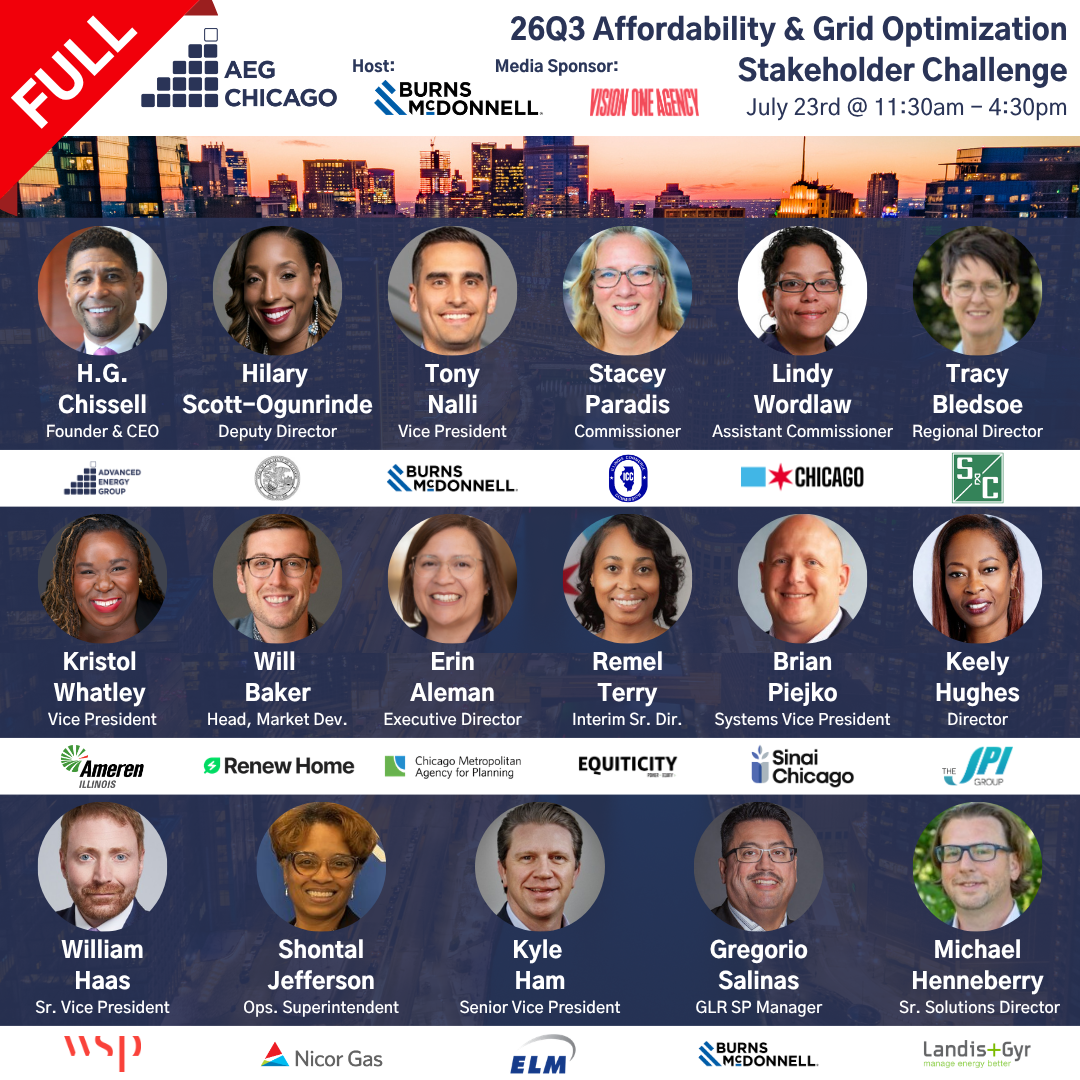
Held on July 23rd, 2026 at Burns & McDonnell in Chicago, IL, fifty-eight public and private industry leaders convened for the AEG Chicago 26Q3 Affordability & Grid Optimization Stakeholder Challenge. The purpose of this challenge was to: 1.) Align on a critical obstacle regarding Affordability & Grid Optimization for Chicagoland; 2.) Engage as cross sector teams to agree on a 90-day sprint and 12-month goal; 3.) Empower leaders to deliver the solution and present the outcome in 12 months with 90 day sprints.
Tony Nalli, Vice President T&D Regional Manager for Burns & McDonnell, Stacey Paradis, Commissioner of Illinois Commerce Commission, Hilary Scott-Ogunrinde, Deputy Director of Energy & Business Utility for State of Illinois, Erin Aleman, Executive Director for Chicago Metropolitan Agency for Planning and Lindy Wordlaw, Assistant Commissioner for City of Chicago, opened the conversation, providing diverse perspectives to frame the discussion surrounding Affordability & Grid Optimization for Chicago.
Opening remarks were followed by the Speaker Challenge, where each speaker provided a presentation that concluded with this completed statement: "Regarding Affordability & Grid Optimization, to achieve Chicagoland's energy, health and prosperity goals, a critical obstacle to collectively overcome in 12 months is _________."
5 Key Themes
1. Workforce Ecosystem Optimization & Simplification
Connecting employers to job seekers requires streamlining and unifying existing workforce development (WFD) programs across Illinois. Rather than creating new programs, stakeholders emphasized mapping existing initiatives to bridge gaps and make entry pathways clear for the talent needed in growing infrastructure sectors.
"Strengthening Illinois' economy by simplifying workforce programs for job seekers and connecting employers to the talent needed for business and infrastructure growth." — Kristol Whatley-Simms, Vice President, Clean Energy Transition, Ameren Illinois
2. Accreditation & Recognition of Residential Demand Flexibility
To address capacity shortfalls and rising costs, Illinois must establish formal standards that count home virtual power plants (VPPs) and flexible load devices toward grid capacity. Without state accreditation, gigawatts of available residential flexibility remain uncounted, forcing consumers to pay higher costs for backstop power procurement.
"The lack of a state standard for counting residential flexibility as capacity." — Will Baker, Head of Market Development, Renew Home
3. Community-Centric Planning & Collaborative Partnerships
Achieving an affordable and resilient electric grid depends on establishing clear data-sharing, regional frameworks, and local engagement strategies. Regional bodies need to equip local communities with the right planning tools to support long-term electrification and grid stability.
"Defining the information, partnerships, and planning approaches needed to help communities actively support an affordable, reliable, and resilient electric grid." — Erin Aleman, Executive Director, Chicago Metropolitan Agency for Planning
4. Accelerating Grid-Edge Technology Deployment
Mitigating distribution line outages requires deploying automation and advanced grid technologies closer to end-users. Scaling proven grid-edge solutions enhances overall reliability and resilience while keeping long-term electricity costs manageable for consumers.
"Accelerating the large-scale deployment of proven grid optimization technologies at the grid edge that improve reliability and resilience while keeping electricity affordable for customers." — Tracy Bledsoe, Regional Director, S&C Electric
5. Balancing Climate Goals with Equity and System Reliability
Grid decarbonization must be balanced against low-income household protections, system reliability, and economic development. Regulatory agencies and utilities need to collaborate with diverse stakeholders to maintain support programs for low-to-moderate-income (LMI) residents while transitioning the energy system.
"Keeping the lights on while advancing climate goals. Maintaining assistance/programs for LMI households. Supporting economic development." — Stacey Paradis, Commissioner, Illinois Commerce Commission
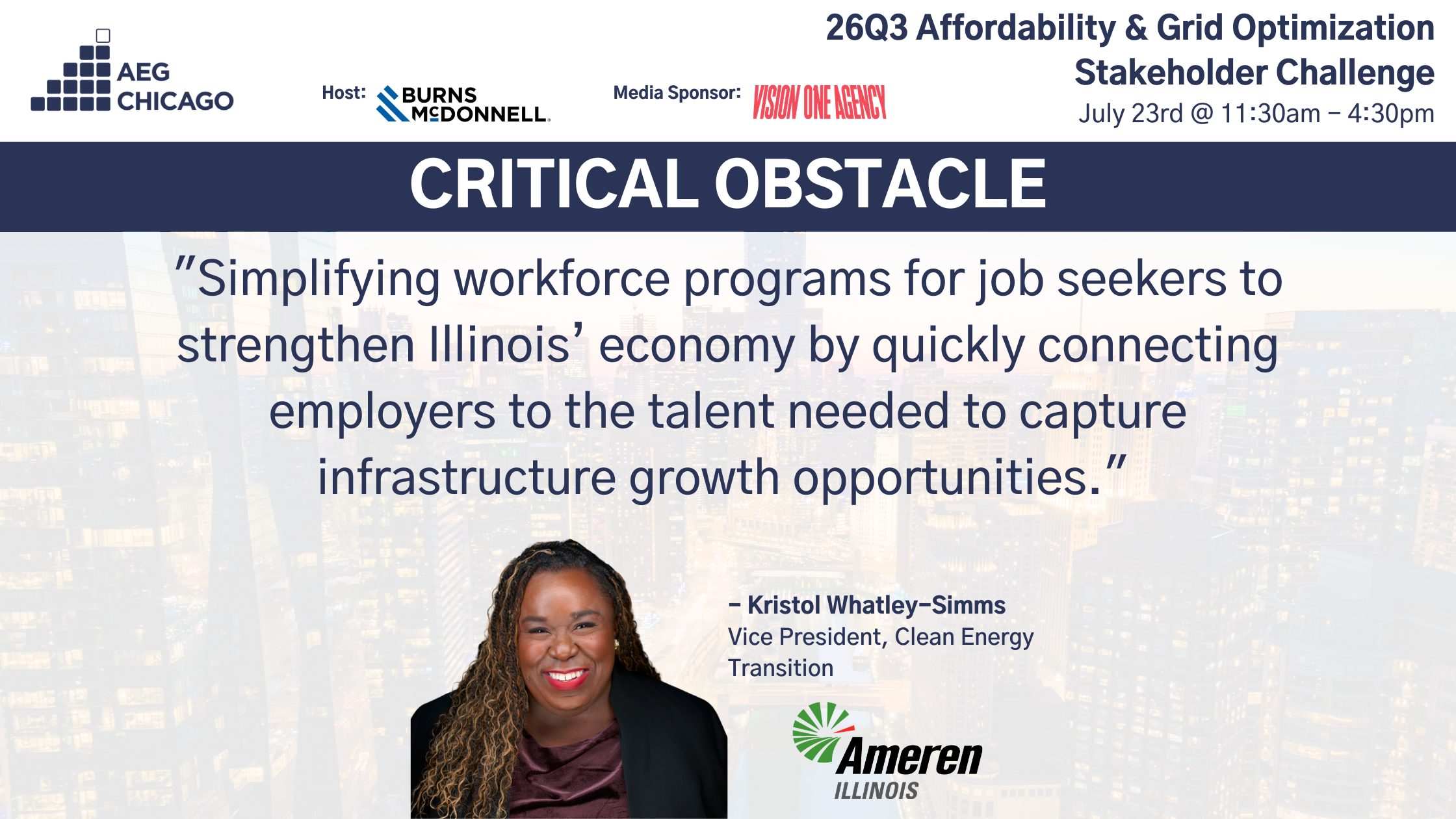
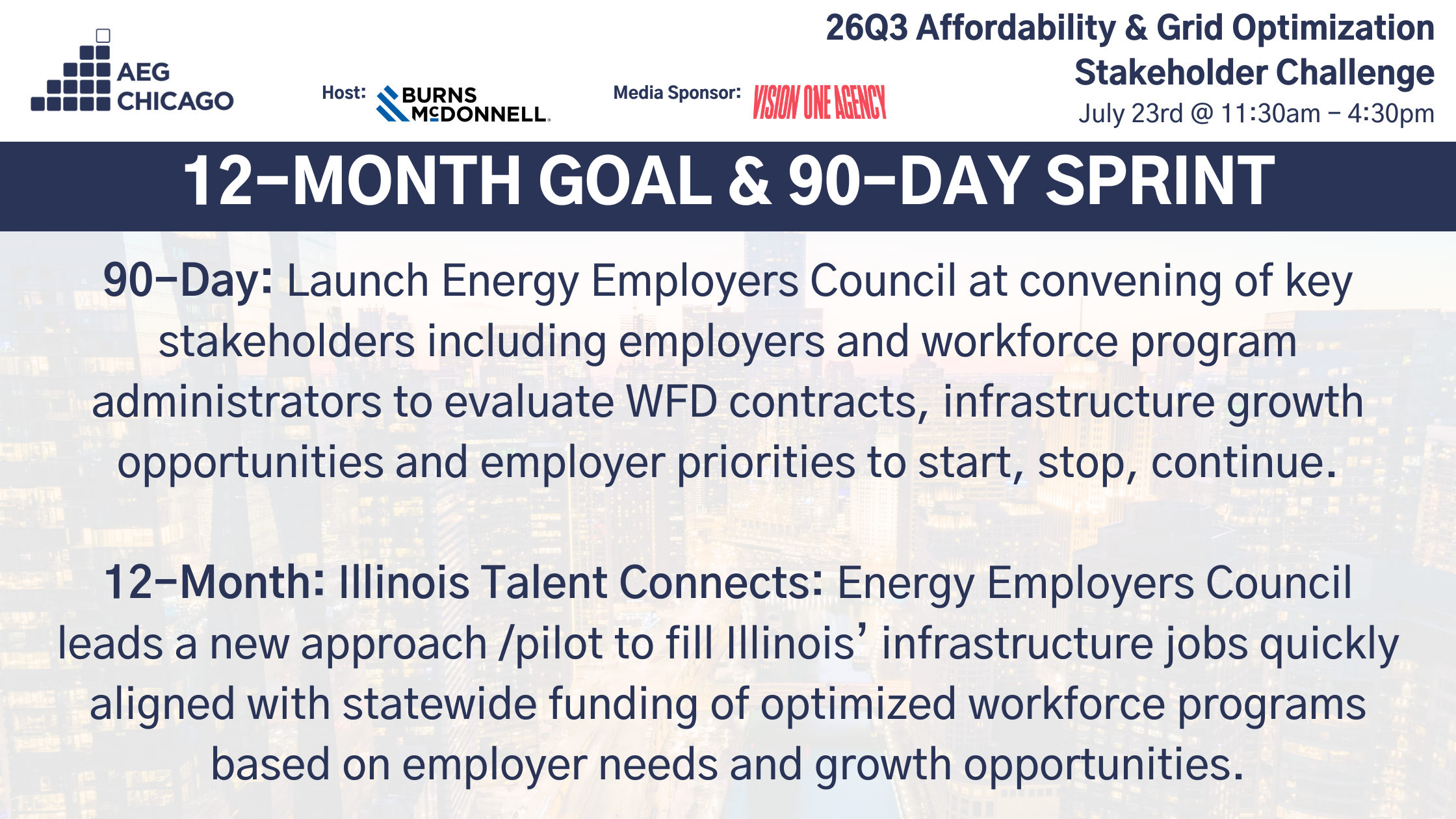
Inspired by the statement provided by Kristol Whatley-Simms (Ameren Illinois), participants agreed to prioritize this selected obstacle statement: "Simplifying workforce programs for job seekers to strengthen Illinois’ economy by quickly connecting employers to the talent needed to capture infrastructure growth opportunities.” Participants then designed, and pitched a 90-day sprint and 12-month goal to best address this critical obstacle.
13 leaders formed a volunteer Task Force to complete the 90-day sprint and 12-month goal.
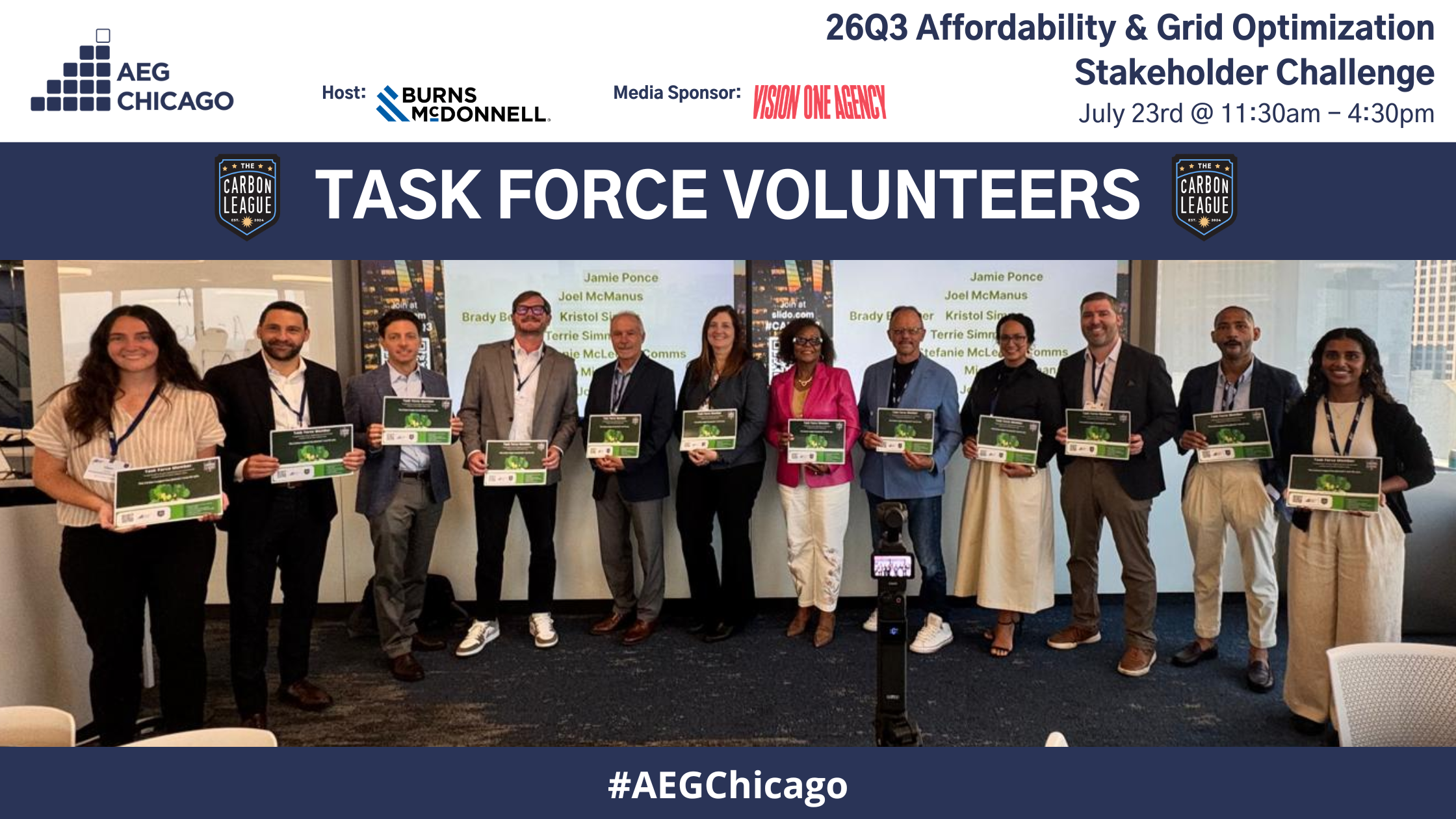
Task Force Volunteers (Listed A-Z): Brady Bedeker (Walker-Miller Energy Services), Ciara Henry (The Carbon League), Deb Dynako (Energy Infrastructure Partners), Isha Sura (The Carbon League), Jamie Ponce (Civic Infrastructure Collaborative), Joel McManus (TRC Companies), John Sztykiel (Harbinger Motors), Jonathan Haas (ICF), Kristol Whatley-Simms (Ameren Illinois), Michael Pittman (Ameren Illinois), Ryan Wolfe (Illinois DCEO), Stefanie Santos McLeese, Terrie Simmons (Lewis Simmons Foundation)
To join this group of volunteers, please contact us at info@goadvancedenergy.com.
Conclusion
The AEG Chicago 26Q3 Affordability & Grid Optimization Stakeholder Challenge convened state regulators, utility executives, regional planners, grid technology leaders, and community partners to confront the regulatory, technological, and workforce barriers slowing the clean energy transition. The strategic focus centered on simplifying and connecting existing workforce programs to talent pipelines, establishing state accreditation standards for residential demand flexibility, deploying grid-edge optimization technologies, and equipping local communities with regional planning tools. Moving forward, stakeholders will advance a focused 90-day sprint dedicated to launching an Energy Employers Council at a convening of key stakeholders—including employers and workforce program administrators—to evaluate WFD contracts, infrastructure growth opportunities, and employer priorities to start, stop, or continue key initiatives. This collaborative alignment will directly support the overarching 12-month goal to launch Illinois Talent Connects, where the Energy Employers Council leads a new pilot approach to fill Illinois’ infrastructure jobs quickly, aligned with statewide funding of optimized workforce programs based on employer needs and growth opportunities. Ultimately, this Challenge establishes a coordinated, replicable pathway for Chicago to bridge critical grid capacity and workforce gaps, maintain system reliability, and ensure long-term, equitable prosperity for all residents.
Access to private resource pages, which include speaker presentations, and survey responses, from AEG Stakeholder Challenges is reserved for Signature Sponsors and City/Government Partners. To become a Signature Sponsor, learn more here: https://aeg.team/engage
Advanced Energy Group is a sponsor supported organization that facilitates quarterly challenges for high-impact stakeholders to deliver on health, energy and prosperity commitments for U.S. cities and vulnerable regions.