Executive Summary: July 21st AEG East St. Louis Stakeholder Challenge: Health, Prosperity & Resilience
Overview
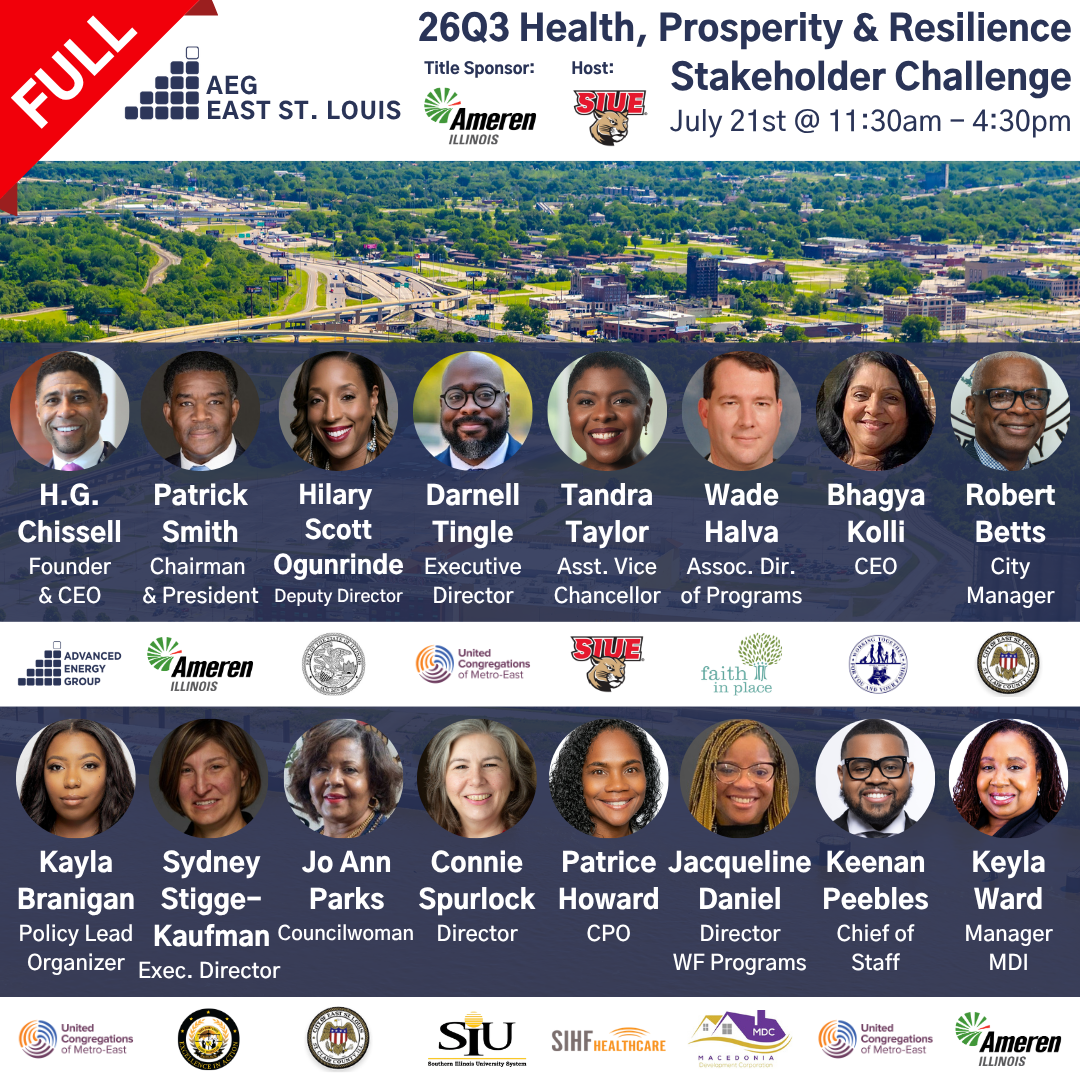
Held on July 21st, 2026 at Southern Illinois University Edwardsville in East St Louis, IL, sixty-four public and private industry leaders convened for the AEG East St Louis 26Q3 Health, Prosperity & Resilience Stakeholder Challenge. The purpose of this challenge was to: 1.) Align on a critical obstacle regarding Health, Prosperity & Resilience for East St Louis; 2.) Engage as cross sector teams to agree on a 90-day sprint and 12-month goal; 3.) Empower leaders to deliver the solution and present the outcome in 12 months with 90 day sprints.
Tandra Taylor, Assistant Vice Chancellor for Educational Pathways and Community Engagement, SIUE, Patrick Smith, Chairman & President, Ameren Illinois, and Robert Betts, City Manager, City of East St. Louis opened the conversation, providing diverse perspectives to frame the discussion surrounding Health, Prosperity & Resilience for East St Louis.
Opening remarks were followed by the Speaker Challenge, where each speaker provided a presentation that concluded with this completed statement: "Regarding health, prosperity, and resilience for East St. Louis, a critical obstacle to collectively overcome in 12 months is _________."
5 Key Themes
1. Coordinated Health, Food, and Transportation Infrastructure
A central barrier to community resilience is the lack of an integrated network connecting residents to critical preventive health services, healthy food choices, and reliable transit. Overcoming this requires mapping resources and aligning routes and schedules to streamline access.
“The lack of a coordinated access system that connects residents to preventive care, healthy food, and transportation." - Bhagya Kolli, Public Health Administrator (CEO), East Side Health District
2. Rebuilding Civic Participation and Confidence
Decades of systemic disinvestment have eroded local civic trust, resulting in low voter engagement. Re-engaging community members through open dialogue and education is essential to restoring public confidence and driving local policy.
"Regarding health, prosperity, and resilience for East St. Louis, a critical obstacle to collectively overcome in the next 12 months is rebuilding civic confidence through sustained civic participation." - Kayla Branigan, Policy Lead Organizer, United Congregations of Metro-East
3. Eliminating Organizational Fragmentation
Community non-profits often operate in silos or view one another as competitors for limited resources. Overcoming this fragmentation requires cross-sector collaboration, shared data, and unified strategies to keep score by community impact rather than individual organization wins.
"Communities and groups that serve communities often see themselves in competition with each other for scarce resources. As a result, conversations and relationships break down... [We must] keep score by community, not by organization." - Rev. Wade Halva, Associate Director of Programs, Faith in Place
4. Fostering Youth Engagement and School Belonging
Long-term community prosperity depends on creating supportive, inclusive environments for young people. Addressing chronic absenteeism by prioritizing student belonging directly drives better educational and long-term economic outcomes.
“Creating a community culture where every student feels supported, connected, and encouraged to show up to school every day." - Sydney Stigge-Kaufman, Executive Director of Communications and Strategic Partnerships, East St. Louis School District 189
5. Unifying Regional Investment and Municipal Leadership
East St. Louis faces a critical turning point where converging investments across housing, infrastructure, renewable energy, and workforce development must be actively aligned. Local municipal leadership must serve as the central coordinator—removing barriers, aligning grants, and ensuring development leads directly to resident self-sufficiency rather than isolated, competing projects.
"Isolated projects compete for resources, leading to inefficiencies and missed opportunities... The City acts as coordinator by removing barriers, aligning grants, investing in infrastructure, and connecting partners." - Robert Betts, City Manager, City of East St. Louis
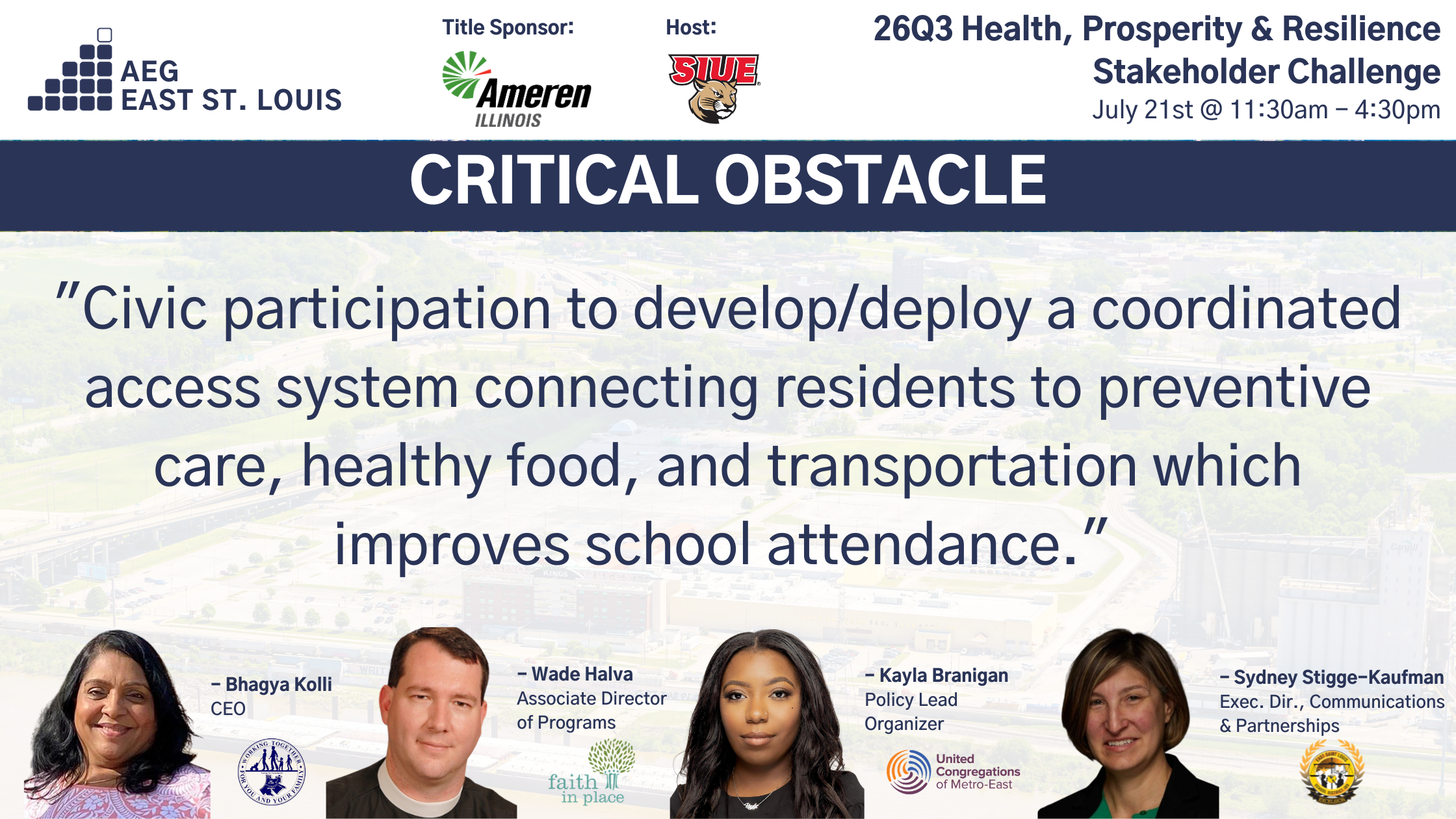
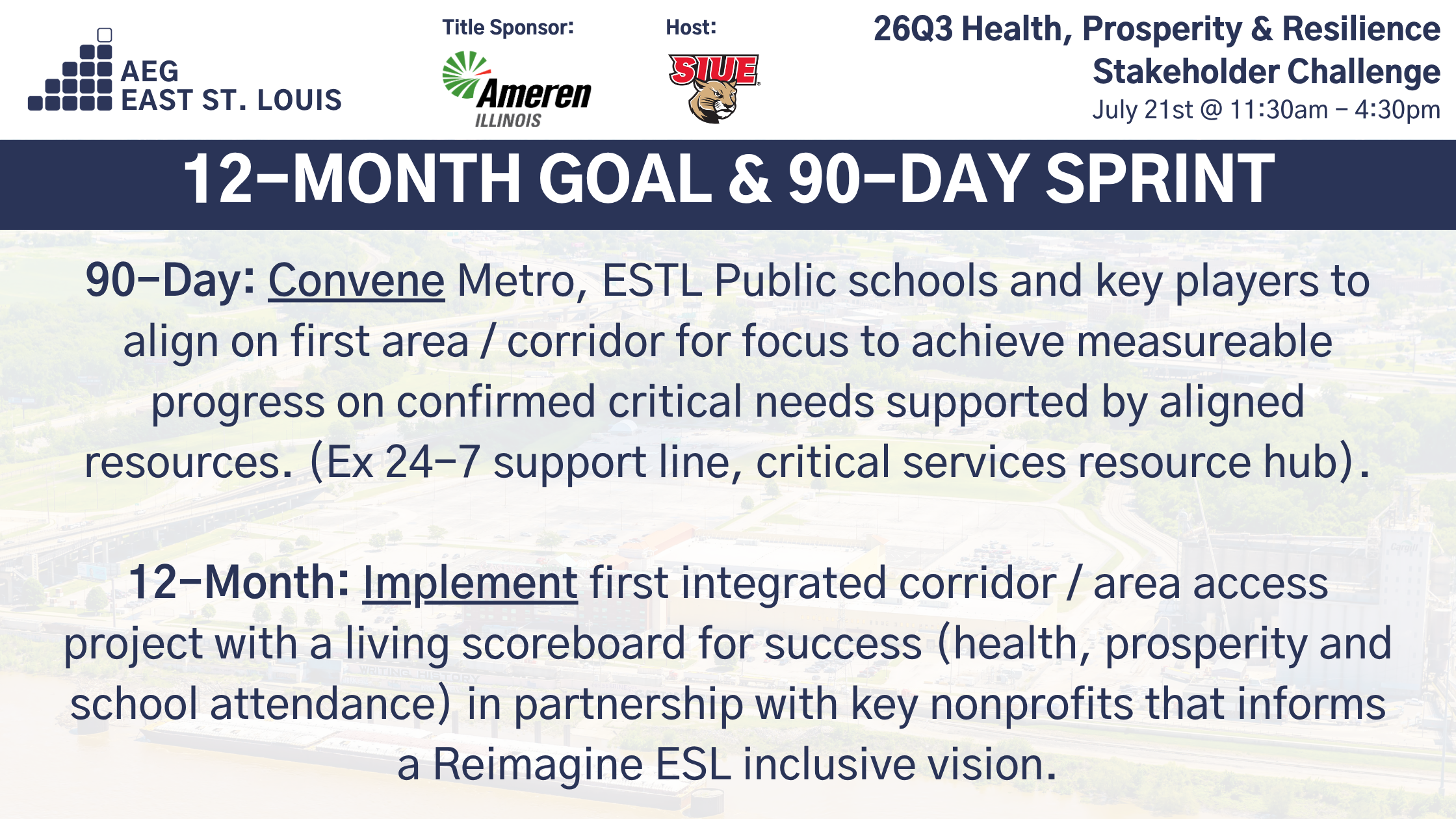
Inspired by the statements provided by all speakers, Bhagya Kolli (East Side Health District), Sydney Stigge-Kaufman (East St. Louis School District 189), Wade Halva (Faith in Place), Kayla Branigan (United Congregations of Metro-East), participants agreed to prioritize this selected obstacle statement: "Civic participation to develop/deploy a coordinated access system connecting residents to preventive care, healthy food, and transportation which improves school attendance.” Participants then designed, and pitched a 90-day sprint and 12-month goal to best address this critical obstacle.
20 leaders formed a volunteer Task Force to complete the 90-day sprint and 12-month goal.
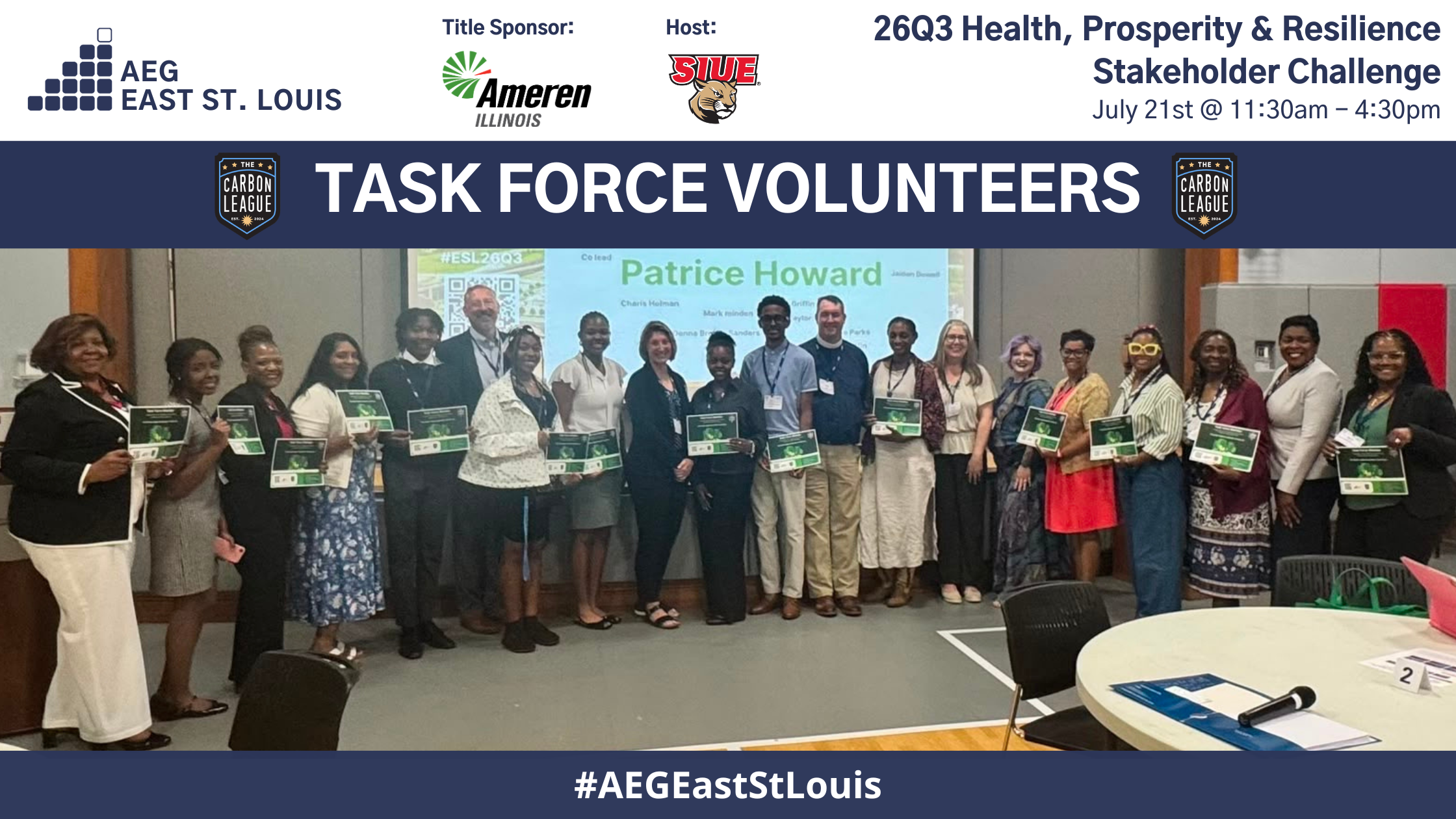
Task Force Volunteers (Listed A-Z): Alex Bonds (SIUE), Ayanna Hampton James (James Family Urban Agriculture Institute), Bhagya Kolli (East Side Health District), Charis Holmon (SIUE East St. Louis Charter High School), Connie Spurlock (Southern Illinois University System), Devon Moody (The Biz Spot Community), Donna Brooks-Sanders (United Congregations of Metro-East), Grace Griffin (JJK Fan), Jaiden Dowell (SIUE), Jo Ann Parks (East St. Louis), LaTonya Hull (SIUE - Clean Energy Contractor Incubator), Mariah Samuels (TRIO Upward Bound Program), Mark Minden (Ameren Illinois), Monique Leonard (Ameren Illinois), Patrice Howard (SIHF), Sydney Stigge-Kaufman (East St. Louis School District 189), Tandra Taylor (SIUE), Wade Halva (Faith in Place), and Yosiyah Griffin (Belleville-O’Fallon (IL) Alumni Chapter of Kappa Alpha Psi Fraternity, Inc.)
To join this group of volunteers, please contact us at info@goadvancedenergy.com.
Conclusion
The AEG East St. Louis 26Q3 Health, Prosperity & Resilience Stakeholder Challenge convened public health leaders, education administrators, faith-based organizations, and community advocates to confront the structural, informational, and organizational barriers slowing holistic community resilience. The strategic focus centered on eliminating systemic fragmentation across service providers, establishing a coordinated access system connecting residents to preventive care, healthy food, and transportation, and fostering a community-wide culture of student belonging to tackle chronic absenteeism. Moving forward, stakeholders will advance a focused 90-day sprint dedicated to mapping existing assets, establishing baseline health metrics, identifying priority transit routes with Metro and public schools, and publishing a comprehensive Community Resource Guide. This collaborative alignment will directly support the overarching 12-month goal to launch a unified Coordinated Access Hub and establish dedicated task force initiatives that drive measurable improvements in public health access, civic participation, and educational engagement. Ultimately, this Challenge establishes a coordinated, replicable pathway for East St. Louis to bridge critical resource gaps, rebuild civic confidence, and ensure long-term, equitable prosperity for all residents.
Access to private resource pages, which include speaker presentations, and survey responses, from AEG Stakeholder Challenges is reserved for Signature Sponsors and City/Government Partners. To become a Signature Sponsor, learn more here: https://aeg.team/engage
Advanced Energy Group is a sponsor supported organization that facilitates quarterly challenges for high-impact stakeholders to deliver on health, energy and prosperity commitments for U.S. cities and vulnerable regions.